For more than three decades South Africa has debated the mechanics of transformation far more than its purpose. We argue about scorecards, ownership targets, procurement thresholds and compliance costs, yet the central question has remained unchanged: how do we build an economy in which those who were systematically excluded are able to participate meaningfully in creating wealth?The latest proposal — that companies should be permitted to pay a voluntary tax instead of complying with aspects of broad-based black economic empowerment (B-BBEE) — claims to offer a pragmatic answer.It does not. It mistakes transformation for fundraising. The proposal is based on a fundamental misunderstanding of what B-BBEE was designed to achieve. It assumes South Africa’s transformation challenge is primarily a question of finance, that economic exclusion can be addressed by creating another pool of money for black economic development.That has never been the purpose of B-BBEE. South Africa’s transformation challenge is not simply about capital. It is about participation. It is about whether black South Africans have meaningful access to markets, ownership, procurement opportunities, executive leadership, productive assets and commercial networks that remain heavily concentrated more than three decades into democracy.The question has never been whether black South Africans should receive more money from established businesses. The question has always been whether the economy itself is becoming more inclusive. That distinction is critical because black South Africans are not asking corporate South Africa for handouts. We are asking for the opportunity to compete. We are asking for access to markets that were deliberately closed for generations. We are asking for the opportunity to build businesses that win contracts because they are capable, innovative and competitive. We are asking to participate in supply chains from which black businesses were historically excluded, not because we seek preferential treatment, but because exclusion itself was never the product of a free market. It was engineered through law and public policy.B-BBEE was introduced to dismantle those structural barriers. Its purpose has never been to redistribute charity. It was conceived as an economic restructuring instrument designed to broaden ownership, diversify supply chains, develop black enterprises and expand participation in sectors where black South Africans had been systematically excluded. At its core B-BBEE is not a welfare programme. It is a market intervention intended to correct a market that was deliberately distorted by apartheid. This is precisely why the voluntary tax proposal is so deeply flawed. Rather than strengthening transformation, it fundamentally changes its operating principle. Instead of requiring companies to participate in economic transformation, it allows them to finance their absence from it. Transformation ceases to be embedded in the way businesses own, procure, partner and invest. It becomes a financial option available to those who would prefer not to change. That is not reform. It is an exit mechanism.Imagine allowing companies to pay an environmental levy instead of complying with pollution regulations. Or allowing mining companies to make a financial contribution instead of complying with workplace safety standards. The flaw would be immediately obvious. Environmental regulation exists to reduce pollution, not to generate revenue. Safety legislation exists to protect workers, not to raise funds.B-BBEE operates on the same principle. Its purpose is not to collect money. It is to change economic behaviour by broadening participation in ownership, procurement and enterprise development. A voluntary tax achieves the opposite. It allows companies to finance non-compliance while leaving the underlying structure of the economy untouched.Supporters of the proposal will argue the current B-BBEE framework has failed to deliver the transformation South Africans expected. There is merit in parts of that criticism. Too often, B-BBEE has been reduced to a compliance industry dominated by verification certificates, transactional ownership structures and scorecard optimisation. Entire sectors have become proficient at accumulating points while avoiding the difficult work of sharing economic power. Symbolic participation has too often replaced meaningful inclusion. But that is an argument for reforming the system, not abandoning its purpose. The logical response to compliance-driven transformation is to strengthen the link between scorecards and measurable economic outcomes. It is not to create a mechanism that allows companies to bypass transformation altogether.The proposal also misunderstands how businesses grow. Access to finance remains a significant obstacle for many black entrepreneurs, particularly when commercial banks require collateral that emerging businesses simply do not possess. Expanding access to capital is therefore essential. But capital without customers is a bridge to nowhere.A business cannot repay loans without revenue. It cannot generate revenue without contracts. It cannot secure contracts if procurement opportunities remain concentrated among the same established incumbents.Finance enables enterprise. Markets sustain it. This is why procurement matters so profoundly. Every successful economy creates pathways for new entrants because competition drives innovation, improves productivity and reduces dependence on dominant incumbents. Diverse supplier ecosystems create more resilient markets. They stimulate entrepreneurship, encourage investment and expand productive capacity. Opening supply chains to capable black businesses is therefore not an act of charity. It is sound economic policy.Protecting concentrated markets in the name of efficiency is not sound economics. It is the preservation of historical advantage. If companies are permitted to write a cheque instead of transforming procurement practices, broadening ownership, developing suppliers or opening commercial opportunities to new entrants, the architecture of the economy remains fundamentally unchanged. Procurement continues to flow through established networks. Ownership remains concentrated. Executive authority remains concentrated. Market power remains concentrated. Only the compliance mechanism changes. Transformation becomes something companies can outsource rather than undertake.There is a profound historical irony in this proposal. Under apartheid, white South Africans did not accumulate wealth because government transferred money to them. They accumulated wealth because government systematically created an economy in which they enjoyed privileged access to land, finance, education, infrastructure, procurement opportunities and commercial markets. Wealth followed opportunity.The democratic project was never intended to reverse that injustice by replacing opportunity with charity. Its purpose was to democratise opportunity itself. Those who continue to characterise B-BBEE as a system of handouts fundamentally misunderstand its purpose. There is nothing charitable about expecting companies that have benefited from generations of structural advantage to broaden ownership, diversify supply chains or create opportunities for historically excluded participants. These are not acts of corporate generosity. They are mechanisms through which a more inclusive, competitive and resilient economy is built.South Africa does not suffer from a shortage of transformation funds. It suffers from the continued concentration of economic opportunity. The question has never been whether established businesses are willing to contribute more money. The question is whether they are willing to share markets.A voluntary tax may generate revenue. It may even fund worthwhile initiatives. But it will not broaden ownership. It will not open supply chains. It will not redistribute economic agency. Transformation was never intended to be something companies could pay for. It was intended to be something in which they participated.Nomlala is founder and executive director at NCS Investment Holdings.Business Day
ANDILE NOMLALA | Transformation cannot be bought through a voluntary tax
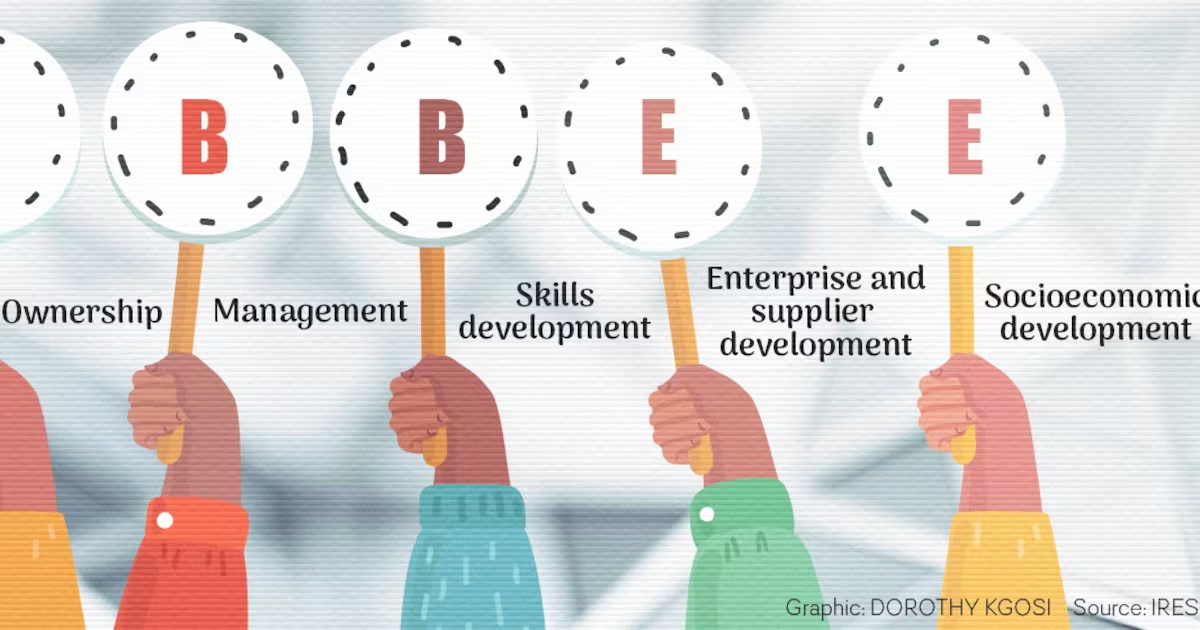
The aim of B-BBEE is to change economic behaviour by broadening participation in ownership, procurement and enterprise development
1,141 words~5 min read