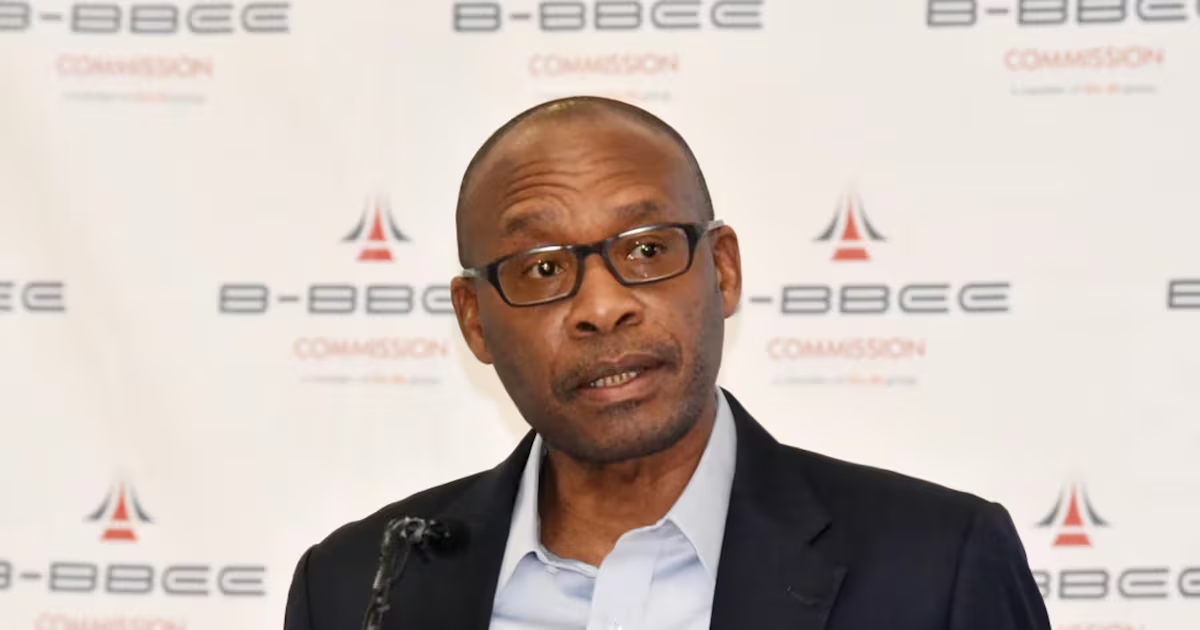
Broad-based BEE policy, a key pillar of efforts to reverse the apartheid legacy, is facing its strongest criticism since it became official in 2004. A growing number of black South Africans are beginning to worry that the BBBEE boat may have sailed past them. This frustration with BBBEE — expressed mainly by black entrepreneurs — has been bubbling under the radar for quite some time. It burst into the open in October last year after the National African Federated Chamber of Commerce and Industry (Nafcoc) lodged a complaint with parliament against the Industrial Development Corporation (IDC), the state-owned financier responsible for financing industrial development. The 2.3-million-member business chamber accused the IDC of aggressively collecting debt from five black-owned businesses, which were eventually liquidated. This complaint prompted Mzwandile Masina, chairperson of the portfolio committee on trade, industry and competition, to summon Nafcoc and the IDC to appear before the committee. The complaint brought scrutiny on the lending and debt collection practices of all state-owned development finance institutions (DFIs), including the National Empowerment Fund, Small Enterprise Development and Finance Agency, and the Public Investment Corporation.This scrutiny triggered fierce debates on social media about the paucity of BBBEE funding. While Nafcoc has taken issue with the IDC’s debt collection practices, disgruntled black entrepreneurs have accused DFIs of cutting off funding to their businesses. They have lambasted DFIs for perceived hurdles in accessing funding, for demanding collateral, taking too long to approve funding, and granting credit to mostly white-owned companies rather than black-owned businesses.Be that as it may, I believe it is a stretch of the imagination to claim that BBBEE is being crippled solely by DFIs. What we are seeing today is a generation of young black entrepreneurs who are being increasingly vocal about their desire to participate meaningfully in the economy. Having witnessed the success of earlier BBBEE beneficiaries, many are no longer satisfied to wait indefinitely for their turn to benefit.However, the old BBBEE guard financed its wealth acquisition differently. The old generation bought minority stakes in large JSE-listed companies. These transactions were vendor-financed, in most instances with participation from DFIs that contributed by offering equity and debt funding to black industrialists and entrepreneurs who did not have upfront capital to participate in the transactions. This intervention enabled black investors to buy shares without putting cash upfront. The debt was repaid through dividends. But large vendor-financed BBBEE deals are rare these days. This is because many companies opted not to do replacement empowerment deals after early BBBEE investors sold their equity stakes. A recently published research report by economist Duma Gqubule confirms BBBEE progress has slowed, if not stagnated.According to the report, black ownership accounted for 1.5% of the market capitalisation of the JSE’s top 60 companies. In rand terms, this market cap is equivalent to R255bn. If this is the case, Gqubule’s findings contradict claims that R1-trillion of wealth has been transferred to black people since the end of apartheid in 1994. The findings also contradict a BBBEE Commission report in 2022, which said black ownership has reached 29% of the JSE’s market cap.But what does the slow progress of BBBEE mean for young black entrepreneurs? In thinking about this question, I could not help coming to the conclusion that the current generation of black entrepreneurs has no option but to accumulate wealth the way entrepreneurs have always accumulated wealth since time immemorial — through guts and perseverance. They have no choice but to level up entrepreneurially compared with their predecessors, who benefited from early empowerment initiatives — an era that was fertile with vendor-financed BBBEE transactions. A black entrepreneur operating in 2026 must learn to spot business opportunities and raise capital in debt markets that are extremely sceptical of lending to early-stage businesses with no track records. This is a hard thing to do. Lenders fear burning their fingers due to the high failure rate of early-stage businesses. About 70% to 80% of businesses in South Africa go bust within five years of their inception. This is because startups and small businesses can’t compete with established, well-capitalised, vertically integrated companies that control multiple stages of their supply chains — from raw materials to manufacturing, distribution, and sales. This end-to-end control of supply chains creates economies of scale, enabling big companies to undercut prices and dominate access to markets.On the other hand, startups and small businesses usually operate in just one part of the supply chain, making it difficult for them to replicate business models of large companies without massive capital. So, large vertically integrated companies are not just competitors; they are barriers to market entry for new businesses. The high failure rate of early-stage businesses is reflected in the loan books of DFIs, which have more risk appetite than commercial banks. It is no wonder that DFIs have higher bad loans than commercial banks.Take the IDC, for example. In the past financial year, the state-owned lender approved about R26.6bn towards BBBEE, of which R23.4bn was allocated to black industrialists. However, the lender’s current distressed portfolio stands at R30bn, with black-empowered entities accounting for 34% (R9bn) of the distressed portfolio. These numbers contradict the perception that the IDC is not lending to black businesses. The reality is that the IDC is self-funded and borrows money from capital markets to finance its activities. So, it has a responsibility to extend credit responsibly to keep impairments and non-performing loans at acceptable levels to preserve capital. In other words, the IDC cannot afford to loosen its credit policies, as this could lead to its collapse. There is also an important conversation to be had about the relationship between entrepreneurs and DFIs. While access to finance remains a significant challenge for many black-owned businesses, it is equally important to recognise that development finance is, in most cases, repayable capital rather than grant funding. Like all lenders, DFIs have a responsibility to safeguard public resources and ensure that capital is recycled to support future generations of entrepreneurs. This means that borrowers are expected to meet their repayment obligations.A second consideration is the need for greater clarity about the role of DFIs in the entrepreneurial ecosystem. Development finance is intended to unlock commercially viable opportunities that may struggle to access traditional funding, but it is not meant to replace grants, subsidies or permanent financial support.The third and last point to make is that black entrepreneurs should consider casting their capital-raising net wider beyond DFIs and commercial banks. While these institutions play a critical role in supporting business growth, they are only one part of a much larger funding ecosystem. Expanding access to alternative sources of capital can help businesses become more resilient and less dependent on a single source of funding. Regarding this particular point, there are two areas to explore. The first is that South Africa has developed hundreds of excellent black finance professionals. These professionals must help raise money from pension funds and set up private equity and venture capital funds that target black SMEs and startups. Second, black entrepreneurs and communities must mobilise savings and investment capital to support enterprise development. Stokvels, which collect about R50bn annually from their members, are an excellent platform for mobilising community savings. However, appropriate governance mechanisms must be put in place to facilitate channelling a portion of these savings into black businesses while protecting members’ capital.Ntingi is the founder of GetBizBusiness Day
ANDILE NTINGI | Black entrepreneurs must explore funding sources beyond DFIs
Vendor-financed BBBEE deals have largely disappeared, leaving young black entrepreneurs to seek new funding models beyond traditional development finance
1,225 words~6 min read