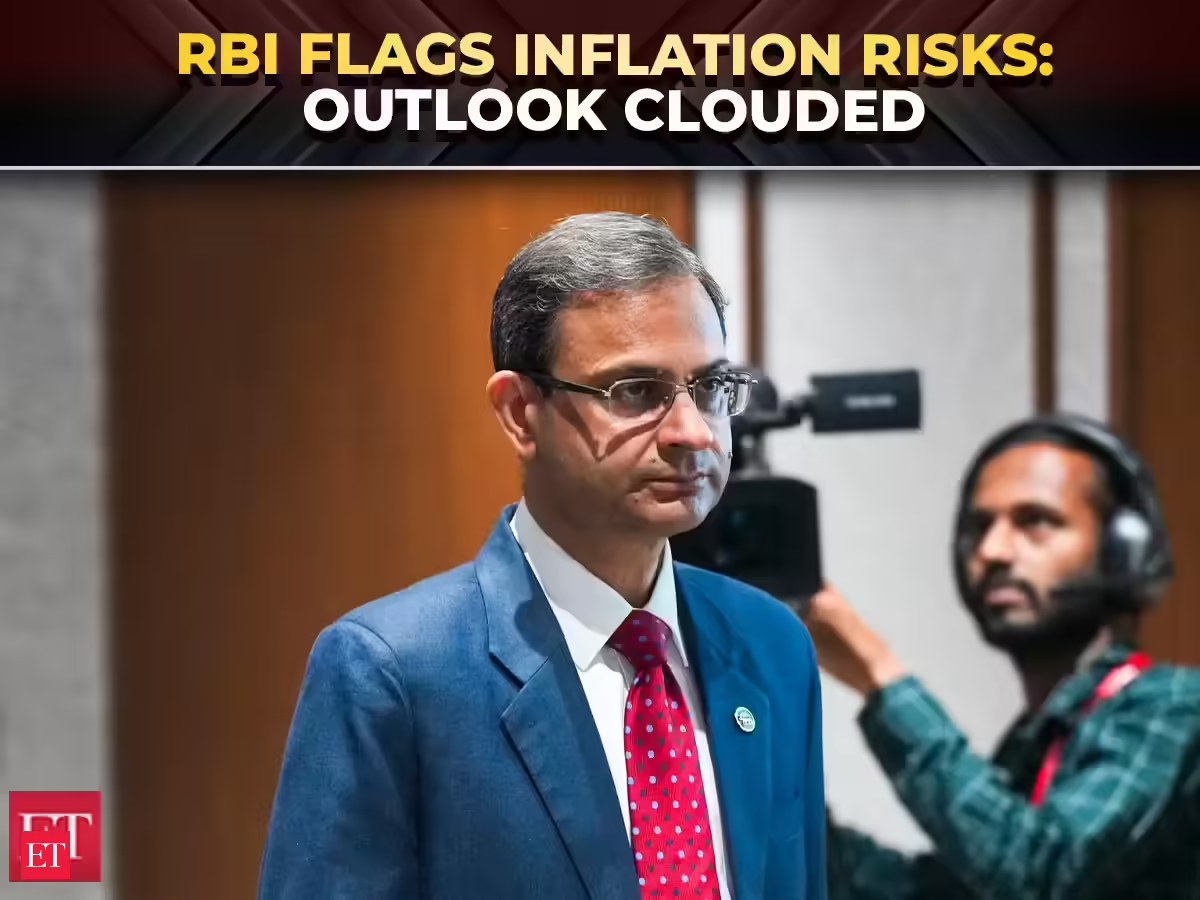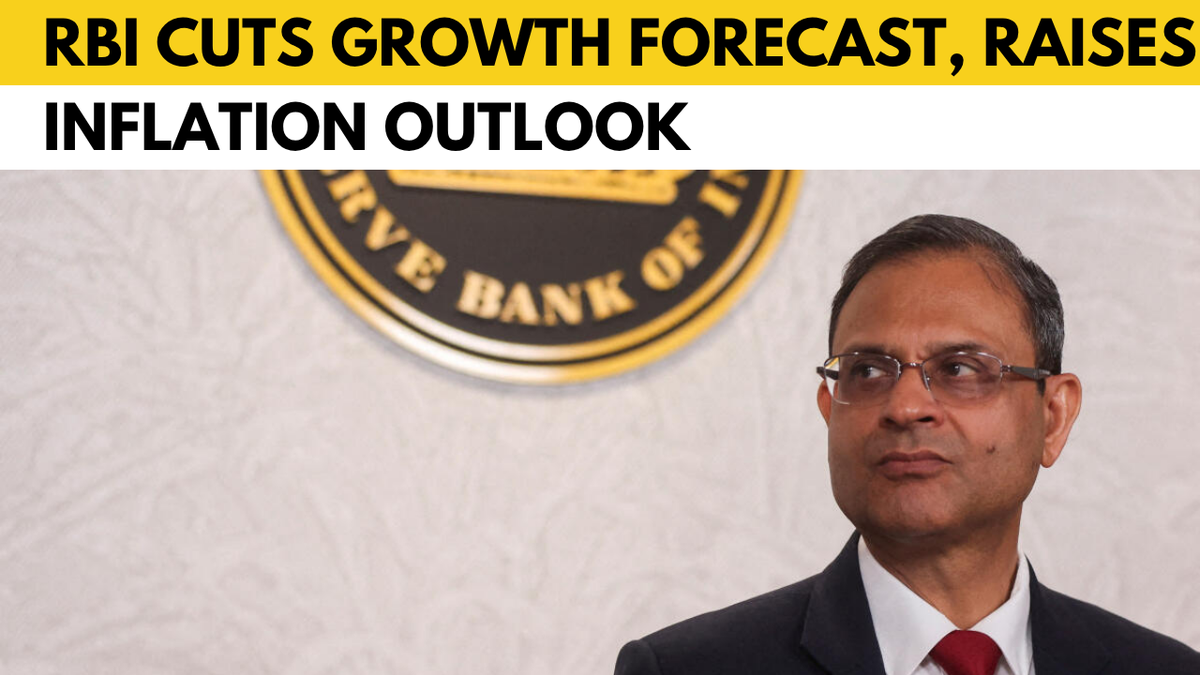
The Reserve Bank of India on Wednesday raised its FY27 GDP growth forecast to 6.7% from 6.6%, citing resilient domestic economic activity and a better-than-expected first quarter, while keeping the policy repo rate unchanged at 5.25% and retaining its neutral stance.The six-member Monetary Policy Committee said growth, although resilient, is expected to be lower in the current financial year, while the outlook remains clouded by uncertainties around global trade policy and geopolitical tensions.The RBI projected GDP growth at 7% in Q1, 6.4% in Q2, 6.5% in Q3 and 6.8% in Q4 of FY27. The risks to the growth outlook are evenly balanced.Also Read: Sanjay Malhotra & team keeps repo rate at 5.25% as global risks linger with Iran war flare-upThe central bank said greater clarity on inflation, including its trajectory and composition, is needed before taking further policy action.RBI keeps repo rate unchanged at 5.25%The MPC unanimously decided to keep the policy repo rate unchanged at 5.25% and retained its neutral stance, signalling a wait-and-watch approach as policymakers assess the evolving growth and inflation outlook.The RBI said the outlook remains uncertain, particularly amid global trade policy uncertainties. The central bank indicated that it would need greater clarity on the path and composition of inflation before taking further policy action.The decision comes after the RBI's earlier rate cuts and amid renewed volatility in global energy prices following the escalation of the West Asia conflict.RBI raises FY27 GDP forecast to 6.7%The RBI raised its FY27 GDP growth forecast by 10 basis points to 6.7%, with Governor Sanjay Malhotra saying domestic economic activity had remained resilient despite persistent global uncertainty.High-frequency indicators available for Q1 point to stronger activity, while early corporate results indicate healthy performance in manufacturing.Services activity has also remained buoyant, supported by strong domestic demand. Private consumption continued to be driven by discretionary spending, while investment activity remained steady on the back of robust government spending on infrastructure and construction.Merchandise exports rebounded with double-digit growth, while services exports sustained their momentum.“Overall, the Indian economy performed better than expected in Q1,” Malhotra said.The first-quarter GDP data, due later this month, will provide the next major test of India's economic momentum and offer a more detailed reading of the performance that prompted the RBI to raise its FY27 growth forecast.West Asia conflict keeps growth risks elevatedSupply-side pressures caused by the West Asia conflict eased somewhat since June, allowing the government to withdraw temporary measures and key input supplies to normalise, the RBI said.However, the re-escalation of the conflict since the first week of July has amplified volatility in energy prices and renewed uncertainty around global supply chains.Also Read: Malhotra & Co trim FY27 inflation forecast to 5% as easing crude prices offer reliefThe RBI said renewed tensions in West Asia, disruptions to global supply chains, volatility in international financial markets and weather-related shocks pose downside risks to growth.RBI says inflation outlook needs closer watchThe MPC said headline inflation is projected to increase, but primarily due to supply-side pressures from food and fuel.Core inflation, however, continues to remain moderate and is expected to decline after peaking in the third quarter, the RBI said.The central bank's assessment suggests that policymakers are distinguishing between temporary supply-driven inflation and broader, demand-led price pressures.The MPC said greater clarity is needed on inflation's trajectory and composition before it takes any further policy action.Weak monsoon clouds agriculture outlookThe outlook for agriculture remains clouded by deficient and uneven southwest monsoon rainfall amid El Nino conditions.However, reservoir levels remain close to normal, providing some buffer, while government measures around crop diversification, climate-resilient and short-duration crops, and water harvesting and conservation are expected to mitigate the impact of deficient rainfall.The RBI expects any hit to rural consumption from a weak monsoon to be partly offset by allied-sector activity and government schemes.Services, investment to support growthThe services sector is expected to maintain its buoyancy on the back of strong domestic demand, while steady employment conditions should support urban consumption.Strong capacity utilisation, robust credit flows and the government's continued thrust on infrastructure are expected to sustain investment activity.Net external demand is also expected to derive strength from bilateral trade agreements that have recently been concluded, some of which are now being operationalised, as well as manufacturers' efforts to diversify export markets.The RBI's latest assessment therefore points to continued domestic resilience, even as geopolitical tensions, energy-price volatility, global trade uncertainty and weather-related shocks remain key risks to the FY27 outlook.
RBI GDP Growth 2026-27: Malhotra & Co lift FY27 GDP forecast to 6.7% from 6.6% on growth resilience
RBI GDP Growth 2026: The Reserve Bank of India lowered its FY27 GDP growth forecast to XX% from 6.6%. It kept the benchmark repo rate unchanged at 5.50% while balancing growth and inflation risks. Higher oil prices and ongoing geopolitical risks are cited as key concerns impacting the economy. Weak investment and global economic uncertainty also contribute to the revised growth projection.
734 words~3 min read