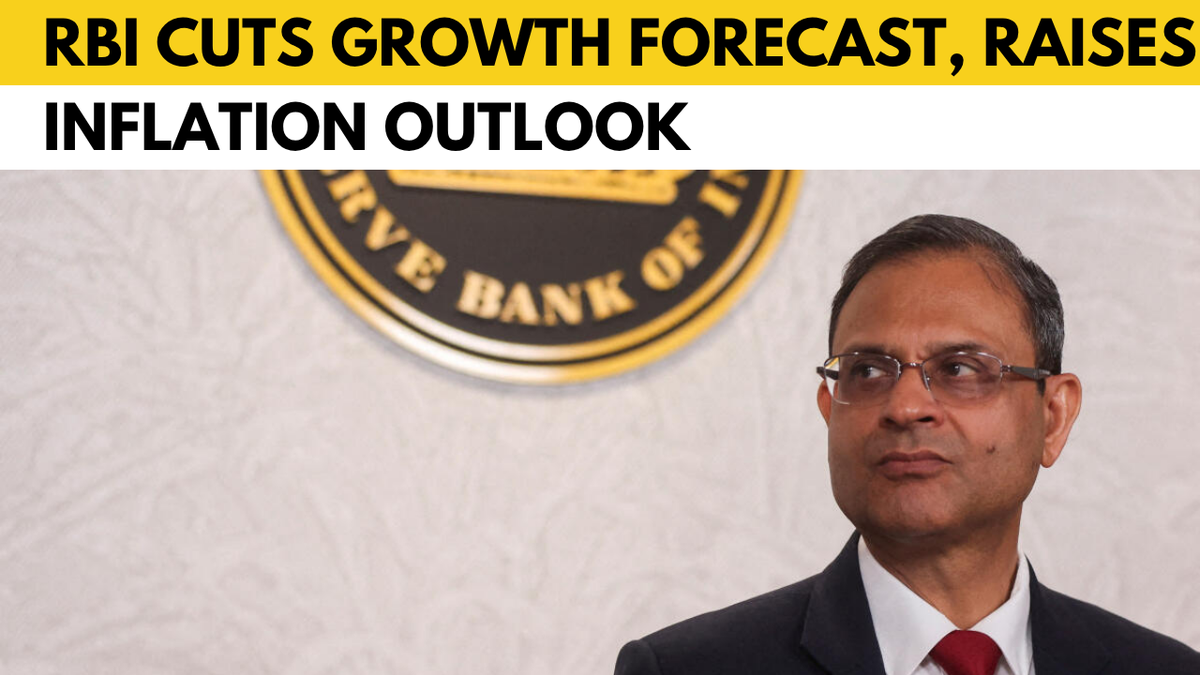
The Reserve Bank of India on Friday lowered its FY27 GDP growth forecast to 6.6% from 6.9%, citing rising risks from the ongoing West Asia conflict, elevated energy prices, supply disruptions and weather-related uncertainties, while keeping the benchmark repo rate unchanged at 5.25%.The central bank now expects GDP growth of 6.6% in the first quarter, 6.3% in the second quarter, 6.5% in the third quarter and 6.8% in the fourth quarter of FY27.Announcing the Monetary Policy Committee's decision, RBI Governor Sanjay Malhotra said the Indian economy had so far remained resilient despite the conflict, supported by strong private consumption, fixed investment, manufacturing activity and services exports.Also Read: Why the RBI kept rates unchanged amid oil, rupee and geopolitical pressuresThe six-member MPC voted to keep the policy repo rate unchanged and retained its neutral stance, saying it would continue to remain data-dependent and closely monitor supply-side pressures and inflation expectations.Malhotra also flagged weather-related risks, including a subnormal southwest monsoon and El Nino conditions, as key monitorables for the outlook, even as it noted that adequate food stocks and reservoir levels provide some buffer against supply shocks.“The outlook also remains clouded due to the sub normal southwest monsoon forecast and El Nino risks,” Malhotra said.Weather is a key driver of India’s economy, with monsoon performance directly shaping farm output, rural demand and food inflation, making it a critical macroeconomic risk factor.Oil shock emerges as biggest riskThe RBI's assessment echoes concerns raised by economists who have identified crude oil as the single biggest threat to India's growth trajectory.India imports more than 85% of its crude oil requirements, making the economy particularly vulnerable to a sustained increase in energy prices.Earlier this year, ICRA cut its FY27 GDP growth forecast to 6.5% from 7.1% and raised its inflation projection to 4.5%, assuming average crude oil prices of $85 per barrel.However, the rating agency warned that a longer conflict pushing average crude prices to $105 per barrel could drag India's growth rate below 6% while driving inflation above 5%."These estimates are subject to sizeable risks," ICRA said, adding that a prolonged conflict could significantly worsen both growth and inflation outcomes.Also Read: RBI MPC Meeting 2026: Sanjay Malhotra & Co hold rates steady at 5.25% as oil shock, weak rupee & West Asia war cloud outlookAmong the most bearish forecasts, HSBC recently cut its FY27 GDP growth estimate to 6% from 7.4%, citing the combined impact of higher oil prices and weather-related disruptions."Bringing together both the shocks, and factoring in some fiscal slippage, we forecast GDP to grow 6% in FY27, lower than our previous year's forecast of 7.4%," HSBC said in a report.The brokerage warned that the twin shocks would weigh on formal-sector activity, rural incomes and smaller businesses while simultaneously stoking inflationary pressures.HSBC expects inflation to average 5.6% in FY27 and sees at least two quarters where headline inflation could breach the RBI's upper tolerance band of 6%.Growth versus inflation dilemmaThe latest GDP projections highlight the increasingly difficult balancing act facing policymakers.While slowing growth would typically argue for a supportive monetary policy stance, rising energy prices and supply-side pressures are increasing the risk of higher inflation.Economists broadly expect the RBI to prioritise inflation management if crude prices remain elevated for an extended period.HSBC expects the central bank to raise interest rates twice during FY27, while several other economists have also turned more cautious on the policy outlook.External balances under pressureApart from inflation and growth, economists are also concerned about the impact of higher oil prices on India's external accounts.ICRA expects the current account deficit to widen to a four-year high of 1.7% of GDP under its baseline scenario, a sharp contrast to the surplus recorded during the pandemic period.The rating agency also warned that government efforts to shield consumers from rising global energy prices may eventually become difficult to sustain, potentially forcing fuel-price adjustments that could feed into inflation.Higher global uncertainty has already pushed government bond yields higher and increased concerns around fiscal slippage, adding another layer of risk to the economic outlook.
RBI GDP growth 2026-27: Forecast cut to 6.6% as oil, war and subpar monsoon risks mount
RBI GDP Growth 2026-27: The Reserve Bank of India has reduced its economic growth forecast for FY27 to 6.6 percent. This adjustment comes amid concerns over global conflicts, energy prices, and weather. The central bank has maintained the key interest rate at 5.25 percent. India's economy shows resilience, but future growth faces challenges from oil prices and monsoon forecasts.
668 words~3 min read