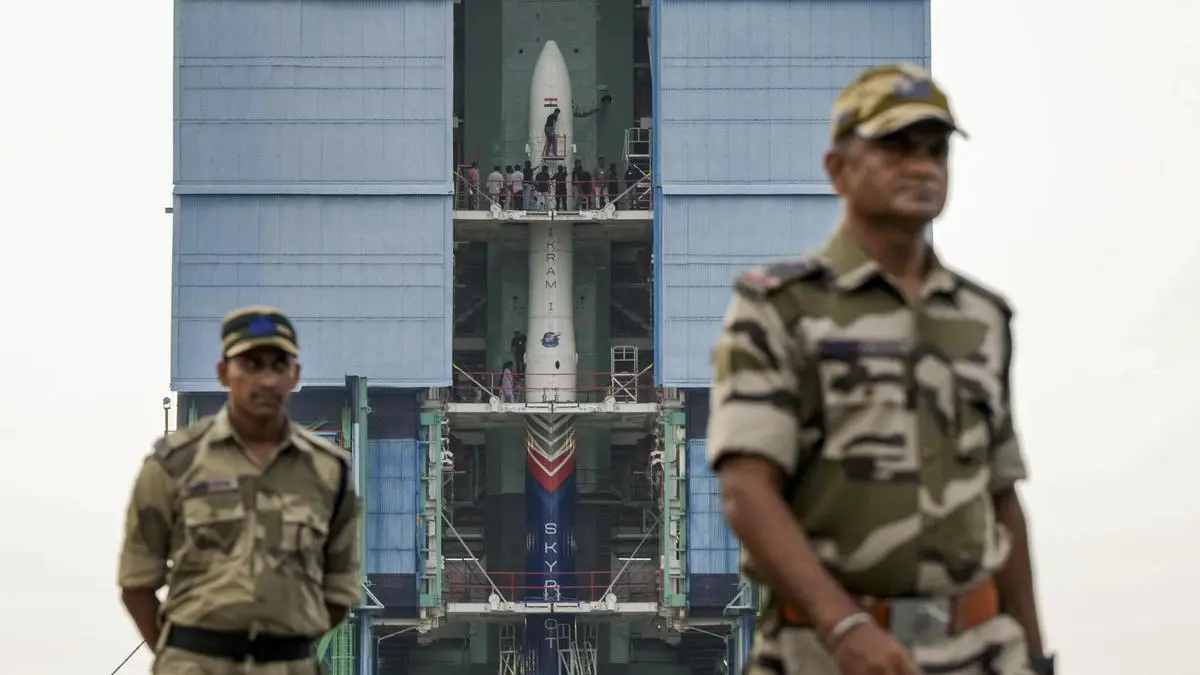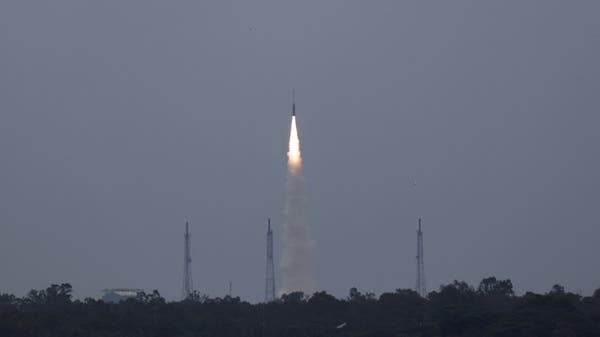
Vikram-1, India's first privately developed orbital-class rocket, built by Hyderabad-based firm Skyroot Aerospace (file photo)
| Photo Credit:
The Indian space sector has been in the news recently. A launch vehicle made in the private sector has successfully put a payload in the desired orbit. Not only that, it did so in its very first attempt which was not achieved even by Elon Musk’s Space X.This feat is a classic case of public-private partnership since the Indian Space Research Organisation (ISRO) did all the hand holding including providing its infrastructure for the launch. It will take a while for the private sector to break the umbilical chord from ISRO and handle all the operations independently using its own infrastructure.Incidentally, in the US, all the private space operators function independently of the National Aeronautics and Space Administration (NASA).The Indian space sector was thrown open to the private sector in 2020 and there are about 400 start-ups already up and about. The total business, it is estimated to be around $8.4 billion today which is about 2-3 per cent of the world market. Prior to 2020, the Indian space programme was solely led by ISRO. ISRO was set up in 1969 to develop and apply space technology for various national needs. The government decided to rope in the private sector for various reasons.The first and foremost is that the government was desirous of getting additional financial resources to fund space activities within the country, be it private or public. Also, ISRO was keen that the private sector should handle launching of satellites, a lucrative business, while ISRO could concentrate on specialised research programmes.With the private sector moving into the area of space, there are a lot of issues which need to be tied up and for this purpose, the government has set up an organisation called the Indian National Space Promotion and Authorisation Centre (IN-SPACEe).There are a host of activities which need to be addressed by IN-SPACEe.The two major ones are: first, this organisation will have to ensure a level playing field between the public and the private sector. Second, IN-SPACEe will also have a regulatory role and as far as the private sector is concerned, it has to ensure that its activities are in harmony with all the international treaties on space where India is a signatory.Talent huntMeanwhile, it seems that over a hundred scientists have left ISRO last year possibly because the private sector is offering not only better salaries but also stock options. The fact that government jobs are bereft of meritocracy is also proving to be a disadvantage.The government has decided to put restrictions on senior scientists leaving ISRO. This especially applies to scientists working in specialised space projects such as Gaganyaan and Chandrayaan. While the concern of the government is well appreciated, it was only obvious that such a situation would eventually arise. The private sector has no option but to source its manpower from ISRO and its affiliates. Getting expatriates to work here at much higher salaries was never really an option. If availability of manpower becomes a critical issue for the private sector, it is going to choke its growth and the vision of the government to engage ISRO only in research activities may falter.Nuclear issuesA similar manpower crunch is also likely to occur in nuclear generation. Now that the private sector has the option of moving into nuclear generation aided by the Sustainable Harnessing and Advancement of Nuclear Energy for Transforming India (SHANTI) Act, there is going to be a clamour for manpower with the requisite skills. Already a number of leading industrial groups are proceeding full steam for nuclear generation.One of them is evaluating sites across several States to deploy large modular reactors and is in talks with global leaders for collaboration. Another major industrial house plans a 6000-MW nuclear plant in Ratnagiri, Maharashtra.Yet another industrial house has committed $2 trillion to develop a 7.2 GW nuclear power capacity. Needless to say, the private sector will depend upon organisations like the Nuclear Power Corporation of India (NPCIL) and the Bharatiya Nabhikiya Vidyut Nigam Limited (BHAVINI) for sourcing their manpower needs.The government will soon have to prepare a contingency plan to deal with this issue. Drain of manpower from the public sector was also experienced when private banking and insurance companies mushroomed in India.Manpower requirements along with other inputs have to be assessed prior to privatisation. We owe it to the private sector to keep them informed of the difficulties that they may face in getting indigenous manpower.The writer is visiting professor, ICRIER and former Member (Economic & Commercial), CEAPublished on August 5, 2026