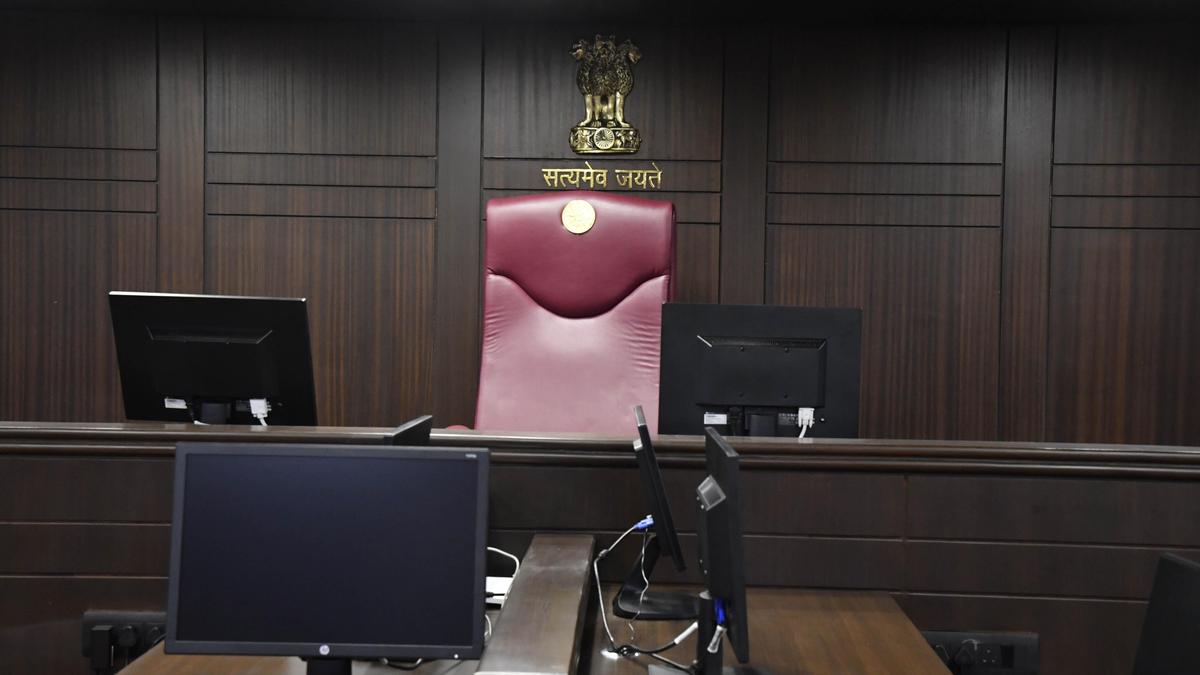
In July 2026, the Delhi High Court designated a court in the Rouse Avenue complex to try, exclusively, offences under the Public Examinations (Prevention of Unfair Means) Act, 2024. Public Examinations (Prevention of Unfair Means) Amendment Bill, 2026 gives investigators two months and the court three. No new post was created. A serving judicial officer was moved to the new docket; her pending cases were redistributed. The queue was not shortened. It was reordered.Reordering and shortening are not the same thing. In 1961, John Little proved (Operations Research, 9(3)) that in any stable queue, the average number waiting equals the arrival rate multiplied by the average wait. In 1965, Leonard Kleinrock proved a conservation law: provided the server never idles and the work is unchanged, no priority rule reduces total weighted waiting time; it only decides who waits. Shorn of notation, a fast-track court is a queue discipline, not a service rate. Disciplines redistribute delay. Only capacity destroys it.The Report of the Eleventh Finance Commission (June 2000) recorded, in paragraph 7.17, “a pendency of about two crore cases in the district and subordinate courts in the States” and provided ₹502.90 crore under Article 275(1) for 1,734 additional courts, at ₹29 lakh each. The expression “fast track court” appears nowhere in the report; the Department of Justice supplied the name when it notified the scheme from April 1, 2001. There was no first fast track court, only a first day.Member NC Jain’s design, in Appendix VII.1, was capacity honestly bought: retired sessions judges appointed ad hoc, 14 sessions trials a month, priority to the 1,88,241 undertrials then in jail, ₹87 crore a year of cost against a computed saving of ₹240 crore. “Above all, the fundamental rights of a citizen for a speedy trial will be met.” The 2026 version keeps the label and drops the arithmetic.The five ironiesFive ironies follow. First, in Hussainara Khatoon versus State of Bihar (1979), the Supreme Court read speedy trial into Article 21, everyone’s right. A special court that delivers speed to a chosen category converts a universal right into a rationed privilege, and Kleinrock tells us precisely who pays for the ration.Second, the choosing is done ex post, headline by headline: sexual offences after December 2012, POCSO cases in 2019, legislators’ cases after 2017, examinations in 2026. Exceptio probat regulam in casibus non exceptis, the exception tests the rule in the cases not excepted. Our exceptions have stopped testing the rule; they are replacing it.Third, in State of West Bengal versus Anwar Ali Sarkar (1952), the Court held that speed alone cannot justify picking whose case jumps the queue; Article 14 demands a principle, and sentiment is not one.Fourth, nothing inside a fast track court is procedurally fast. The CrPC then, the Bharatiya Nagarik Suraksha Sanhita now, apply unamended.Fifth, and deepest: Kautilya listed swift justice among the elementary duties of the king. A state that requires a special scheme to perform an elementary duty has quietly reclassified the elementary as the exceptional. Every fast-track court is a confession, entered by the judiciary on its own docket.Five observationsThe record permits five observations. When capacity was real, it worked: 1,562 courts functional on March 31, 2005, and 32.34 lakh of 38.9 lakh transferred cases disposed by 2010-11 (Brij Mohan Lal versus Union of India, 2012). But the scheme treated pendency as a stock while institution is a flow; grants ended on March 31, 2011, and functional courts fell from 1,192 to roughly 473. Schemes lapse; arrival rates do not. Speed was uneven: Crime in India 2017 records Bihar’s fast track courts settling 6,704 cases, of which 2,507 had run past 10 years. The Fast Track Special Courts (October 2, 2019; 1,023 sanctioned) numbered 775 in April 2026 and received 1,43,936 cases in 2025 while disposing of 66,500, a clearance rate of 46 per cent; by Little’s theorem, a queue whose arrivals exceed its disposals has no finite resting point, so the pendency of 2,45,579 is not a mystery but a corollary. And we measure little of this: the National Judicial Data Grid publishes no disposal times for these courts, and the norm of 14 cases a month migrated, unannounced, from per judge to per court. It is a capital mistake to theorise before one has data. It is a worse one to legislate before collecting any.What follows also comes in fives. Raise the service rate permanently; the Law Commission’s 245th Report (2014) warned of “the lack of accountability in the functioning and performance of ad-hoc judges” and offered a rate-of-disposal method for computing how many judges, where. Attack the slowest stage, since a series system moves at the pace of its binding constraint; the IIPA evaluation (2023) found the evidence stage consuming half of trial time, which indicts forensic laboratories and prosecutors, not judges. Publish court-wise, per-judge disposal times. Replace sentiment with a stated rule for what earns a track. And give every track a sunset tied to its clearance rate, honouring the Court’s 2012 binary: permanent, or wound up, never ad hoc in perpetuity.In 2000, Jain expected the backlog substantially cleared in 8-10 years. District courts today hold about 4.8 crore cases. Little’s theorem admits no exception for good intentions. The queue can be reordered endlessly. It shortens only one way.Sinha writes on macroeconomics and geopoliticsPublished on August 4, 2026
The ‘confessions’ of fast-track courts
Fast-track courts only end up reordering the queue. Only some are guaranteed speedier justice
885 words~4 min read