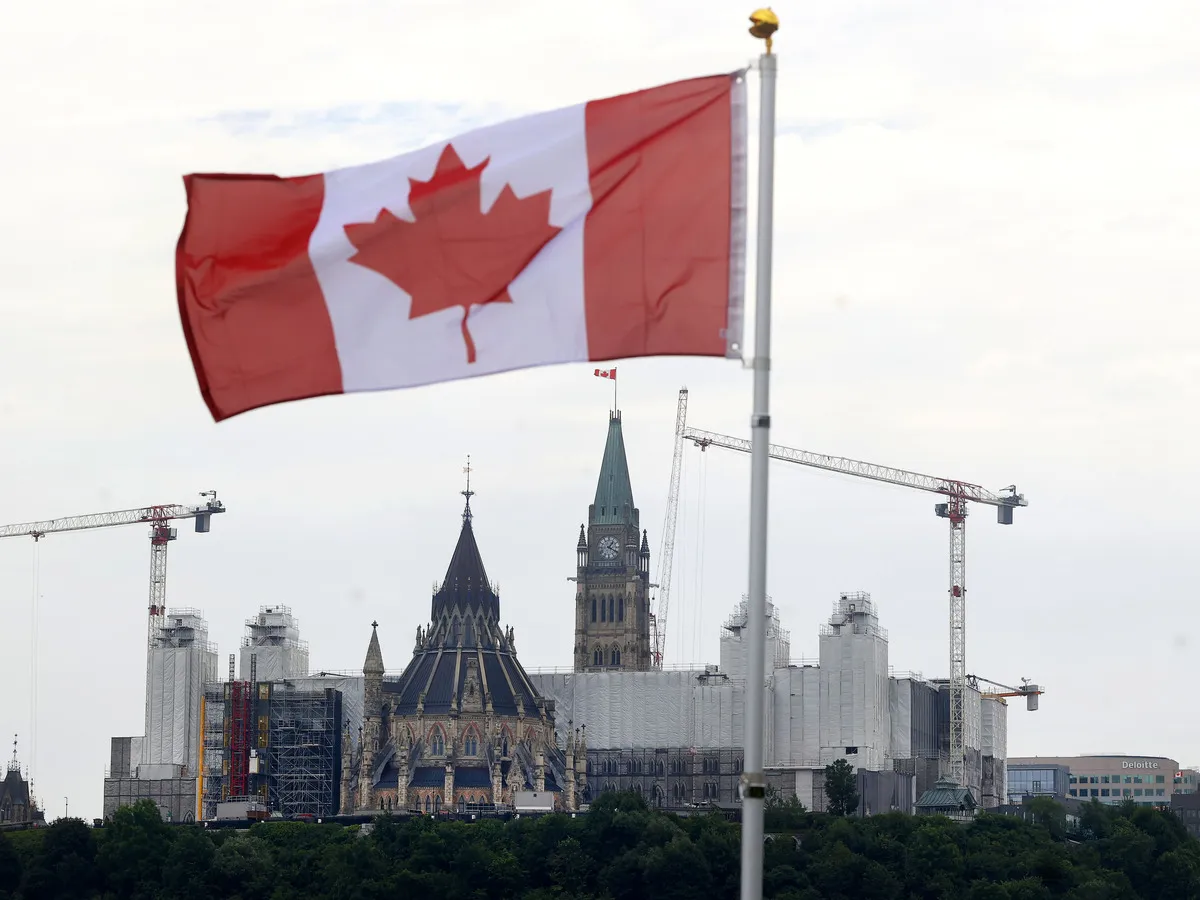
Skip to Content News Archives Economy Energy Oil & Gas Renewables Electric Vehicles Mining Commodities Agriculture Real Estate Mortgages Mortgage Rates Finance Banking Insurance Fintech Cryptocurrency Work Wealth Smart Money Wealth Management Investor Personal Finance Family Finance Retirement Taxes High Net Worth FP Comment Executive Women Puzzmo Newsletters Financial Times Business Essentials More Innovation Information Technology FP500 Podcasts Small Business Lives Told Tails Told Shopping Financial Post Store Obituaries Place a Notice Advertising Advertising With Us Advertising Solutions Postmedia Ad Manager Sponsorship Requests Classifieds Place a Classifieds ad Working Profile Settings My Subscriptions Saved Articles My Offers Newsletters Customer Service FAQ News Economy Energy Mining Real Estate Finance Work Wealth Investor FP Comment Executive Women Puzzmo Newsletters Financial Times Business Essentials HomePersonal FinanceTaxesOur federal government keeps trying to defy economic gravity and keeps failingKim Moody: Canada has a recurring pattern of tax measures built for a headline and drafted without regard for how people move You can save this article by registering for free here. Or sign-in if you have an account.Canadian flag with Parliament Hill in the background in Gatineau. Photo by TONY CALDWELL, PostmediaWe independently select everything we recommend. Buying through us may earn us a commission, which supports our work.Every time I drive across a bridge, I thank the engineers who designed it. They respect the laws of physics because they know gravity doesn’t compromise. Tax policy shouldn’t be any different. Ignore economic gravity long enough, and reality will eventually demand its due.Subscribe now to read the latest news in your city and across Canada.Exclusive articles from Barbara Shecter, Joe O'Connor, Gabriel Friedman, and others.Daily content from Financial Times, the world's leading global business publication.Unlimited online access to read articles from Financial Post, National Post and 15 news sites across Canada with one account.National Post ePaper, an electronic replica of the print edition to view on any device, share and comment on.Daily puzzles, including the New York Times Crossword.Subscribe now to read the latest news in your city and across Canada.Exclusive articles from Barbara Shecter, Joe O'Connor, Gabriel Friedman and others.Daily content from Financial Times, the world's leading global business publication.Unlimited online access to read articles from Financial Post, National Post and 15 news sites across Canada with one account.National Post ePaper, an electronic replica of the print edition to view on any device, share and comment on.Daily puzzles, including the New York Times Crossword.Create an account or sign in to continue with your reading experience.Access articles from across Canada with one account.Share your thoughts and join the conversation in the comments.Enjoy additional articles per month.Get email updates from your favourite authors.Create an account or sign in to continue with your reading experience.Access articles from across Canada with one accountShare your thoughts and join the conversation in the commentsEnjoy additional articles per monthGet email updates from your favourite authorsSign In or Create an AccountorCanada keeps testing that principle, not with one bad idea, but with a recurring pattern of tax measures built for a headline and drafted without regard for how people and capital actually move, followed by the inevitable correction or elimination once gravity reasserts itself.Some recent examples of ideas that were never going to hold weight include the short-term rental expense denial rule that strips a landlord of the ability to deduct legitimate expenses against rental income if the property runs afoul of provincial or municipal licensing rules.Get the latest headlines, breaking news and columns.By signing up you consent to receive the above newsletter from Postmedia Network Inc.A welcome email is on its way. If you don't see it, please check your junk folder.The next issue of Top Stories will soon be in your inbox.We encountered an issue signing you up. Please try againIt uses the tax system to punish a licensing violation, with consequences wildly disproportionate to the offence since these landlords are supposedly the cause of Canada’s housing problems. A tax-compliant drug dealer can deduct their business expenses, but these landlords cannot. It isn’t just poor policy; it’s upside-down logic.The luxury tax on aircraft and vessels is the cleanest example of gravity winning outright.Introduced in 2022 to tax the portion of a private aircraft or vessel’s price above a set threshold, it was repealed last November once it became clear it was mostly succeeding at pushing Canadian aircraft and yacht sales across the border. The tax on luxury vehicles, harder to avoid and easier to defend politically, survived untouched. Capital doesn’t negotiate; it simply goes where the drag is lowest. Economic gravity eventually won.Then there are the measures where the warnings existed and were overridden anyway.The private corporation tax proposals in July 2017 tackled three things at once: income splitting, converting income into capital gains and passive investment income held inside private corporations. The timing gave away the intent: released in the dead of summer, with comments due a mere 76 days later. It was not a genuine consultation; it was a box checked to minimize scrutiny.The income-splitting rules were sold as a crackdown on the wealthy, but they have never needed income splitting, so the rules landed on the average small business owner. The result was a genuine firestorm because the proposals were never built to survive contact with the people they affected.The Underused Housing Tax told the same story. Aimed at non-resident, non-Canadian owners of vacant housing — another politically attractive housing villain — the tax was drafted so broadly that average Canadians who owed no tax at all still faced filing requirements and large penalties just to prove an exemption they were entitled to. The tax was mercifully scrapped in the last budget after a three-year run.The bare trust reporting rules followed this exact same arc. Despite years of warnings from the tax community and a series of recent amendments, the upcoming filing season is setting up to be yet another preventable gong show.The third category is the most telling because gravity wasn’t even allowed to do the correcting. Politics did it first.The Digital Services Tax was rescinded in 2025 within days of becoming collectible, under direct United States trade pressure. Last week, it was revealed that the Canadian Radio-television and Telecommunications Commission’s streaming-services levy, the so-called Netflix tax, is being scrapped after similar U.S. trade pressure, with the foregone revenue replaced by taxpayer-funded federal spending.The 2024 capital gains inclusion rate increase was eliminated after poor consultation and a lot of political fury.None of these examples reflect a government that reconsidered the merits; they reflect one that discovered the political cost first.New Zealand recognized decades ago that tax policy works best when taxpayers, practitioners, business leaders and government all stress-test ideas before they become political announcements. Its Generic Tax Policy Process, running since 1995, builds genuine consultation into the earliest stage of policy development rather than bolting it on after an announcement.Canada has drifted in the opposite direction. Consultation typically begins only after the government has already announced its preferred outcome. It’s then too late to test whether an idea should proceed and it only pays lip service to the feedback.The United Kingdom once had a rigorous tax policy design process — a formal five-stage Tax Consultation Framework that became an international benchmark for disciplined tax policy development — but it was replaced in June 2025 with looser Tax Policy Making Principles that trade staged rigour for government flexibility, a shift some tax professionals are already warning could mean less consultation, not more. Canada should view this as a cautionary tale.Recognizing that our tax system is failing, the Liberals promised an expert review of the corporate tax system during the 2025 election campaign. However, Finance Minister François-Philippe Champagne has since said he doesn’t need one.Instead, the government will once again rely on pre-budget consultations, a charade that is long on submissions, but short on meaningful influence. To date, the consultations have collected 1,300 submissions, but virtually all those submissions will be ignored.We don’t simply have bad tax policies; we have a broken process for creating them and both need reform.Engineers don’t ask the public for input and then build whatever they’d already decided to build. That’s the difference between consultation and theatre. Our government has spent more than a decade proving it can’t tell them apart.Gravity doesn’t reward the appearance of listening. It rewards the load-bearing work of doing it. Canada hasn’t reviewed or rebuilt its tax system from first principles since the Royal Commission on Taxation 60 years ago.I’ll keep thanking the engineers who respect gravity, but I’m still waiting for our government to do the same.Kim Moody, FCPA, FCA, TEP, is the founder of Moodys Tax/Moodys Private Client, a former chair of the Canadian Tax Foundation, former chair of the Society of Estate Practitioners (Canada) and has held many other leadership positions in the Canadian tax community. He can be reached at kgcm@kimgcmoody.com and his LinkedIn profile is https://www.linkedin.com/in/kimgcmoody._____________________________________________________________If you like this story, sign up for the FP Investor Newsletter._____________________________________________________________ Join the Conversation This website uses cookies to personalize your content (including ads), and allows us to analyze our traffic. Read more about cookies here. By continuing to use our site, you agree to our Terms of Use and Privacy Policy.
Our federal government keeps trying to defy economic gravity and keeps failing
Kim Moody: Canada has a recurring pattern of tax measures built for a headline and drafted without regard for how people move. Read more.
1,523 words~7 min read