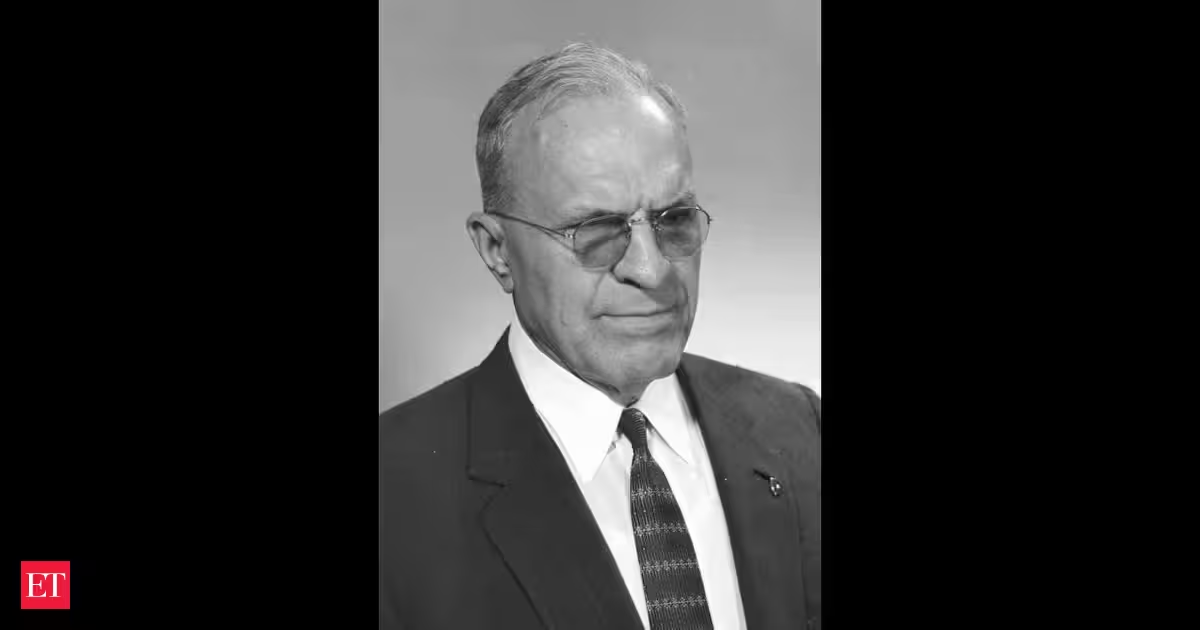
SynopsisRalph Teetor cruise control inventor: Ralph Teetor, who became blind early in life, was the genius behind cruise control in the 1940s. His creation of the Speedostat allowed for consistent speed maintenance while driving. Teetor faced engineering challenges with his remarkable ability to harness touch, sound, and memory.Global DeskRalph Teetor cruise control inventor: Blind since childhood, automotive engineer Ralph Teetor never let the loss of his sight stop him from inventing. During the 1940s, he developed a device he called the Speedostat, an invention that later became known as cruise control and changed highway driving, as per a report.Teetor spent decades solving engineering problems through touch, sound and memory, eventually becoming an accomplished automotive engineer and inventor despite losing his eyesight at the age of five.From childhood blindness to engineering successRalph R. Teetor was born on August 17, 1890, and lost sight in one eye after a childhood accident in 1896, as per an United States Patent and Trademark Office report. Over the next two years, he gradually lost vision in his remaining eye because of sympathetic ophthalmia.Rather than allowing blindness to define him, Teetor's parents encouraged him to live as independently as possible. According to his grandnephew, Jack Teetor, this approach helped him develop his tactile and auditory senses, skills that later became central to his engineering career, according to the report.As a child, Teetor and his cousin built a one-cylinder automobile from scratch using parts from the family's workshop. The vehicle reached 12 miles per hour, an impressive achievement considering one of its young builders was blind.You Might Also Like:Building a career in automotive engineeringTeetor studied mechanical engineering at the University of Pennsylvania before joining the family business in Hagerstown, Indiana, in 1912.The company eventually became Perfect Circle, where Teetor spent nearly five decades improving piston rings and automotive components. During his career, he received multiple patents related to piston ring technology, along with inventions that included a fishing rod handle and an automatic gear-shift system.His ability to judge the size of mechanical parts through touch often surprised colleagues. His sense of vibration also helped him solve turbine balancing problems during a volunteer assignment at New York Shipbuilding Corporation in 1918.You Might Also Like:The invention that became cruise controlAmong Teetor's many inventions, his best-known creation was the Speedostat, which he developed during the 1940s, as per USPTO report.The invention later became known as cruise control and changed highway driving by allowing drivers to maintain a steady speed without continuously pressing the accelerator.In the 1990s, Teetor's vision inspired the development of Adaptive Cruise Control (ACC), which uses sensors, radar or cameras to monitor traffic and automatically adjust a vehicle's speed. The technology improved driving comfort while also helping reduce the risk of rear-end collisions.A legacy that continued long after his lifetimeBeyond engineering, Teetor supported education, youth programs and community activities throughout his life. He also served as a steward at the Indianapolis 500 and remained deeply involved with the automotive industry.Teetor died in 1982 at the age of 91. He was posthumously inducted into the Automotive Hall of Fame in 1988 and the National Inventors Hall of Fame in 2024, as per the USPTO report.Read More News on(Catch all the US News, UK News, Canada News, International Breaking News Events, and Latest News Updates on The Economic Times.) Download The Economic Times News App to get Daily International News Updates....moreless
In 1940s, a blind automotive engineer created the car feature, cruise control that changed highway driving forever
Ralph Teetor cruise control inventor: Ralph Teetor, who became blind early in life, was the genius behind cruise control in the 1940s. His creation of the Speedostat allowed for consistent speed maintenance while driving. Teetor faced engineering challenges with his remarkable ability to harness touch, sound, and memory.
561 words~3 min read