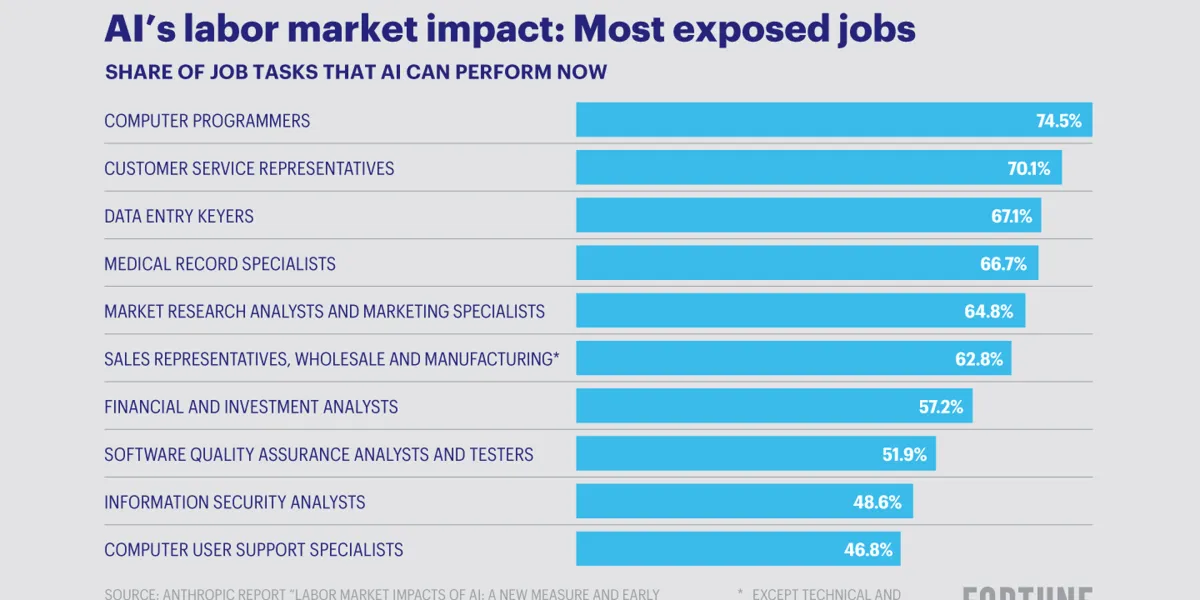
The company combines the US occupational database O*NET, theoretical exposure scores from a previous study, and usage data from its in-house Anthropic Economic Index, which draws on real Claude conversations. Fully automated use through API integrations is weighted more heavily than cases where humans only use AI as an assistant. Work-related contexts also count more than personal ones. The data is based exclusively on Claude usage.
Most AI capabilities remain unused in practice
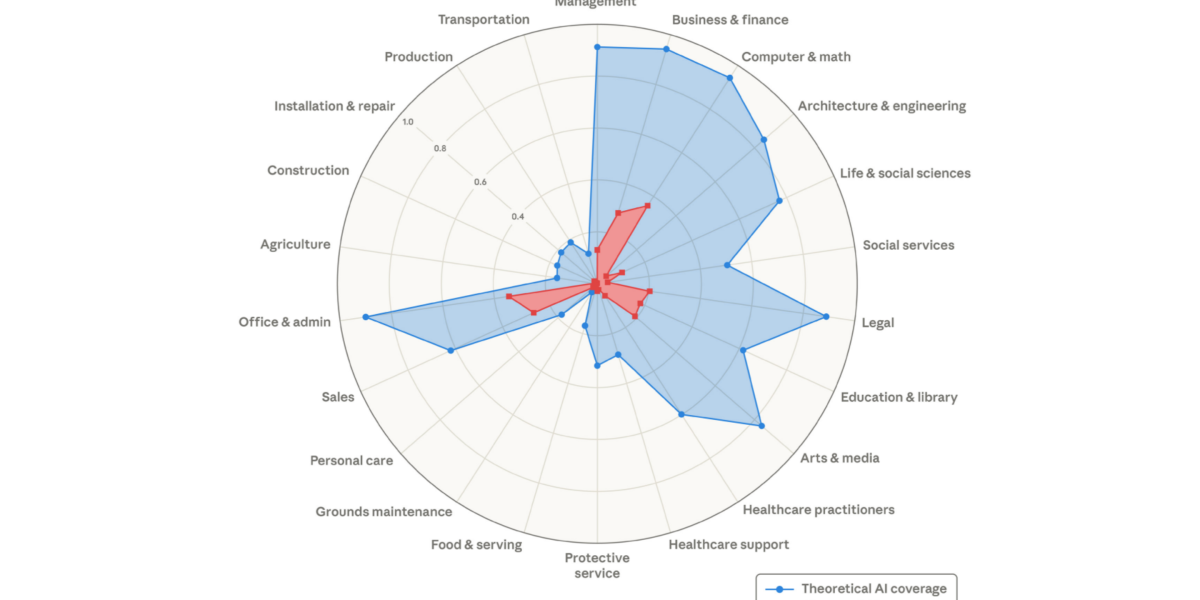
The study's central finding: AI is nowhere near reaching its theoretical potential. It doesn't dispute that the theoretical potential might be wrong, however, so keep that in mind for the rest of this article.
In any case, according to estimates, large language models could theoretically speed up 94 percent of all computer and math tasks. In practice, only 33 percent of those tasks are actually covered based on Claude usage, Anthropic says.
The scoring uses a simple scale: tasks a language model alone can complete twice as fast get a score of 1. Tasks that require additional tools get a 0.5. Tasks with no AI speed advantage get a 0.