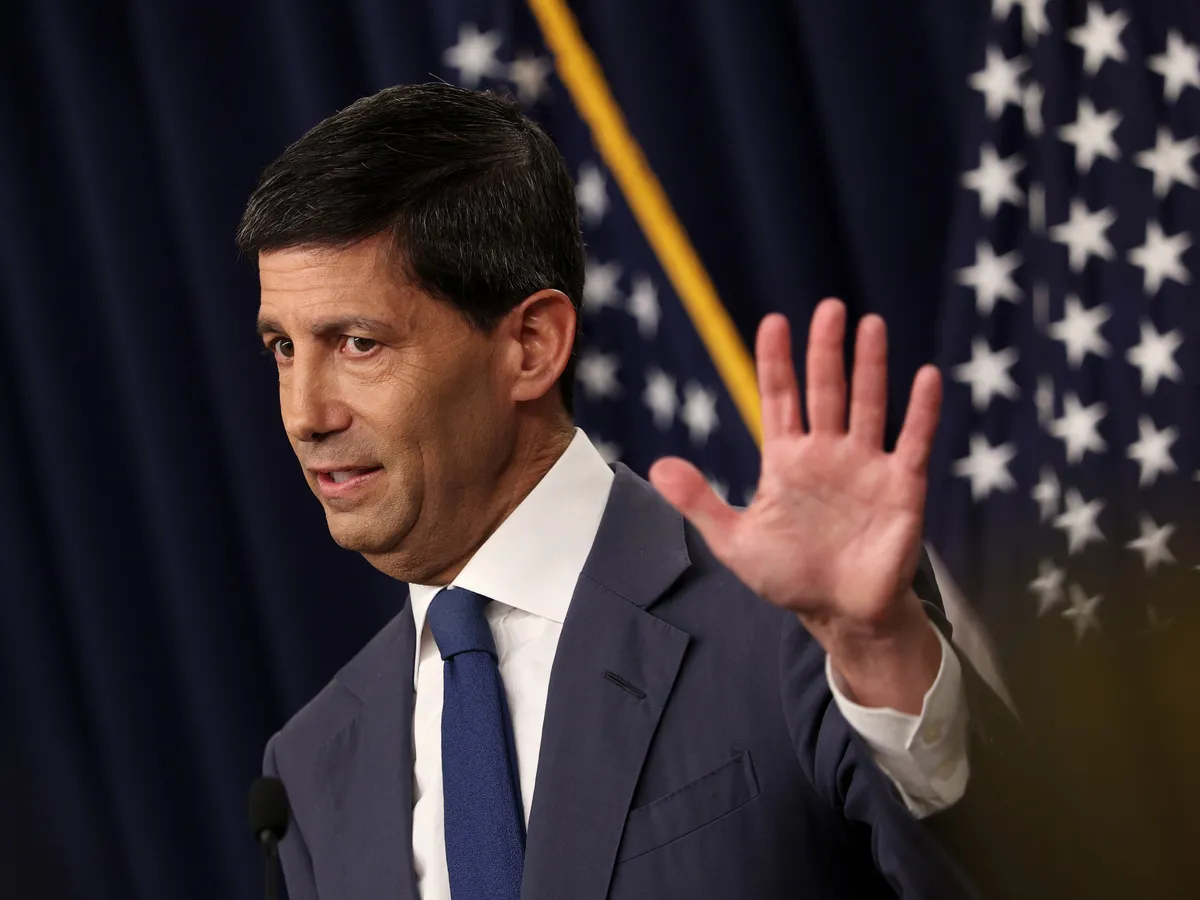
Skip to Content News Archives Economy Energy Oil & Gas Renewables Electric Vehicles Mining Commodities Agriculture Real Estate Mortgages Mortgage Rates Finance Banking Insurance Fintech Cryptocurrency Work Wealth Smart Money Wealth Management Investor Personal Finance Family Finance Retirement Taxes High Net Worth FP Comment Executive Women Puzzmo Newsletters Financial Times Business Essentials More Innovation Information Technology FP500 Podcasts Small Business Lives Told Tails Told Shopping Financial Post Store Obituaries Place a Notice Advertising Advertising With Us Advertising Solutions Postmedia Ad Manager Sponsorship Requests Classifieds Place a Classifieds ad Working Profile Settings My Subscriptions Saved Articles My Offers Newsletters Customer Service FAQ News Economy Energy Mining Real Estate Finance Work Wealth Investor FP Comment Executive Women Puzzmo Newsletters Financial Times Business Essentials HomeInvestorWhy investors can breathe easier after the Fed holds its fireMartin Pelletier: Markets have already tightened financial conditions, improving the investment outlookLast updated 2 hours ago You can save this article by registering for free here. Or sign-in if you have an account.Kevin Warsh's focus on what he called the "big things" suggests a Federal Reserve that is more interested in restoring confidence in its mandate than in fine-tuning every short-term market expectation. Photo by Win McNamee/Getty ImagesHeading into the United States Federal Reserve’s July 29 meeting, I was increasingly concerned about the possibility of a major policy mistake. While this may seem like an issue for American investors, the reality is that Federal Reserve decisions have enormous implications for Canadians as well. U.S. interest rates influence everything from bond yields and equity valuations to the direction of the Canadian dollar, mortgage rates, commodity prices and the flow of global capital. When the Fed gets policy wrong, the consequences rarely stop at the border.Subscribe now to read the latest news in your city and across Canada.Exclusive articles from Barbara Shecter, Joe O'Connor, Gabriel Friedman, and others.Daily content from Financial Times, the world's leading global business publication.Unlimited online access to read articles from Financial Post, National Post and 15 news sites across Canada with one account.National Post ePaper, an electronic replica of the print edition to view on any device, share and comment on.Daily puzzles, including the New York Times Crossword.Subscribe now to read the latest news in your city and across Canada.Exclusive articles from Barbara Shecter, Joe O'Connor, Gabriel Friedman and others.Daily content from Financial Times, the world's leading global business publication.Unlimited online access to read articles from Financial Post, National Post and 15 news sites across Canada with one account.National Post ePaper, an electronic replica of the print edition to view on any device, share and comment on.Daily puzzles, including the New York Times Crossword.Create an account or sign in to continue with your reading experience.Access articles from across Canada with one account.Share your thoughts and join the conversation in the comments.Enjoy additional articles per month.Get email updates from your favourite authors.Create an account or sign in to continue with your reading experience.Access articles from across Canada with one accountShare your thoughts and join the conversation in the commentsEnjoy additional articles per monthGet email updates from your favourite authorsSign In or Create an AccountorIn particular, I was worried that relatively new Fed Chair Kevin Warsh and the Federal Open Market Committee might choose to raise interest rates even though financial conditions had already tightened significantly on their own. Instead, the Fed left rates unchanged at 3.5 to 3.75 per cent, resisting calls from some policymakers for an increase.Canada's best source for investing news, analysis and insight.By signing up you consent to receive the above newsletter from Postmedia Network Inc.A welcome email is on its way. If you don't see it, please check your junk folder.The next issue of Investor will soon be in your inbox.We encountered an issue signing you up. Please try againMy concern stemmed from the fact that markets had already been doing much of the Fed’s heavy lifting. Since the spring, long-term interest rates had risen sharply, with the 10-year U.S. Treasury yield moving from roughly 3.95 per cent to nearly 4.7 per cent, while the U.S. dollar had also strengthened, following rates higher. Of concern is that real rates also increased from a low of 1.48 per cent in March to 2.08 per cent. Higher bond yields and a stronger dollar both act as forms of monetary tightening, raising borrowing costs and putting additional pressure on economic activity. During his press conference, Warsh effectively acknowledged this reality several times, noting that financial conditions today are materially tighter than they were only a few months ago.That matters because monetary policy works with long and variable lags. The effects are often felt first by businesses making investment decisions today. Even companies with fortress balance sheets are not immune. Take Alphabet Inc., for example, which while reporting its second quarter results cited negative free cash flow for the first time in years, meaning it now needs to tap the bond market to help fund its enormous artificial intelligence infrastructure buildout.My bigger concern, however, was the risk of tightening interest-rate policy into a supply-driven inflation shock at the same time bond markets have already done so.When inflation is caused by excessive demand, higher rates can help cool spending and restore balance. However, when inflation is being driven by an oil shock, geopolitical conflict, supply chain disruption or other constraints on production, higher rates cannot solve the underlying problem. They do not magically create more oil, reopen shipping lanes or reverse geopolitical events. What they can do is slow economic growth.Historically, when central banks tighten aggressively into supply shocks, the result is often stagflation: weaker growth; higher unemployment; pressure on corporate profits and inflation that remains stubborn because the original source was never demand-driven. Going into last week’s meeting, I worried the Fed might focus too heavily on headline inflation while underestimating how much tightening had already occurred through markets themselves.Then I listened to Warsh’s press conference. And I have to admit, I changed my mind and my overall opinion of the new Fed Chair.One of the most important qualities in investing is the willingness to change your view when the facts change. What impressed me was not simply the decision to hold rates steady, but the framework Warsh used to explain it.His message appeared directed as much toward Main Street as Wall Street. He repeatedly emphasized that the Fed understands the damage inflation has caused households and remains fully committed to restoring price stability. At the same time, he demonstrated an appreciation for how policy transmits through markets and the real economy.What stood out most was his emphasis on understanding the source of inflation rather than mechanically reacting to every data release. That distinction really matters because not every price increase is a sign of excess demand. Some reflect supply disruptions, others stem from major investment cycles, such as the massive spending wave currently underway in artificial intelligence. The challenge for policymakers is determining which forces are temporary, which are structural and which require a monetary response.I also came away with the impression that Warsh is attempting to reshape the institution itself. His focus on credibility, accountability and what he called the “big things” suggests a Fed that is more interested in restoring confidence in its mandate than in fine-tuning every short-term market expectation.Most importantly, he appeared comfortable with the idea that markets are already responding to the Fed’s message. Financial conditions have tightened, bond yields have adjusted and investors have recalibrated expectations. In other words, markets have heard the Fed loud and clear.That may be why Warsh sounded relatively comfortable leaving rates unchanged. He appears to recognize that monetary policy is ultimately measured by its effect on financial conditions and economic behaviour, not by the number of rate hikes delivered at FOMC meetings or locking themselves into some dot plot or forward guidance that could be made irrelevant overnight.A few weeks ago, I was worried the Fed was preparing to overdo it and I was skeptical of the uncertainty surrounding its new leadership. After listening to Warsh, I came away with a different impression. Rather than a policymaker eager to prove his inflation-fighting credentials, I heard someone trying to better understand the forces driving the economy before reaching for the interest rate lever, while recognizing when to step back and let markets do some of the work.That matters for investors because financial conditions have already tightened considerably and those effects take time to work their way through the economy. With businesses continuing to spend aggressively on artificial intelligence and other growth initiatives, the Fed’s decision to hold rates steady gives markets and policymakers an opportunity to assess whether higher borrowing costs alone are sufficient to cool inflation. The risks have not disappeared, but the likelihood of a Fed-induced slowdown appears lower than it did only a few weeks ago, which supports a more constructive outlook for equities.Martin Pelletier, CFA, is the author of Investing Through the Storm and a senior portfolio manager at TriVest Wealth, a team that is part of Wellington-Altus Private Counsel Inc. TriVest provides discretionary risk-managed portfolios, investment audit/oversight and advanced tax, estate and wealth planning. The opinions expressed are not necessarily those of Wellington-Altus._____________________________________________________________If you like this story, sign up for the FP Investor Newsletter. Join the Conversation This website uses cookies to personalize your content (including ads), and allows us to analyze our traffic. Read more about cookies here. By continuing to use our site, you agree to our Terms of Use and Privacy Policy.
Why investors can breathe easier after the Fed holds its fire
Martin Pelletier: Markets have already tightened financial conditions, improving the investment outlook. Find out more
1,573 words~7 min read