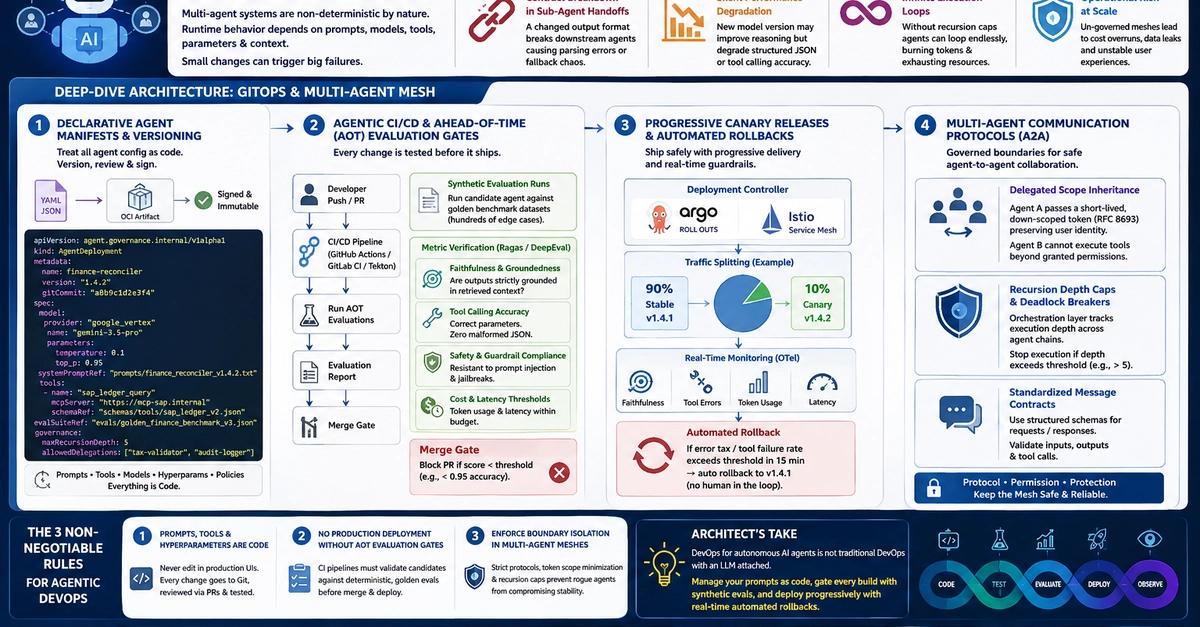
The Agentic DevOps Challenge
As enterprise AI adoption matures, organizations are shifting from single-turn chat assistants to complex multi-agent orchestration meshes. In these architectures, specialized autonomous agents—such as planners, researchers, code executors, and API orchestrators—collaborate asynchronously to execute multi-step business workflows.
However, managing the lifecycle of non-deterministic, agentic software introduces severe platform engineering challenges. Unlike traditional software microservices with static code paths, an agent’s runtime behavior is shaped by a non-deterministic combination of system prompts, foundation model versions, temperature parameters, tool definitions, and dynamic context windows.
Updating a single sentence in a system prompt or changing a tool JSON schema can cause unintended regression cascades across downstream sub-agents:
Contract Breakdown in Sub-Agent Handoffs: A modified primary planner agent changes its JSON output format, causing secondary worker agents to fail parameter parsing or trigger unexpected fallback logic.
 aws.amazon.com