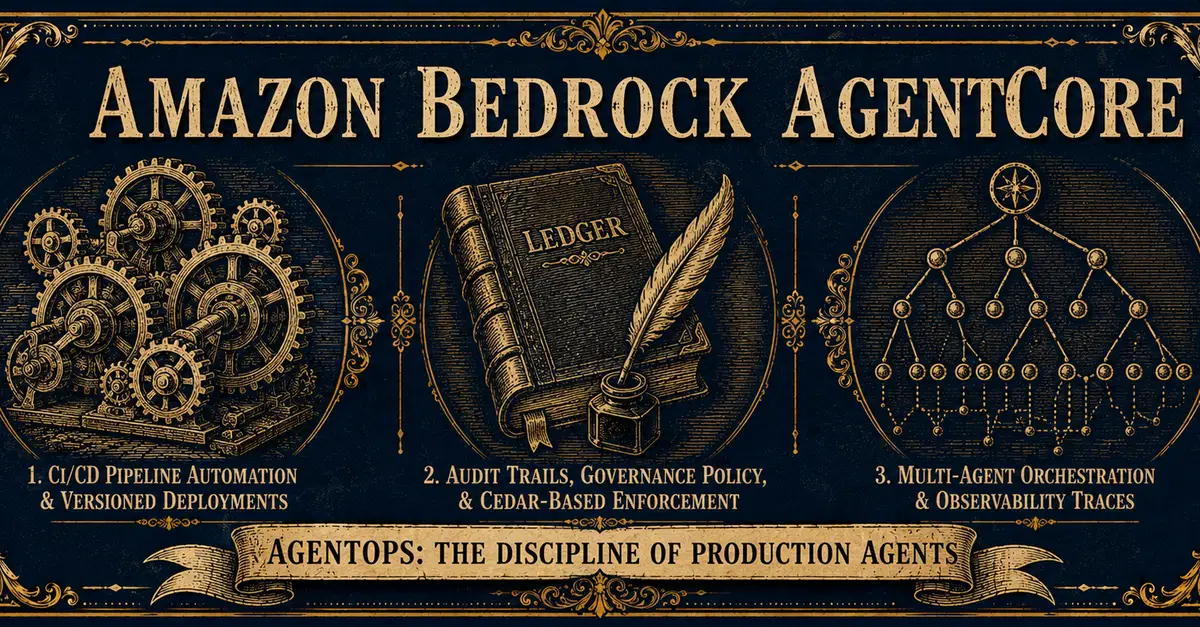
When you build agentic AI solutions, you face unique operational challenges. Agents make unpredictable decisions, costs spiral unexpectedly, and debugging non-deterministic failures seems impossible. Agentic AI applications don’t just execute predetermined workflows. They reason, adapt, and make autonomous decisions, and DevOps practices need to be adapted. That’s where AgentOps comes in, the operational discipline for deploying, managing, and continuously improving AI agents in production.
The first part of our blog series introduced how to operationalize generative AI workloads. In this post, we show how to accelerate the path to production for agentic AI workloads, check the quality of your agents and tools, and drive agentic AI adoption in your organization by implementing AgentOps with Amazon Bedrock AgentCore. We discuss best practices from real world implementations across four pillars: governance and security, build and operations, evaluation, and observability. We also show how AWS services, people, and processes come together into a reference architecture that you can adapt for your organization.
Note that this post focuses on operations and not agent design. The implementation examples use Amazon Bedrock AgentCore and supporting AWS services, but the principles discussed apply broadly. The reference architecture is a starting point: your organization’s requirements will determine how you adapt it.
 aws.amazon.com