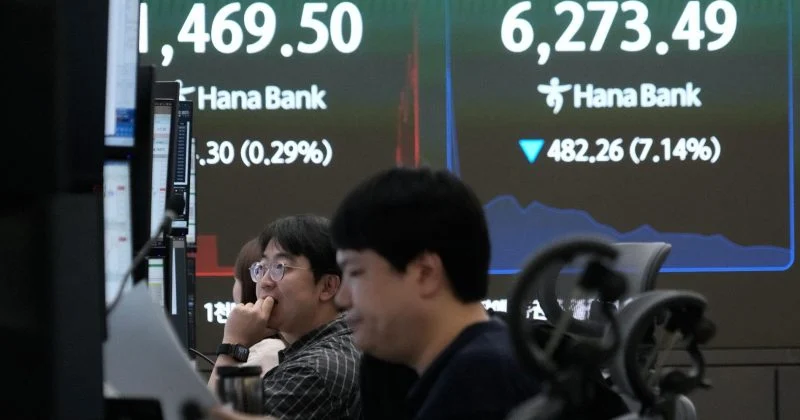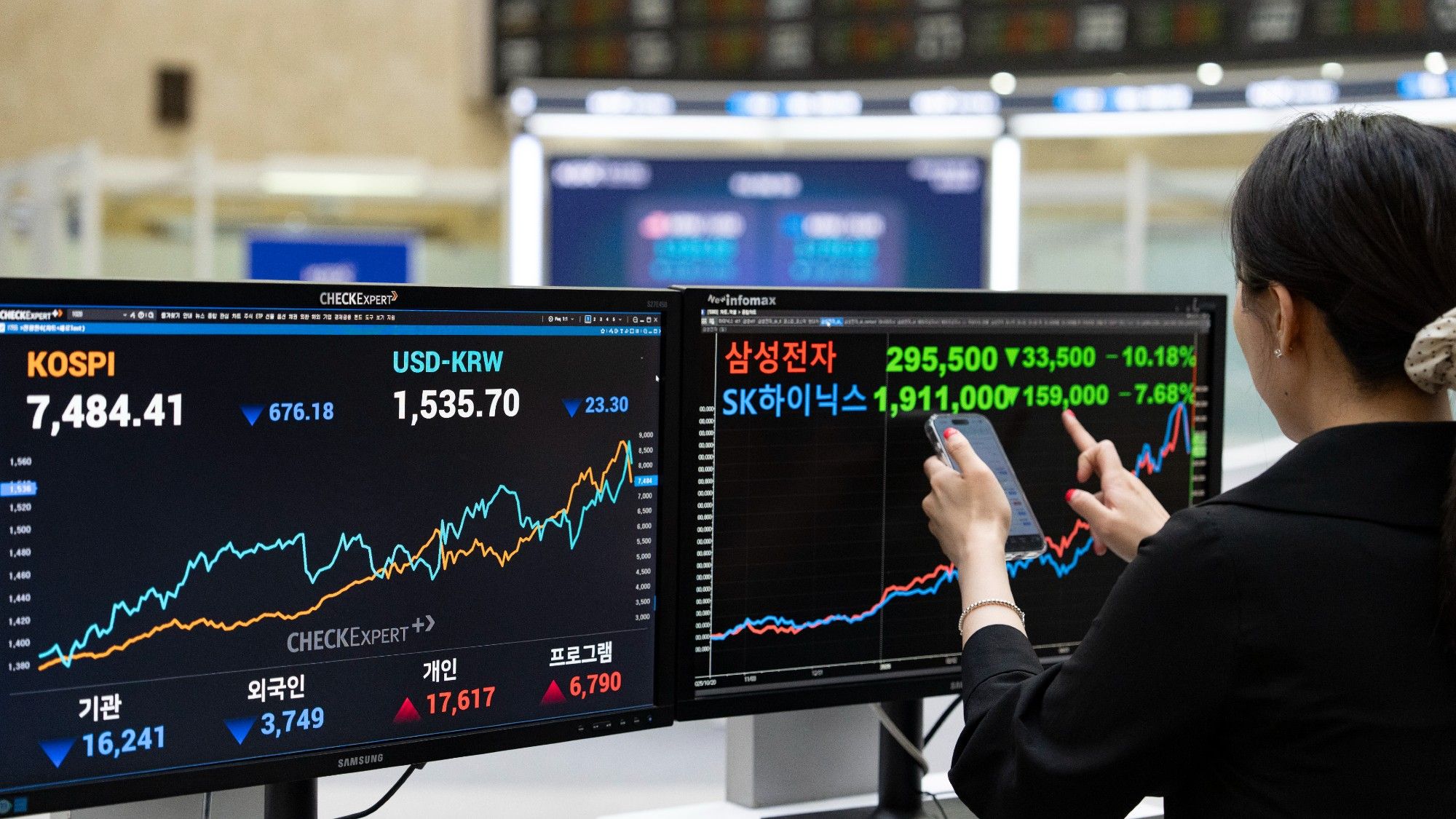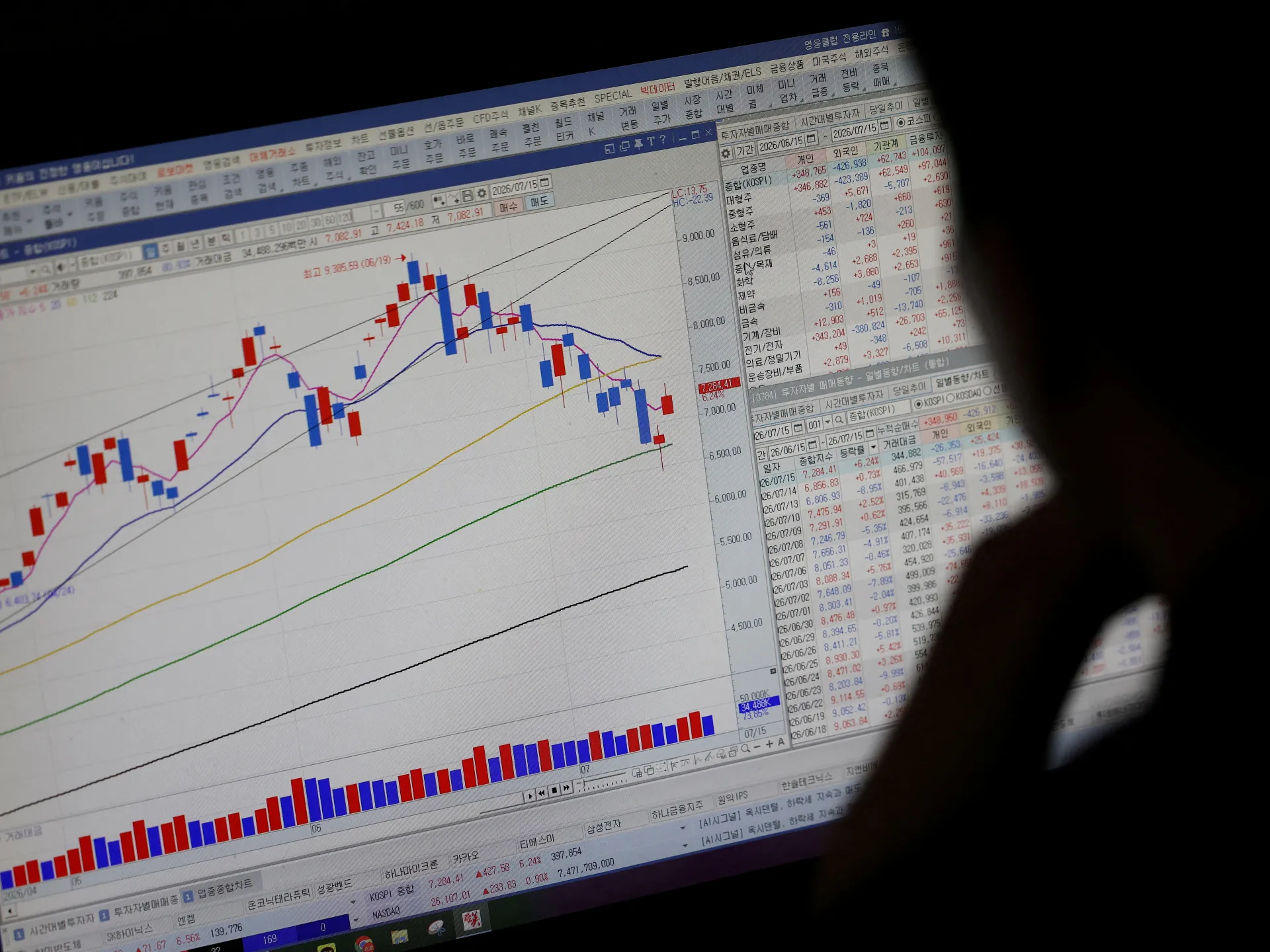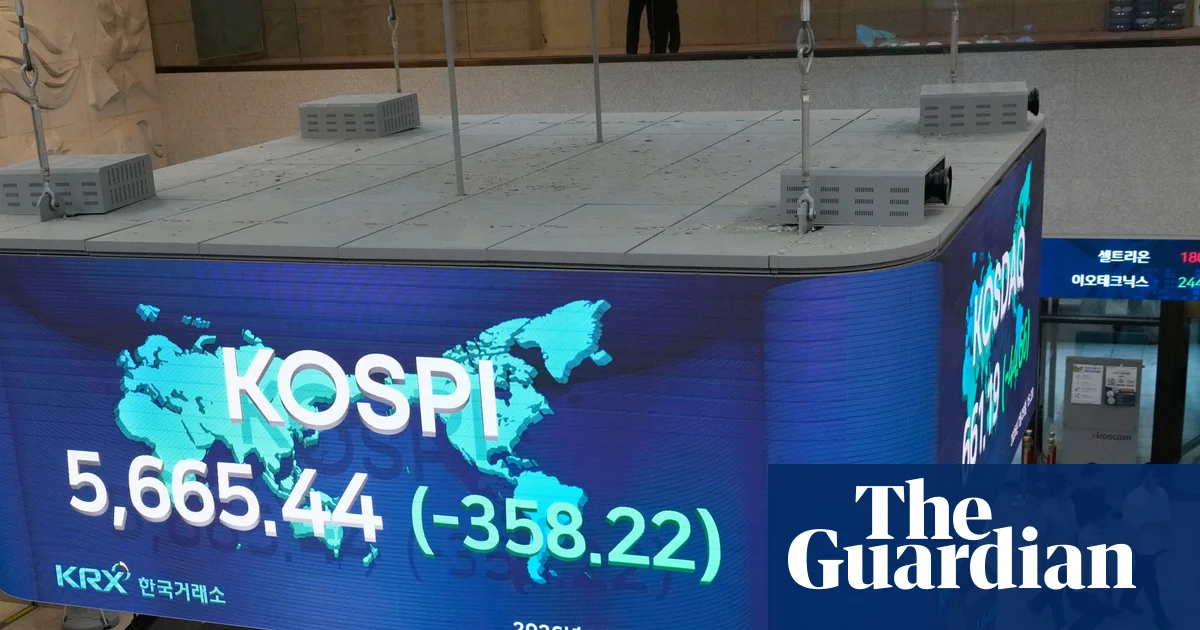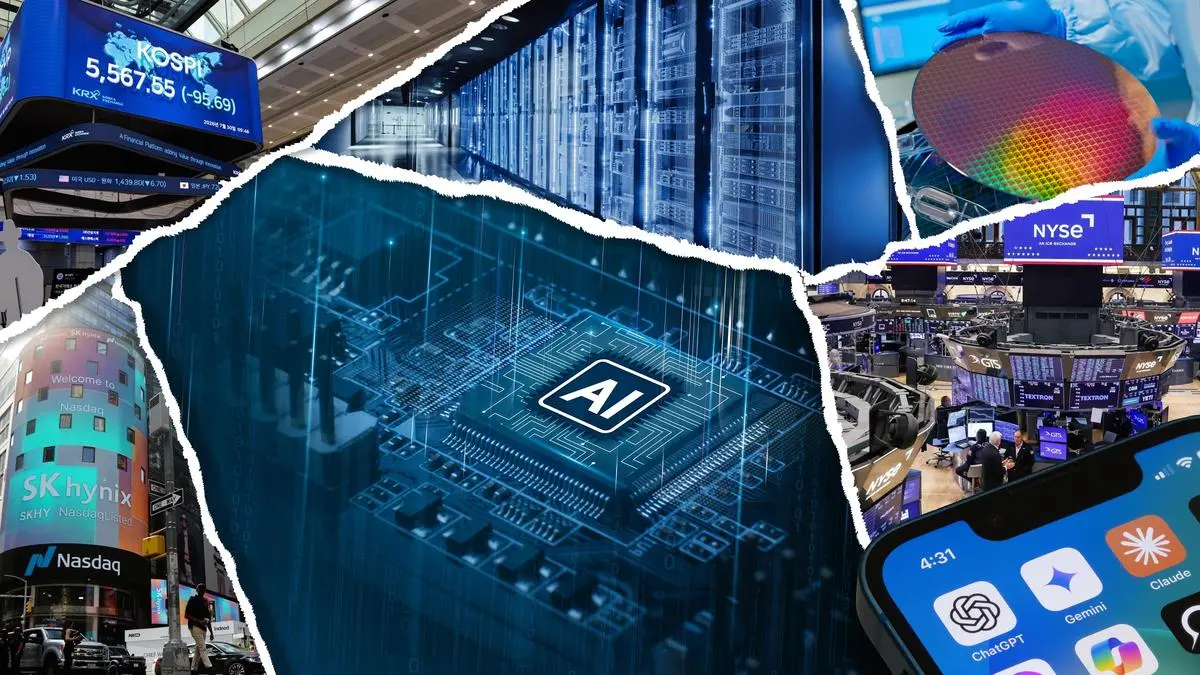
The AI debate has never been hotter and to say that the bears won the argument last month would be an understatement. Any doubts? Look up South Korean stock markets. The benchmark KOSPI Composite Index completed ‘a month to forget’ in July with a loss of 22 per cent. This is the third worst month in the index’s history, after the 27 per cent crash during the Asian financial crisis of October 1997 and 23 per cent plunge during the global financial crisis in October 2008. The country, which raced to a stock market capitalisation of $5.1 trillion as of June peak, has now seen $1.2 trillion of that wealth erode in a matter of weeks — a brief demonstration of the possible fallout if the AI trade were to go South across the globe.The reason? Semiconductor stocks SK hynix and Samsung Electronics, which roughly account for 50 per cent of KOSPI companies’ market cap, slumped 20 per cent and 24 per cent respectively to intra-week lows (versus previous week close) — the very stocks that took the Korean stock market to record highs. .That is not all. The rout was more intense in products such as single-stock leveraged ETFs. These are high risk funds that use derivatives to multiply the daily returns of an underlying stock. For instance, the CSOP SK Hynix Daily (2x) Leveraged Product ETF. This ETF will gain 2 per cent if SK hynix gains a per cent in a day and lose 2 per cent if the stock loses 1 per cent in a day. From its 52-week high on June 25, this ETF has lost over 78 per cent! Products like these and leveraged exposures to chip stocks have wiped out the portfolios of thousands of Korean investors. The situation is so dire that their finance minister apologised and admitted that such leveraged products were introduced without careful consideration.While the impact has been most dramatic in South Korea, that is partly because its stock market had become, in effect, a concentrated bet on the AI trade. However, this unwind is no longer a Korea-only story and AI-theme stocks have been under pressure across markets.Too big to failWe looked at 16 stocks which are front-runners of the AI theme. The list spans across hyperscalers, chip design (Nvidia, Broadcom), semiconductor manufacturing, neoclouds (CoreWeave, Nebius) and an AI investor/ financier in SoftBank. From their 52-week highs, these stocks are down 30 per cent on average (Chart 1). From the said peaks, they have erased investor wealth of about $6 trillion.One of the starkest examples is Oracle. Last year, after it announced Q1 FY26 results in September, the stock zoomed about 43 per cent to a 52-week high, reflecting the recklessness in the AI mania. Today its correction of 62 per cent reflects the concerns building up.Many of them are part of S&P 500, accounting for about 30 per cent of the index’s total market-cap and earnings. Between 2025 and 2026 (consensus estimate), the total net income of the index’s constituents is expected to move from $2.1 trillion to $2.9 trillion. Of this incremental income of about $840 billion in 2026, the said AI constituents account for one in three dollars — showing the weightage of these companies (Chart 2). Further, the index P/E multiple, based on CY25 net income is at 33x, which is a valuation that falls in the bubble territory. However, based on CY26 earnings estimates, the P/E cools to 23x. This expected earnings growth is the thin line dividing the debate between the bulls and the bears. If, unfortunately, these companies fail to meet earnings expectations, the index being in bubble territory, brings back memories of dot-com crash in which the S&P 500 corrected 50 per cent and the Nasdaq Composite 78 per cent from 2000 peak to troughs in late 2002.Cash-flows over capexSo, does the market’s disappointment stem from earnings? Apparently not, as these companies have delivered earnings beat almost all the time in the last four quarters. The problem appears to be capex of astronomical proportions. Take Alphabet’s case. The company reported Q2 2026 earnings on July 22. Revenue grew 24 per cent year-on-year and operating income 30 per cent. Its cloud revenue (20 per cent of consolidated revenue) grew a staggering 82 per cent. Profit growth was muted relative to revenue growth at around 16 per cent after adjusting for one-offs. But what spooked the Street was the company raising full-year 2026 capex guidance from $195 billion to $205 billion. It also posted its first quarter of negative free cash flows. What added fuel to the fire was the management admitting that free cash flows will remain under pressure driven by capex and that capex will continue until it sees an ‘attractive return on that investment’.Meta Platforms came up with Q2 results on Wednesday. Revenue beat expectations. But it barely ended up free cash flow positive with $784 million as against $8.5 billion in Q2 2025.Amazon’s Q2 results on Thursday revealed that it continued to turn negative free cash flows for the quarter, similar to Q1. The company upped capex guidance from $200 billion to $220 billion for 2026.The fact that companies are spending big time on capex and that free cash flows would drain is not a recent development, per se. It’s only now that the market is waking up to smell the coffee. As Keynes said, “Markets can remain irrational longer than you can remain solvent.”High-stakes gameThe top hyperscalers, neoclouds, Meta Platforms alongside newly-listed SpaceX (xAI) are expected to incur capex of over $2.16 trillion in fiscals ending in 2026 and 2027, per Bloomberg consensus (Chart 3). This is around half the size of India’s economy! Also, rising capex has meant a clear downtrend in the fixed assets turnover ratio of hyperscalers (Chart 11).As said earlier, S&P 500’s earnings depend on a handful of tech stocks. Companies like Nvidia and Micron are beneficiaries of the ongoing AI capex. Capex of hyperscalers and neoclouds is their revenue. Imagine what could happen when the capex music stops. Their earnings will taper, having a bearing on the index’s earnings. For example, Micron and Nvidia together account for about 7 per cent of S&P500 earnings (2026 estimates). During the dotcom bubble, Intel, given its dominance in the CPU market, was in a position similar to Nvidia today. The net profit of Intel for CY01 declined 88 per cent versus CY00 after the dot com bubble burst. This apart, their customers currently cannot record money spent on AI infrastructure as fixed assets, as soon as they spend. Per accounting standards, they will have to wait until economic benefits are probable to flow to the entity. Simply put, companies can recognise spending as fixed assets only when they become available for use (will remain under capital work-in-progress until then) and only when a fixed asset is thus recognised, they can begin providing for depreciation. What this means is that commencement of depreciation on the stated unprecedented levels of capex is still a few years away. If it coincides with tapering earnings of chip sellers/ designers, it could be a double whammy for S&P 500’s earnings – lower earnings from leading chip companies, while at the same time depreciation impacting earnings of hyperscalers.A market crash in that case could hit households hard. Corporate equity wealth held by households is at record highs currently, at $65 trillion or twice the nominal GDP (Chart 4).Racking up debtAs cash flows deplete, Silicon Valley is developing an affinity towards debt. Per Bloomberg data, Alphabet, Amazon, Microsoft, Meta Platforms and Oracle have raised a combined $328 billion in debt securities in 2025 and 2026 year-to-date (Chart 5). This is over 45 per cent of the value of debt securities issued by these companies since 1997 (that is as far back as data goes).Alphabet, which has kept away from debt (except for a $3.7-billion issue in 2016 and a $10-billion issue in 2020), has raised about $90 billion in 2025-26. Amazon tops the list at $107.3 billion in the same period. Oracle and Meta have each raised over $50 billion and notably, Microsoft hasn’t raised any. However, its cash levels have fallen to around 60 per cent of what they were five years ago. Meta had turned into a net debt company for the first time since listing (in 2012) in 2025.Companies, which were once deemed to be cash printing machines, given their leading technology and IP moats, are now becoming cash guzzlers. Interestingly, Nvidia, which has never generated negative free cash flows since FY09, is also turning to debt. In 2025-26, the company has issued $25 billion worth of debt securities. Recently-listed SpaceX has raised $25 billion in debt over and above a $75-billion primary issue of shares during its June IPO. SoftBank Group, which has invested over $30 billion in OpenAI and has committed to invest $30 billion more, was reported to have approached a consortium of lenders for a $10-billion loan backed by its stake in OpenAI. However, days later, Bloomberg reported that the company’s attempt stalled for unclear reasons. SoftBank had even downsized the loan requirement to $6 billion.As such, raising debt is not a problem. But the rate at which the balance-sheet story is changing is now making investors nervous and to rethink. Market is evolving by the day and as of now, there is still no proper clarity as to whether AI investments will pay off. The market’s nervousness in this regard is captured in the spreads that the bonds of these companies trade at, over the sovereign bond yield of equivalent tenor (Chart 6).S&P even downgraded Oracle’s long-term credit rating to ‘BBB-‘ – just one notch above junk bond status. It is equally becoming challenging to be an investor in their bonds too. CDS or credit default swap spreads are also on the rise, reflecting some nervousness of possible defaults. It is noteworthy that Oracle’s CDS spread now is higher than the then peak of 211 bps in 2008 (Chart 7).Off-balance-sheet debtThat is not all. A few days ago, a Nikkei Asia study revealed that ‘hidden’ or ‘off-balance-sheet’ debt of Alphabet, Amazon, Microsoft, Meta and Oracle has reached a combined $1.65 trillion, exceeding the $1.35 trillion (transparent) debt reflected on their balance sheet. After recent earnings releases, the ‘hidden’ debt figure stand at $2.5 trillion. This is also one of the reasons why market turned sceptic towards AI stocks (Chart 8).While not strictly ‘debt’ in the traditional sense, these ‘hidden’ debt largely take the form of lease commitments towards data centre operators, semiconductor vendors to secure future chip supply and energy service agreements to secure energy for data centre usage. They run well into the future, often until 2030. The ‘hidden’ debt figure roughly gives one an idea of the quantum of cash outflows, either as capex or revenue expenditure, that these companies are expected to spend.As said above, chips can be capitalised as fixed assets, only when future economic benefits are probable. Similarly, leases give rise to an asset and a liability (each largely equating to the present value of future lease payments). The lease asset will be amortised over the term of the lease (akin to depreciation), while the liability will be unwound similar to a repayment schedule of a term loan (think of lease payments as the EMI here). However, this lease accounting comes into picture only when the recognition criterion is met. The criterion or the trigger event in this case happens to be the day the lessor makes the underlying asset available for use by the lessee and the lessee is able to direct how the asset is to be used. In case of data centre buildouts, the trigger event may not occur in the near term. Hence, until the recognition criteria are met, lease and chip commitments are disclosed in the notes to accounts. The amounts are also subject to change, if companies agree on amending the agreements in the future.Nevertheless, the key risk investors need to note here is that certain contracts, such as for purchase of chips and energy are negotiated on a ‘take-or-pay’ basis — meaning, the companies are obligated to pay the vendor irrespective of whether they avail of the product or service.Moats questionedWhile the hidden debt or commitment figure measures the amount of cash outflows, companies disclose a figure called ‘remaining performance obligations’ (RPO) or simply revenue backlog to give an idea of cash inflows or future revenue. RPO measures the cumulative value of revenue recognisable in the future, provided the company honours its side of the contract with the customer. This figure is also subject to contract additions and cancellations. The RPO growth of some of these companies over the past year are captured in Chart 9.While the magnitude and growth are impressive, investors should note that a large part of this is concentrated in two customers namely, OpenAI and Anthropic. OpenAI and Anthropic account for roughly 41 per cent, 47 per cent, 38 per cent and 48 per cent of the RPOs of Microsoft, Oracle, Google and Amazon respectively.OpenAI and Anthropic are cash-burning companies themselves, whose business model is increasingly being challenged by the rapid rise of much-cheaper open-source models. Specifically, an open-source large model called Kimi K3 from Moonshot, a Chinese AI lab, is seen as a serious contender to the top-tier models of OpenAI and Anthropic. This stands as a testament to how the open-source models are rapidly filling the performance gap between them and their proprietary counterparts. LLM Token Expenditure Index, provided by Silicon Data, shows the decline in token costs over time (Chart 10). Even in the week gone by, Sam Altman announced token price cuts for some of OpenAI’s models.Besides, stocks of Micron, SK hynix and Samsung fell over 20 per cent each during the week, reacting to the blockbuster IPO of ChangXin Memory Technologies (CXMT) on Monday. CXMT is a Chinese supplier of DRAMs. The market’s concern was that the IPO proceeds of $8.6 billion could help CXMT add capacity, in turn increasing supply and denting business and margins of the memory majors. However, while the risk has not abated, the three memory stocks managed to recoup most of the losses towards the end of the week.BottomlineWhile the debate will rage on whether AI is even greater than the Industrial Revolution, the stakes in the financial markets have never been higher. Also at risk is global economic growth which has benefited from the spending boom. As Steve Eisman of Big Short fame recently said, what scares him is that the whole US market ‘is all one (AI) trade, so it better succeed!’Published on August 1, 2026
Micron, SK hynix, Oracle, SpaceX, Google, Microsoft et al: AI’s dotcom deja vu
The unraveling of AI stocks triggers a historic decline in South Korea's KOSPI, signaling global market concerns.
2,440 words~11 min read