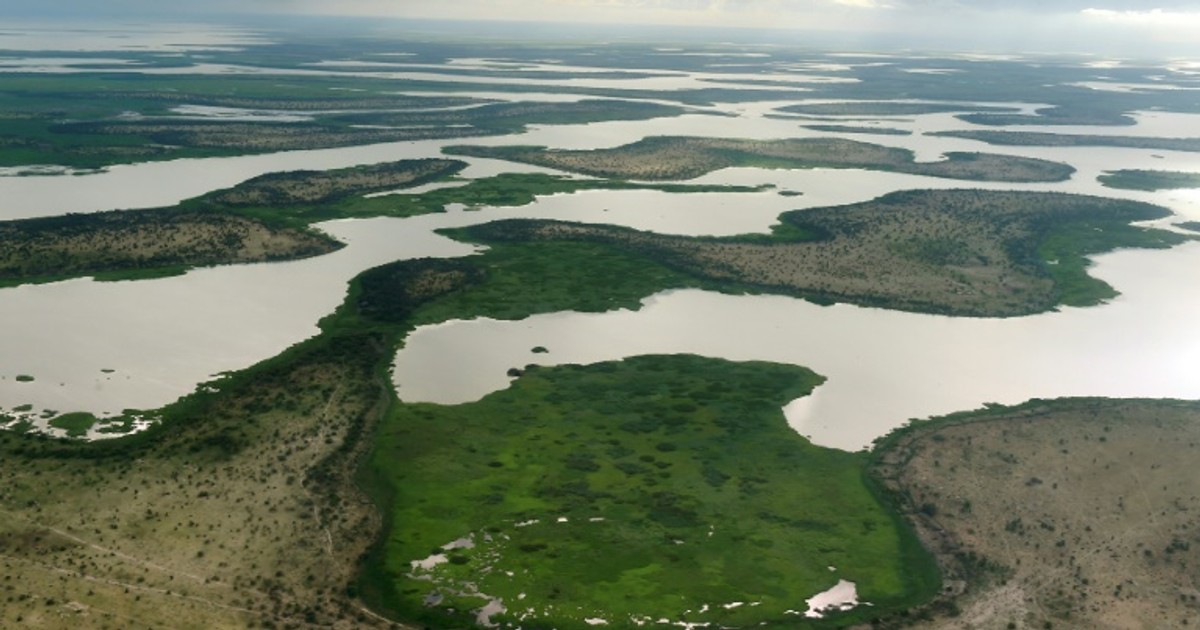
Australia's Lake Eyre. Image credits: Wikimedia CommonsFor generations, Kati Thanda-Lake Eyre has inspired some of Australia’s most ambitious dreams. At its lowest point, the vast salt lake lies about 15m below sea level, making it seem well placed to receive seawater from the nearby coast. During the 1950s, while Australia was grappling with recurring droughts and sought ways to develop its arid interior, engineers revisited a proposal: to excavate a 320km canal from Spencer Gulf near Port Augusta to Lake Eyre, flood the basin with seawater and create a permanent inland sea. Many supporters of this proposal believed the new water body might encourage rainfall, moderate the desert climate and stimulate economic growth. According to the International Journal of Environment and Sustainable Development (IJESD) and historical reviews of Australian water-transfer schemes, the proposal became one of the country’s best-known macro engineering concepts, despite never being built.An ambitious vision for inland seaAccording to the Cambridge University Press volume Inter-Basin Water Transfer, proposals to flood Lake Eyre date back to the late 19th century; however, the interest was renewed during the mid-20th century as planners searched for ways to make Australia’s interior more productive. Notably, one of the best-known proposals called for a gravity-fed canal stretching roughly 320km from the coast to the lake and because the lake lies below sea level, seawater could theoretically flow inland without continuous pumping. Supporters of this idea argued that a prominent inland sea might increase atmospheric pressure, thus generating more rainfall over surrounding regions, support fisheries and even alter local temperatures, creating a more hospitable environment for agriculture and settlement.Australia's Lake Eyre. Image credits: Wikimedia CommonsAccording to the same review, evidence that an artificial inland sea would produce meaningful increases in rainfall is limited, and the region’s climate would make the idea even less plausible. It is worth noting that Lake Eyre lies within one of Australia’s hottest and driest landscapes, where annual evaporation largely exceeds rainfall. Therefore, even if seawater continuously entered the basin, huge quantities would evaporate every year, leaving behind salt and requiring a constant inflow simply to maintain water levels. Furthermore, researchers have cautioned that maintaining a permanent sea would demand enormous engineering works while potentially creating unexpected ecological consequences.Modern science revisits the conceptNotably, rather than abandoning the idea altogether, researchers have later explored whether new technologies could overcome the past shortcomings and concerns. The 2013 IJESD paper suggested that modern macro-engineering concepts no longer rely on an open gravity canal, and instead the authors of the paper suggested gradually filling Lake Eyre by pumping seawater through tensioned textile pipelines, which are powered largely by photovoltaic energy. Additionally, the proposal suggested reducing evaporation by covering parts of the lake with floating plastic membranes or hollow plastic balls, thus allowing the lake to serve as a long-term reservoir supporting biosaline agriculture: the cultivation of salt-tolerant crops using saline water. The researchers indicated that, while technically feasible with existing technologies, such a project would require decades of investment and further study before actual implementation.Furthermore, the study represented a shift in thinking, as, instead of attempting to transform Australia’s climate through an inland sea, it focused on creating new economic opportunities while simultaneously recognising the realities of evaporation and water management. The study authors note that the biggest long-term benefit could be encouraging settlement and productive land use in parts of the lake basin through renewable-energy-powered infrastructure rather than relying on uncertain climate change.Today, Lake Eyre remains an ephemeral salt lake that fills only after exceptional rainfall across its basin before gradually drying beneath the desert sun. As per the IJESD study, the canal proposal remains an important chapter in Australia’s engineering history because it shows how ambitious ideas evolve as scientific understanding improves. While the idea was never realised, it remains a striking example of how geography, climate and engineering ambitions collide in Australia’s interior.
In the 1950s, to bring rain to Australia's parched interior, engineers proposed flooding Lake Eyre through a 320-km ocean canal, but the water would rapidly evaporate
For generations, Kati Thanda-Lake Eyre has inspired some of Australia’s most ambitious dreams. At its lowest point, the vast salt lake lies about 15m below sea level, making it seem well placed to receive seawater from the nearby coast.
642 words~3 min read