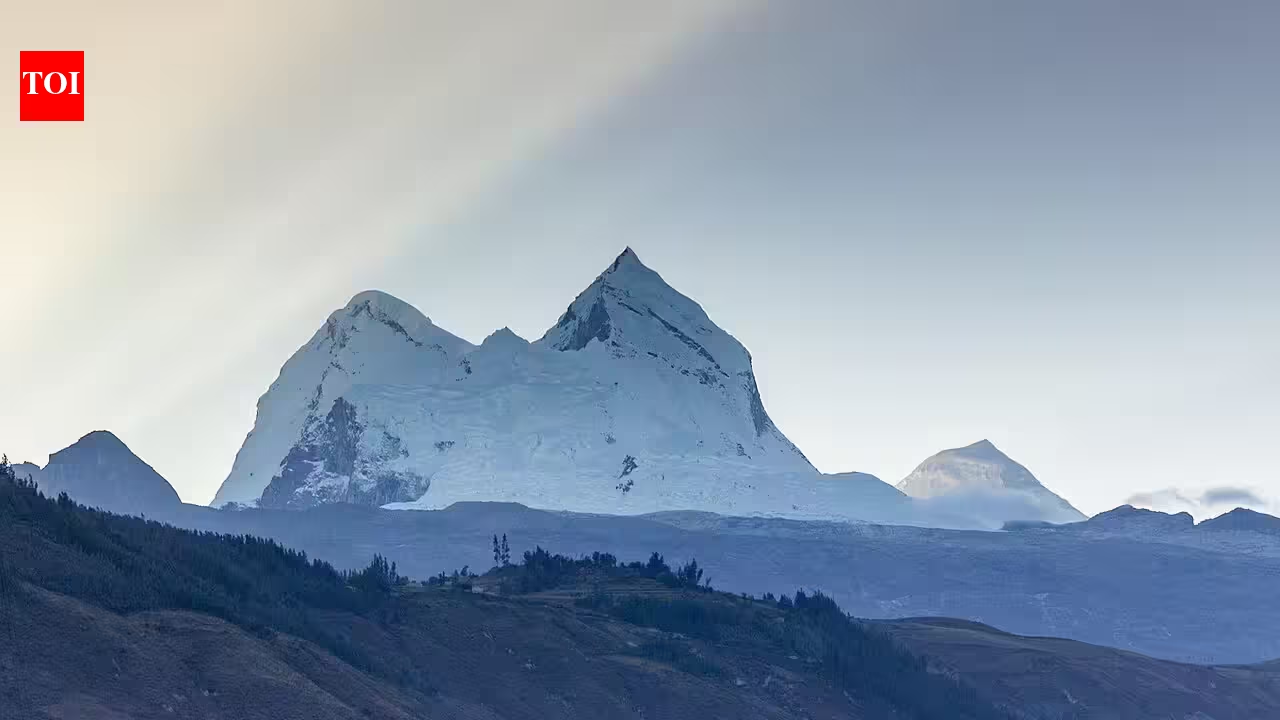
A climate experiment in Peru involved whitewashing a mountain to encourage glacier regrowth. Image Credit: Wikimedia CommonsIn 2010, a strange climate experiment in the Peruvian highlands drew global attention. All it took was a few buckets of whitewash and local workers painting the dark stones on the slopes of Cerro Chalon Sombrero, a mountain in Peru that once had a glacier. Their aim was bold. By whitewashing the entire mountain, people hoped to increase reflected sunlight and cool its surface enough for snow and ice to appear.While it sounded simple, it seemed like an idea worth pursuing. The Peruvian inventor Eduardo Gold got a $200,000 grant after his proposal was chosen among the winning projects of the World Bank's "100 Ideas to Save the Planet" competition in 2009. It is mentioned in the BBC article that in 2010 people started to whiten part of the mountain with a mixture of lime, water, and industrial egg white. A decade later, the experiment remains an example of climate adaptation. But could painting a mountain save its glacier?Why paint the mountain white?The theory behind painting a mountain white was built upon a scientifically established principle called the albedo effect. The albedo effect describes how much sunlight a surface reflects. Bright surfaces such as snow and ice reflect much of the Sun's incoming energy, while darker surfaces like rock absorb more heat. According to the National Snow and Ice Data Center (NSIDC), fresh snow reflects 80 to 90 per cent of incoming sunlight, helping keep the surface cool and reducing heat absorption.As glaciers melt, the rocks beneath them become visible. The dark surfaces can absorb more heat, potentially contributing to further warming and ice loss. This is known as positive feedback.Gold proposed that painting the rocks white would increase surface reflectivity, cool the area and create conditions favourable for prolonged snowfall. According to the BBC, the painters used an environmentally safe whitewash made of lime, water and egg white rather than ordinary paint.While the project showed increased reflectivity, it did not restore the glacier. This creative idea underscored the urgent search for solutions to glacier loss globally. Image Credit: Wikimedia CommonsPeru faces especially high stakes from glacier lossThe experiment took place in a country where glacier loss would significantly affect people. According to Peru's National Institute for Research on Glaciers and Mountain Ecosystems (INAIGEM), Peru is home to around 68 per cent of the world's tropical glaciers, making it the country with the largest concentration of tropical glaciers globally.However, the glaciers are disappearing fast. The National Water Authority of Peru (ANA) and scientific research show that Peru’s tropical glaciers have shrunk by over 40 per cent of their total area from the 1960s due to increased global warming.For Peruvians, glaciers are important not just for their scenery. They are used as sources of drinking water, irrigation, and hydroelectric energy, especially in dry seasons when there is little rainfall.Was the project successful?Although the experiment received extensive international coverage, there is not enough scientific evidence that painting the mountain helped glaciers regrow. The pilot project showed that increased reflectivity could help decrease the energy absorbed by exposed rocks. But glacier formation takes more than just cool rocks. Glaciers form over many years when snowfall accumulation exceeds melting.Thomas Condom, a glaciologist quoted by the BBC, said the increase in reflectivity could have some effect but would not be enough to reverse glacier retreat in the Andes. There is also little evidence that the project expanded to cover the 70-hectare area or that any glacier formed after the initial experiment.Scientific research is following similar directionsDespite the failure of painting mountains as a climate change solution, scientific research is underway to decrease glacial melting through the use of reflective surfaces. For instance, scientists in Switzerland have placed large white geotextile sheets on glaciers during summer to reduce melting in those areas.According to researchers and glacial monitoring bodies, the method can reduce melting in those spots, though it is expensive and only practical in limited areas of a glacier. However, scientists say such measures should be used to protect specific areas such as ski slopes or tourist attractions, not to reverse glacier loss across entire mountain ranges.A creative idea pointing to a much bigger problemIn retrospect, the Peruvian mountain-painting project was not just an attempt to solve a big problem, but also an experiment in creative thinking about climate change. Reflecting sunlight works. Increasing albedo decreases local temperatures. But scientists say that it is impossible to restore glaciers without favourable climate conditions over many years – snowfall and colder temperatures. Even if painting a mountain cannot restore a glacier, the experiment shows how urgently countries are searching for solutions to glacier loss around the world.
In 2010, workers painted part of a Peruvian mountain white to regrow its lost glacier; the World Bank selected the idea for a $200,000 grant
In 2010, a strange climate experiment in the Peruvian highlands drew global attention. All it took was a few buckets of whitewash and local workers painting the dark stones on the slopes of Cerro Chalon Sombrero, a mountain in Peru that once had a glacier.
785 words~4 min read