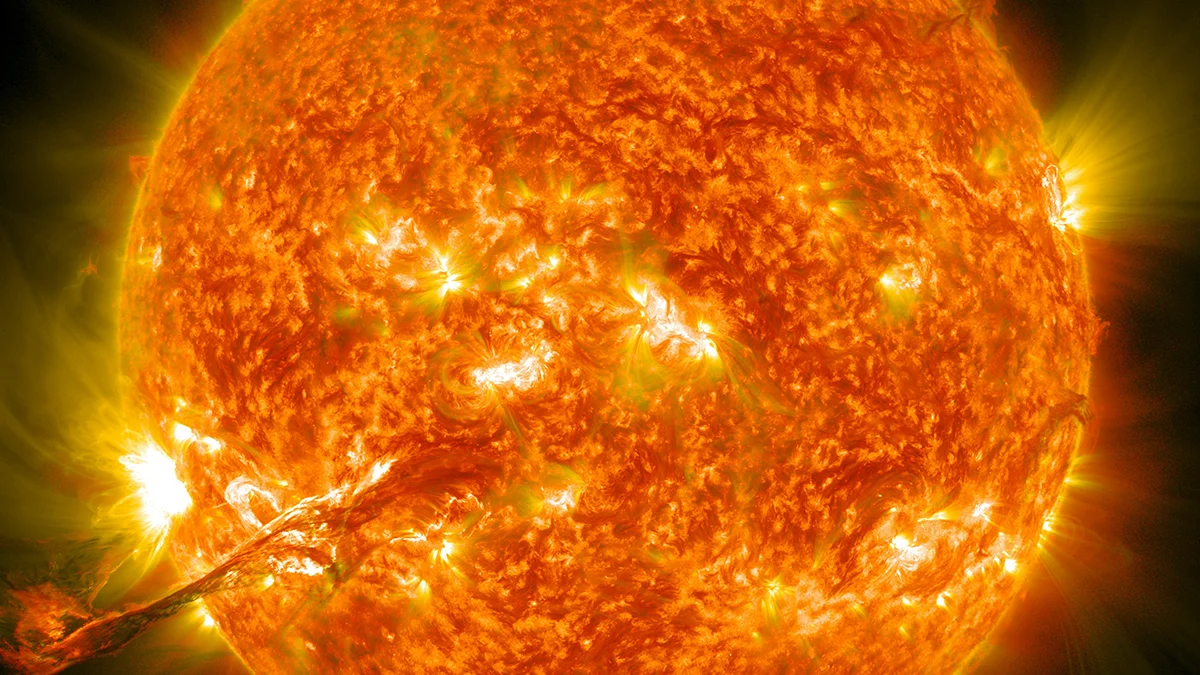
The curious case of the solar system's missing silver has had scientists scratching their heads for years. Why do ancient meteorite fragments contain much more silver than the Sun, if they were formed at the same time, some 4.6 billion years ago?If they formed at the same time, from the same swirling mass of dust and gas, they should have similar ingredients. Now a study published in Astronomy & Astrophysics from a team of international researchers may have the answer…There's a lot more silver in the Sun than we previously thought.We're only talking a small amount overall, as 98.5 percent of the Sun's mass is made up of hydrogen and helium. However, according to the new calculations, there's 55 percent more silver in our star than past studies had concluded.The researchers studied the spectrum of light coming from the Sun to identify the elements within it. (DrPixel/Moment/GettyImages)The big shift in estimates comes from a much-improved model for interpreting light emitted by the Sun. As this light passes through atoms in the outer solar atmosphere, we can tell what that atmosphere is made of by the way the light gets absorbed, leaving dark features at specific wavelengths, known as spectral lines. Each element leaves its own pattern. Certain elements in the Sun's atmosphere absorb certain colors of light. (NASA)With the help of a supercomputer, this study applies a significantly more detailed, 3D model of the Sun and its light output to reinterpret how silver atoms might behave and might interact with solar rays."With our new model, we were able to interpret the spectral lines used to determine the solar silver abundance more accurately," says astrophysicist Sema Caliskan, from Uppsala University in Sweden.
Scientists May Have Finally Solved The Sun's Missing Silver Mystery
The curious case of the solar system's missing silver has had scientists scratching their heads for years.
683 words~3 min read