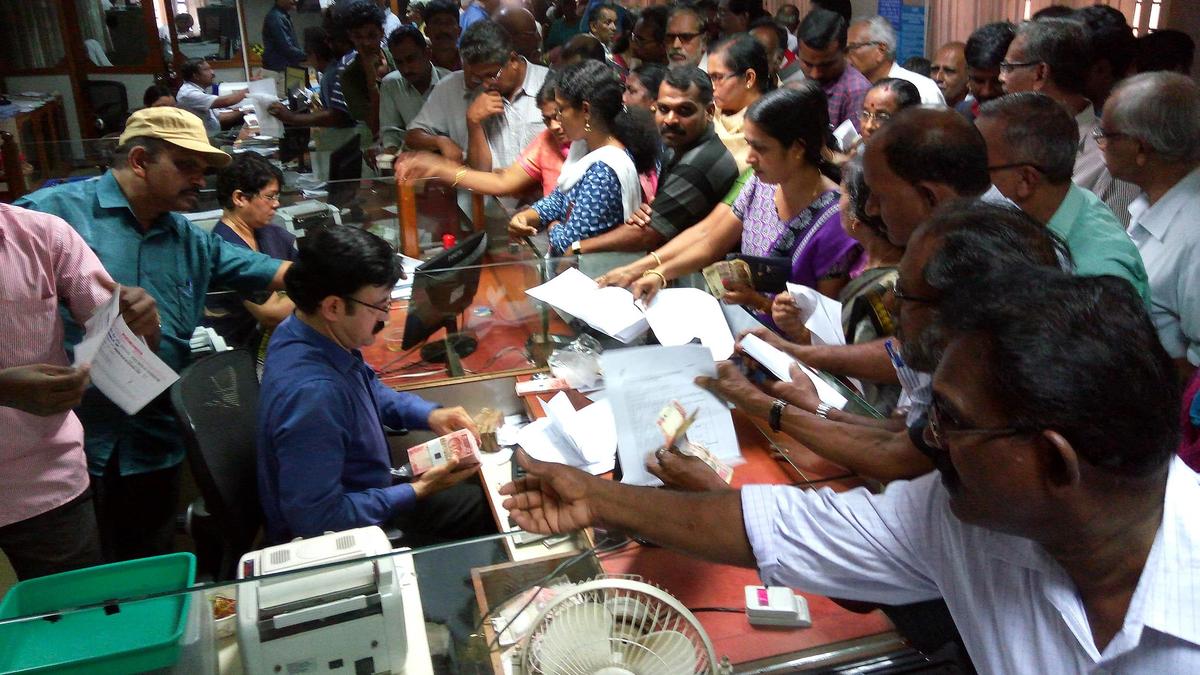
Walk into any bank branch today and notice what the relationship manager is selling. Where once the conversation turned on fixed deposit tenures and interest payout options, it now turns to systematic investment plans, balanced advantage funds, and equity-linked products. The customer is often the same: a retired professional, a government servant’s widow, a small trader parking a lump-sum. The instrument has changed, the risk has changed; whether the customer has changed is the question this column asks.Something quiet and consequential is happening to India’s savings. For decades, the fixed deposit was the household’s instrument of choice, offering certainty in a country where certainty was scarce: a known rate, a known maturity, principal that stayed where it was placed. The deposit base it built was the foundation on which credit flowed to farms, factories, and homes , some of the key priority sectors of the economy. That narrative is now shifting.The RBI’s data for the year ending 2025 is unmistakable: household bank deposits fell nearly 9 per cent to ₹12.54 lakh crore, small savings (excluding provident and pension funds) fell by nearly a quarter, and life insurance fund investments dropped 17 per cent. Mutual fund AUM has grown at a CAGR of 21.9 per cent over five years, crossing ₹81 trillion by May 2026, while annual SIP inflows crossed ₹3 trillion for the first time in 2025, across nearly 10 crore active accounts, most opened after 2020.This shift is presented as the democratisation of Indian capital markets, and the claim has merit. The equity culture of the past decade has created real household wealth, deepened capital markets, and cushioned India against foreign portfolio swings, as in 2024-25, when domestic SIP flows offset large FPI outflows as earlier generations of investors could not. These are genuine gains. But they do not constitute the full picture, and the parts left out deserve serious attention.A bank’s credit-deposit ratio measures the proportion of deposits deployed as loans. The RBI’s historically comfortable range is 75 to 80 per cent. As of February 2026, the system-wide ratio stands at 82.4 per cent, above that ceiling, and the incremental credit-deposit ratio crossed 100 per cent in mid-March 2026, meaning every new rupee deposited was immediately deployed as credit.The mechanism is straightforward: when banks cannot grow deposits in line with credit demand, they compete for funds at higher cost, which passes through to lending rates for home loans, MSME credit, agriculture, and infrastructure. A household that shifts savings from an FD into a balanced advantage fund has made credit marginally costlier for another household borrowing for a home; private decisions aggregate into system-level consequences invisible at the point of choice.The inexperience problemThe more immediate concern is behavioural. The Indian equity bull run has been, with brief interruptions, a 20-year phenomenon. The cohort now holding those 10 crore SIP accounts entered largely after 2016, and in very large numbers after 2020. They have been told, accurately for their own experience, that staying invested through volatility is the correct response. That advice has never been tested against a sustained, multi-year bear market.India’s own market history offers a domestic warning: the Nifty 50, adjusted for inflation, delivered negligible real returns between 2000 and 2013, thirteen years in which a retiree’s gratuity invested at the peak would barely have kept pace with prices. Similar episodes have occurred elsewhere.The evidence from India’s shorter stress events confirms the pattern. In July 2020, as the Nifty recovered from its Covid lows, equity mutual funds saw their first net outflows in four years, a five-month run totalling nearly ₹23,000 crore: investors had bought the dip and exited at breakeven. SIP discontinuations rose 30 per cent year-on-year in 2022, one cancellation for every two new registrations. The Israel-Iran conflict of May 2025 pushed inflows to a 13-month low while redemptions surged to ₹37,591 crore; the US-Iran tensions of May 2026 repeated the pattern, with SIP fatigue becoming visible.These are corrections of 5 to 15 per cent over weeks or months, not prolonged bear markets. The question that does not get asked clearly enough is what this behaviour looks like when the drawdown is higher and persists for months rather than weeks.Among the investors most exposed are retirees and those approaching retirement. The fixed deposit suited this group because it matched their condition: no replacement income, fixed expenses, and principal preservation as the only priority. Inflation eroded real returns, but the principal was safe and the income was predictable. As FDs became less attractive, through low rates, tax treatment favouring equity, and active branch distribution, this group was redirected towards instruments carrying equity risk. Business Standard has documented aggressive hybrid funds, with equity allocations above 65 per cent, sold to retirees on promises of monthly dividends of 11 to 12 per cent; when dividends were cut after corrections, outflows were sharp. The retiree who exits at breakeven does not return to equity, nor does the money return to bank deposits; it sits idle in liquid funds, building neither the deposit base nor equity compounding. The loss is not merely financial. It is the permanent displacement of a saver from every productive instrument.The argument is not that equity markets are dangerous or participation misguided; over 15-year horizons, equity has compounded wealth in India as no other instrument has. The argument is narrower: equity without a foundation of safe, liquid, predictable instruments is a structure without load-bearing walls.The fixed deposit, the PPF, the Senior Citizens Savings Scheme, the post office monthly income scheme: these are not relics. They are shock absorbers. A portfolio that treats them as inferior because their nominal returns trail five years of equity performance has confused a favourable cycle with a permanent condition. Markets are cyclical; expenses are not. An investor who cannot hold through a 40 per cent drawdown should not be 70 per cent in equity, whatever a SIP calculator suggests for a 20-year horizon.India’s regulators have, to their credit, flagged valuation concerns in small and midcap funds and ordered liquidity stress tests. These are necessary, but the larger question, whether savings migration from deposits to equity has outpaced investor preparedness, warrants wider policy attention: deposit taxation parity, incentives facing bank relationship managers who distribute mutual funds, and suitability norms for those entering market-linked products late in their earning lives.The fixed deposit did not die a natural death. It was made progressively less competitive by policy and distribution incentives alike. What replaces it carries risks the system has not prepared its newest participants to absorb. That gap, between financial inclusion and financial literacy, is where the next crisis, if it comes, will find its opening.Kumar is former Managing Director, and Sudhakar is former Executive Director, LIC. Views are personal. All data are drawn from publicly available sourcesPublished on August 1, 2026
The vanishing deposit base
India’s celebrated migration from fixed deposits to equity mutual funds carries systemic risks that neither policymakers nor investors have fully reckoned with
1,127 words~5 min read