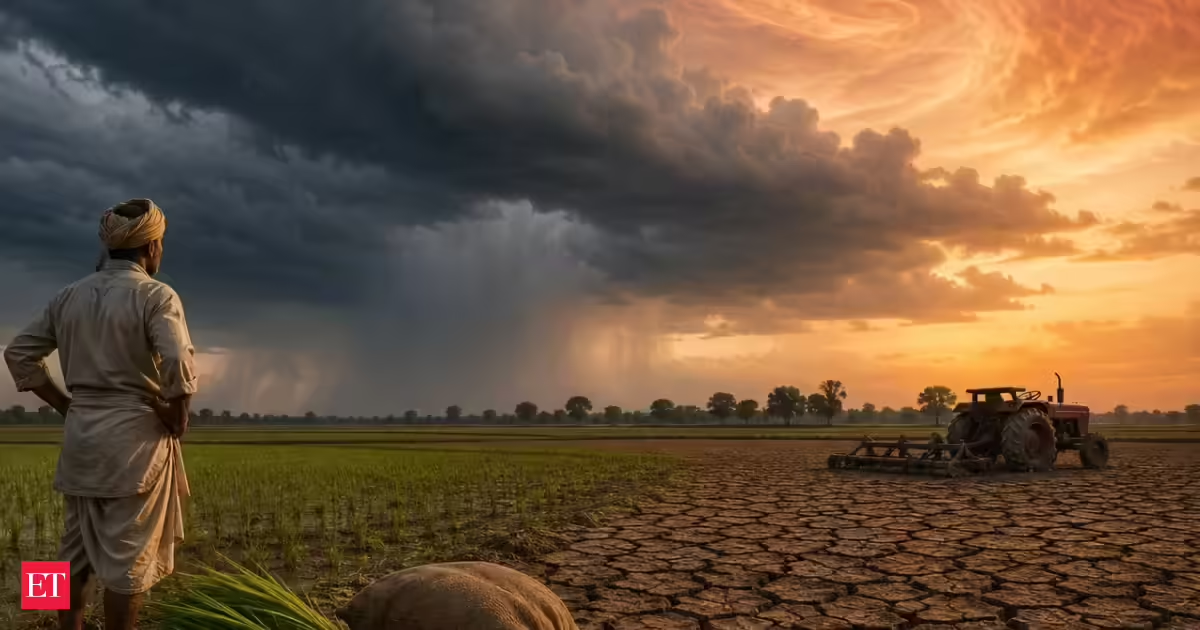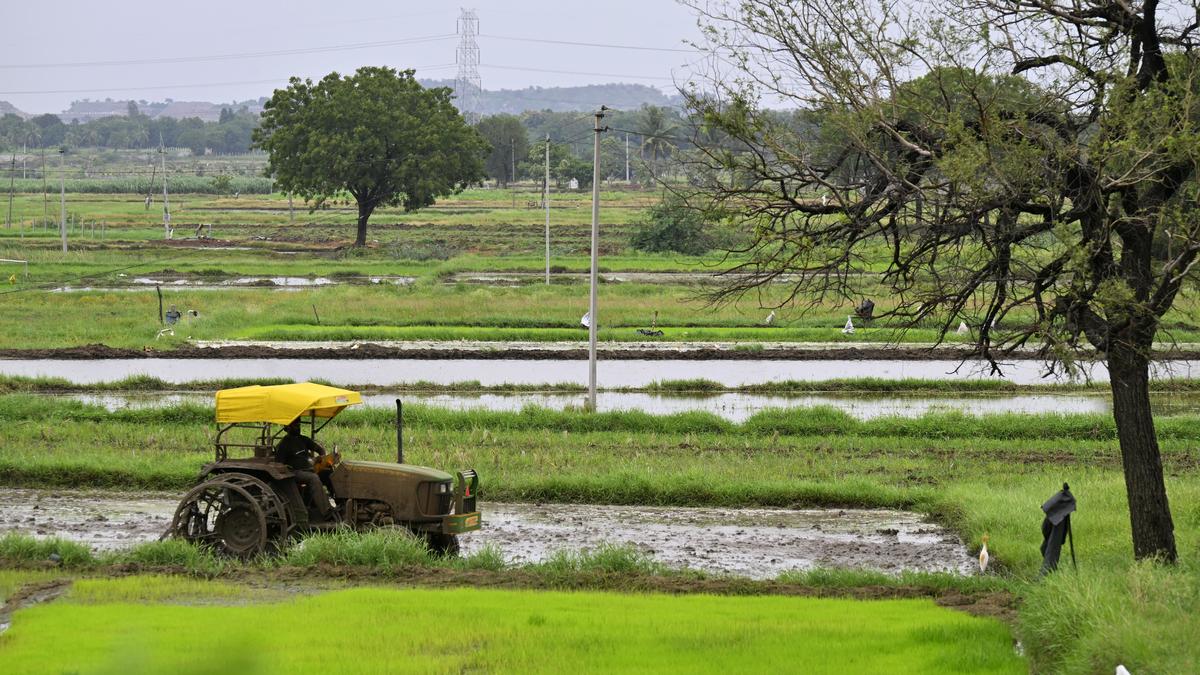
A farmer ploughs a paddy field on a tractor on the outskirts of Hyderabad on Thursday, July 23, 2026. El Niño conditions have weakened the southwest monsoon this year, leading to a severe rainfall deficit across the state.
| Photo Credit:
An uneven spread of the South-West monsoon is causing concern in India despite a one per cent above-normal rainfall in July making up to some extent for the 37 per cent deficient rain in June.The situation looks a little worrisome with the India Meteorological Department (IMD) predicting below-normal rainfall in August. As of July 31, the monsoon was 13 per cent deficient. The non-linear spread of the rain could affect kharif crop prospects. According to IMD, 16 States that account for 36 per cent of the country’s geographical area have reported deficient rainfall till now. These States include Uttar Pradesh, Andhra Pradesh, Karnataka, Jharkhand and Bihar, which are key to the country’s kharif production. Haryana and Punjab, too, have received over 25 per cent deficient rain, but they could be bailed out as they are States that are well irrigated.The linear distribution of rainfall has been lacking within States too. This will likely impact the crop situation during the kharif season. 24-hour effectIn Maharashtra, for example, districts such as Nagpur, Satara, Raigad, Ratnagiri and Sangli have received normal or excess rain. On the other hand, Solapur, Latur, Nanded, Amravati, Gadchiroli and Chandrapur districts have received below-normal rain. Some of these, such as Latur and Solapur, hold the key to a good pigeon pea (arhar) crop. KS Hosalikar, former head of climate research and services, IMD Pune, wrote on X (formerly Twitter) that one powerful spell of rainfall between July 30 and 31 changed the entire rainfall situation in 24 hours. With the system being active, other parts of the state could get rain.In Karnataka, Hasan, a key agrarian region, has received 60 per cent below-normal rain. Other regions important for kharif production such as Tumkur, Mandya and Dharwad have received deficient rainfall. On the other hand, Raichur, Bidar and Belgaum districts have received normal rainfall.A similar phenomenon is being witnessed in other States such as Gujarat, Andhra, Telangana, Madhya Pradesh, Uttar Pradesh and Rajasthan, all key contributors to agricultural production.Opting for short-duration cropsTwo farmers from Maharashtra, Shankarrao Narekar and Sandeep Shamrao Vinde, told businessline that the State received no rainfall until early July. With the monsoon making up in July, farmers may opt for short-duration crops, which could be nutri-cereals. According to the Agriculture Ministry, the area under all kharif crops was 787.37 lakh hectares (lh) as of July 24, some 5 per cent lower than 826.19 lh in the year-ago period. It was, however, far better than 21 per cent as of July 5.The sowing of crops has been affected in Madhya Pradesh, Maharashtra, Haryana, Bengal, Gujarat, Chhattisgarh, Karnataka, Tamil Nadu, Rajasthan, Telangana, Uttar Pradesh. Rice, pulses, nutri-cereals and oilseed coverage has been affected in these States due to the monsoon’s spread being uneven. Published on July 31, 2026