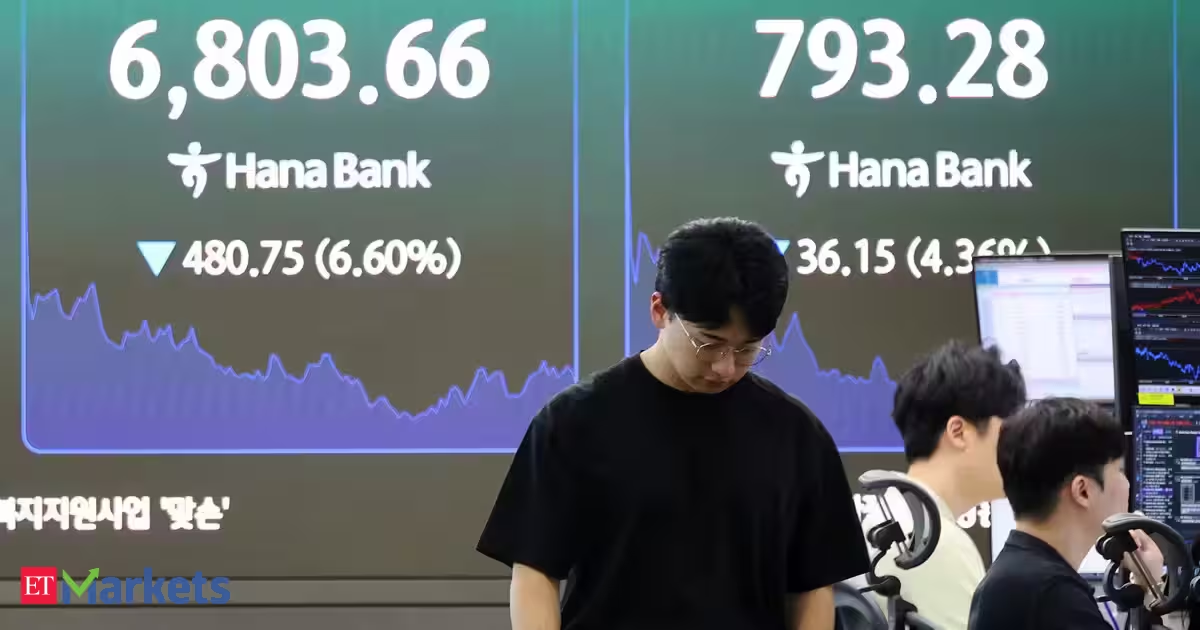
South Korea’s benchmark Kospi index is highly concentrated, with semiconductor giants Samsung Electronics and SK Hynix together accounting for over half of its total market capitalisation
A large section of domestic market participants has been anxious about recent developments in the Korean stock market. While many had watched with envy as Korean equities rallied relentlessly while Indian markets remained subdued, they are now breathing a sigh of relief as the tide has turned and Korean stocks have come under pressure.One important reason Indian markets have remained relatively calm is that they do not have a meaningful cohort of AI-focused stocks, sparing investors the extreme volatility witnessed in markets where AI has become the dominant investment theme.South Korea’s benchmark Kospi index is highly concentrated, with semiconductor giants Samsung Electronics and SK Hynix together accounting for over half of its total market capitalisation. Fearing they would miss out on the AI rally, Korean investors piled into leveraged products such as single-stock 2x ETFs. When the share prices of these companies fell, these funds were forced to sell to rebalance, which, in turn, deepened the decline, leaving a big hole in Investors pockets.South Korea’s Finance Minister was forced to apologise after single-stock leveraged ETFs caused significant losses for retail traders and the regulator introduced several measures, including curbs on retail exposure to high- risk products.While significant turbulence was seen in overseas markets, Indian stock markets remained comparatively steady, thanks in large part to the market regulator, SEBI.SEBI measuresOver the past few years, the Securities and Exchange Board of India (SEBI) has introduced a series of proactive and reactive measures to safeguard market integrity. One decision that deserves particular appreciation is its choice to disallow leveraged single-stock ETFs, thereby avoiding the excesses witnessed in some global markets.After studies conducted during 2023-25 showed that over 91 per cent of individual investors were losing money in the derivatives market, SEBI responded with a series of regulatory reforms. These measures include raising the minimum contract value for single-stock F&O, increasing margin requirements for index derivatives such as the Nifty and Bank Nifty, tightening market-wide position limit norms, and replacing simple notional open interest with delta-adjusted (FutEq) open interest as the benchmark for measuring market exposure.Following the Jane Street episode — in which the firm, according to SEBI, made profits exceeding ₹36,500 crore ($4.3 billion) through index options and derivatives trading — the regulator tightened the rules on index weights.The new eligibility framework for derivatives on non-benchmark indices — sectoral or thematic indices that track specific industries or segments rather than the broader market — requires at least 14 constituent stocks, with the largest stock’s weight capped at 20 per cent and the top three together not exceeding 45 per cent.The objective of the rule is to reduce concentration risk and promote greater diversification in the derivatives market. This is particularly relevant for indices such as the Bank Nifty, where HDFC Bank and ICICI Bank together accounted for over half of the index’s weight, allowing movements in just two stocks to exert a disproportionate influence on the index and increasing the risk of manipulation.Closing auctionSEBI will introduce a closing call auction mechanism for F&O stocks from August 3 to improve price discovery at the close. By introducing the Closing Auction Session (CAS), the regulator has strengthened the integrity of the closing price. Instead of being swayed by a few trades placed just before the closing bell, the final price will better reflect the market’s collective buying and selling interest.Although these measures can reduce systemic risks arising from excessive leverage, retail investors must also do their part. They should evaluate how their portfolios would perform under adverse scenarios — such as a global risk-off environment, a slowdown in AI-driven capital spending, or a sharp FII sell-off — and resist the temptation to use excessive leverage. Equally important is maintaining realistic expectations and recognising that markets do not move in a straight line and that periods of volatility are inevitable.Published on July 31, 2026