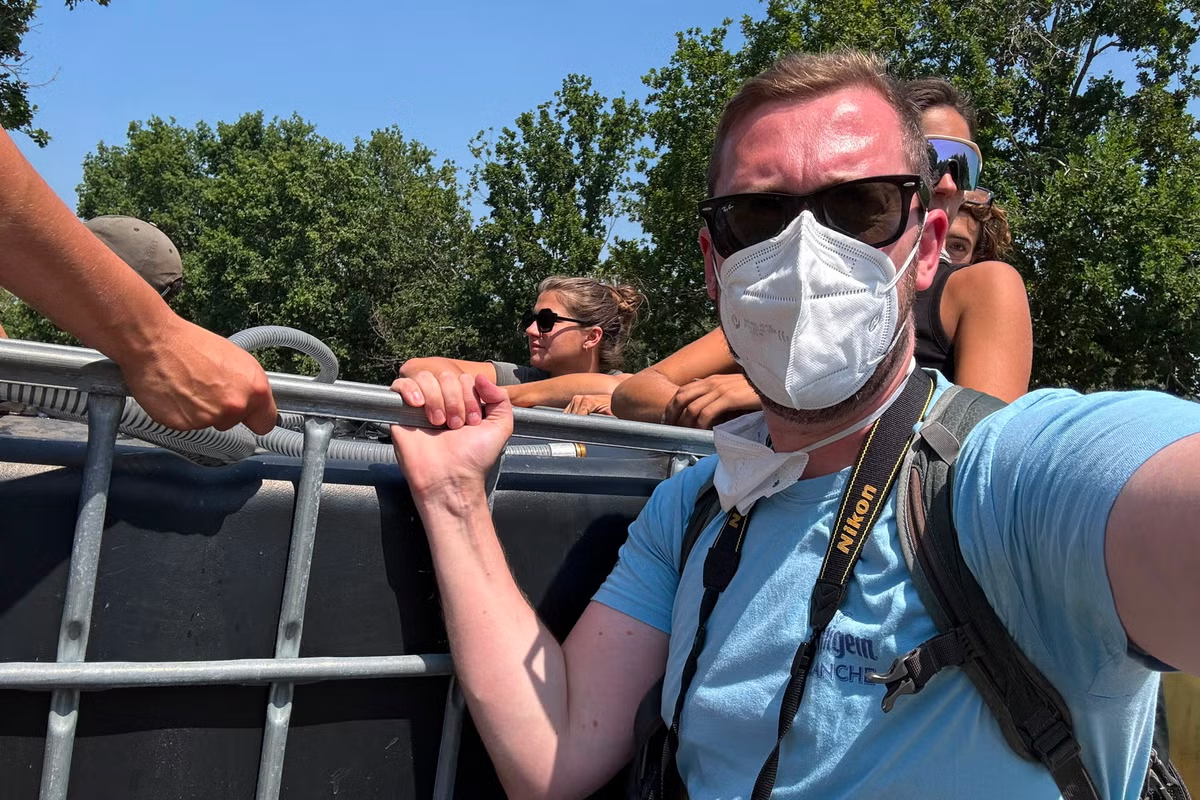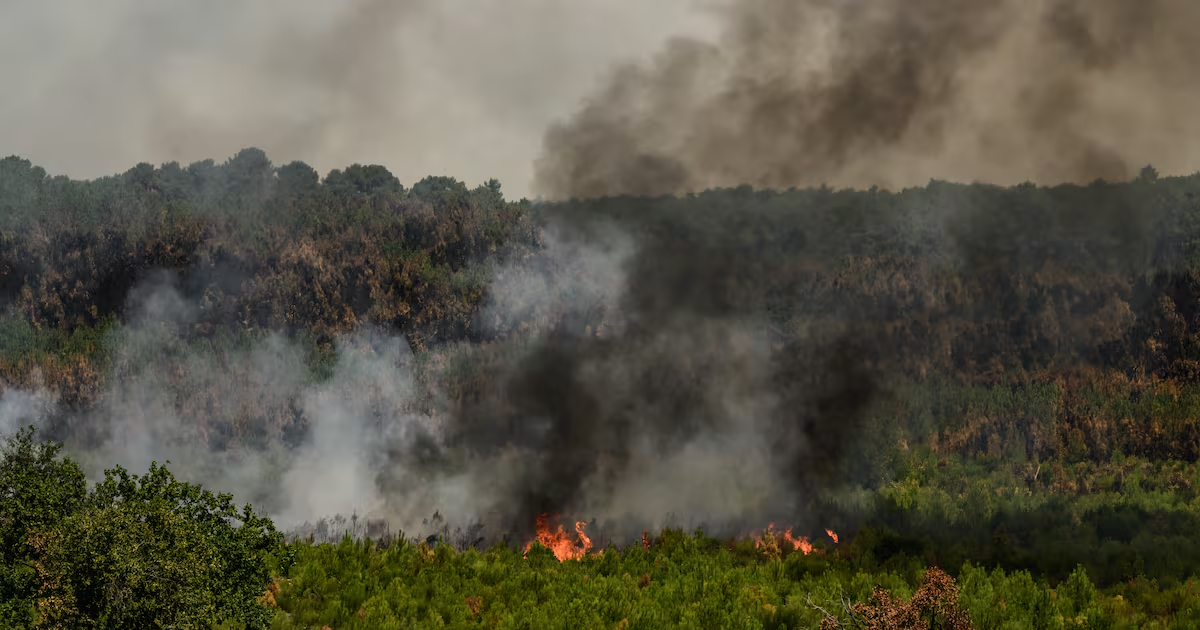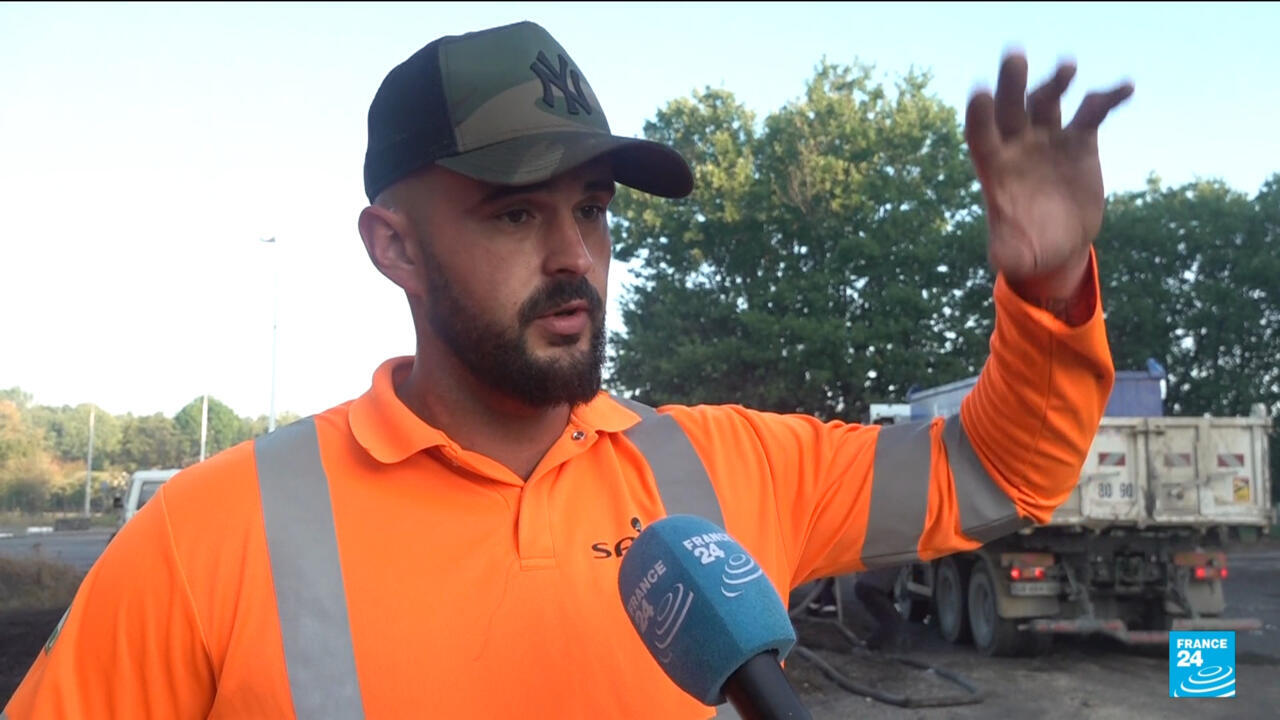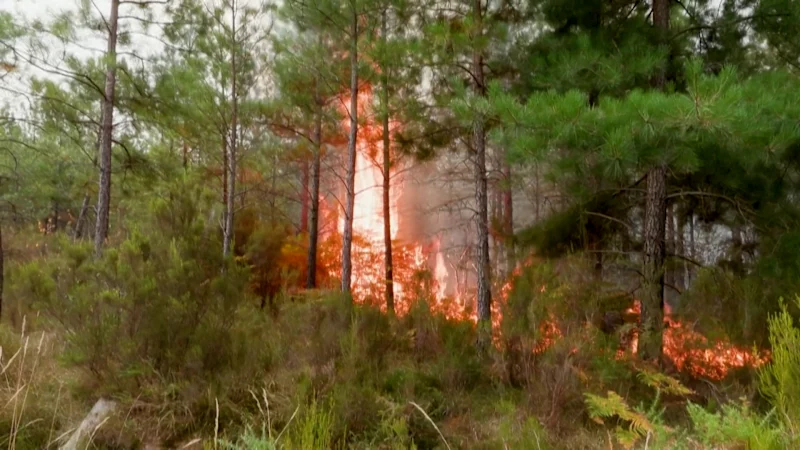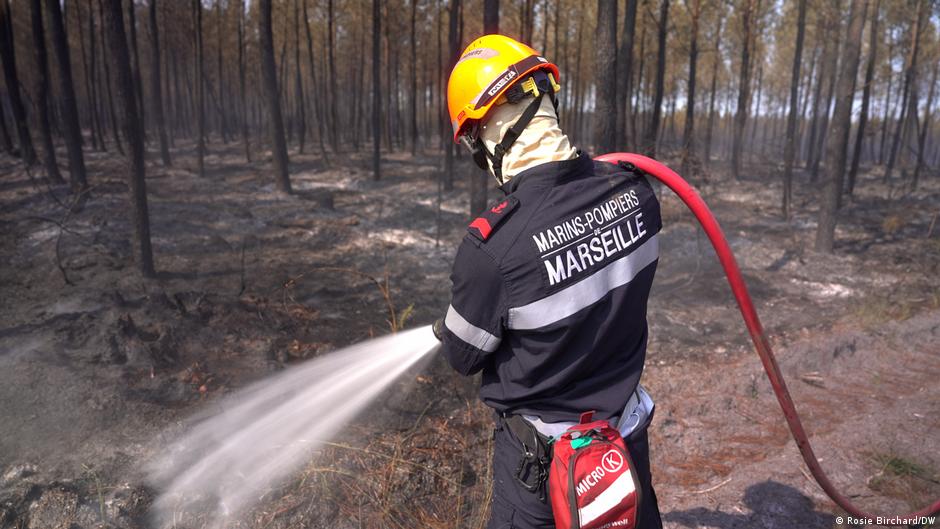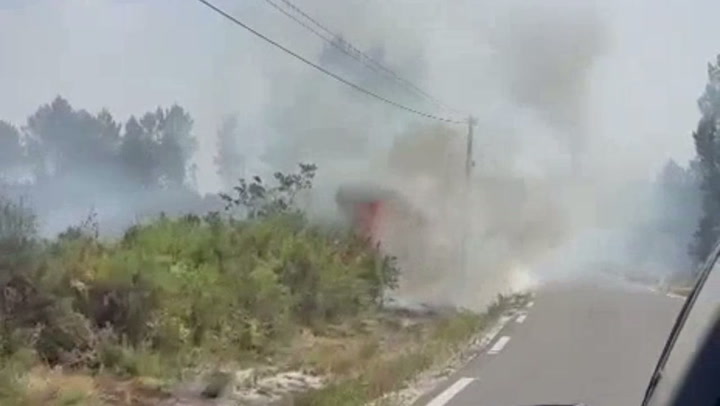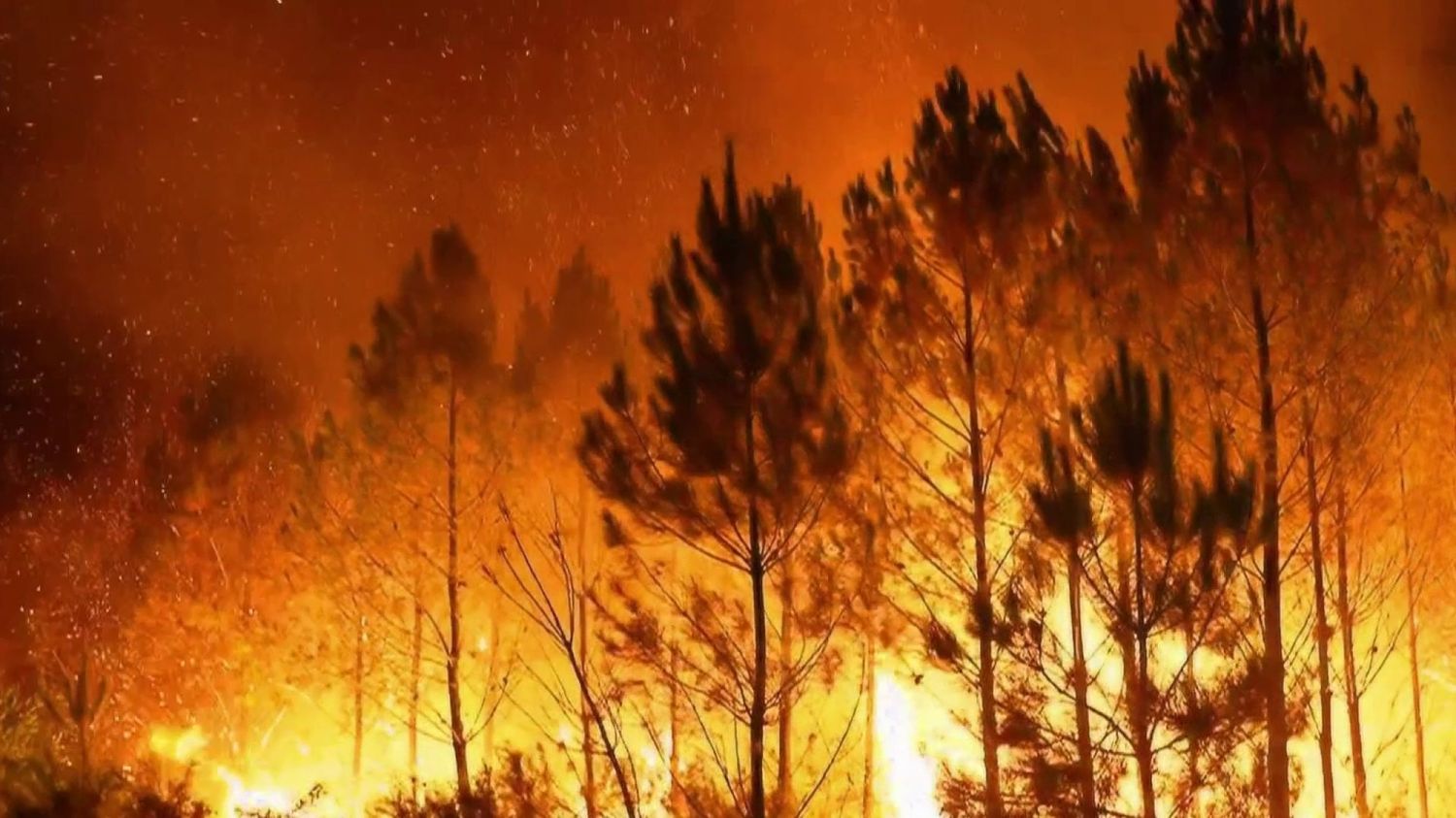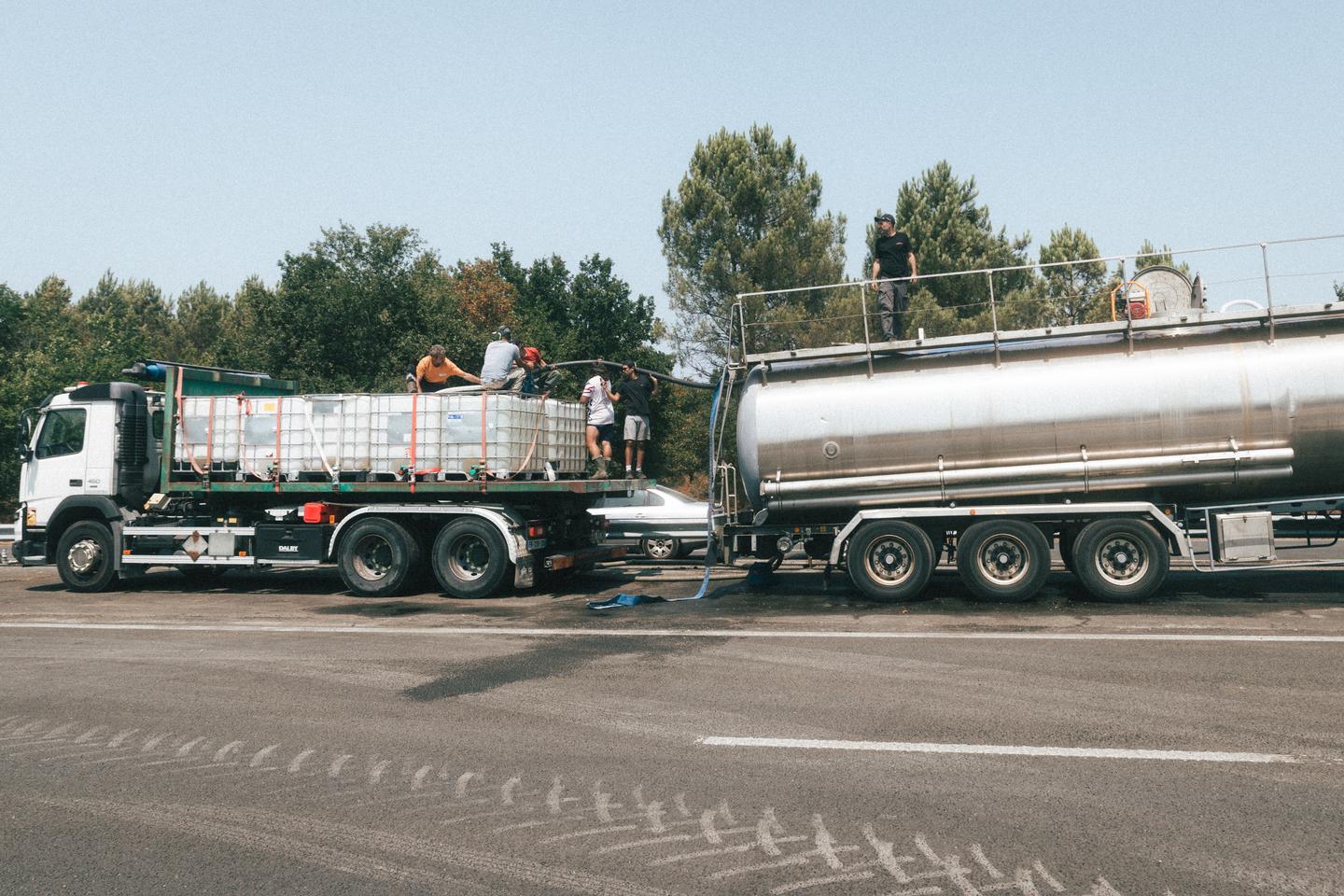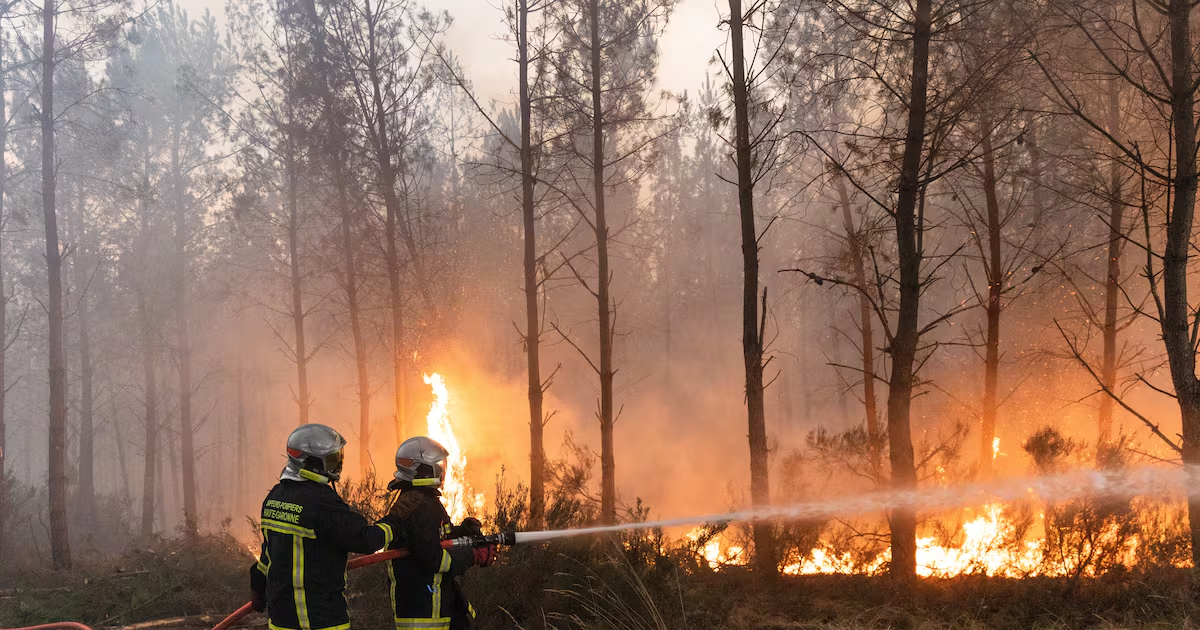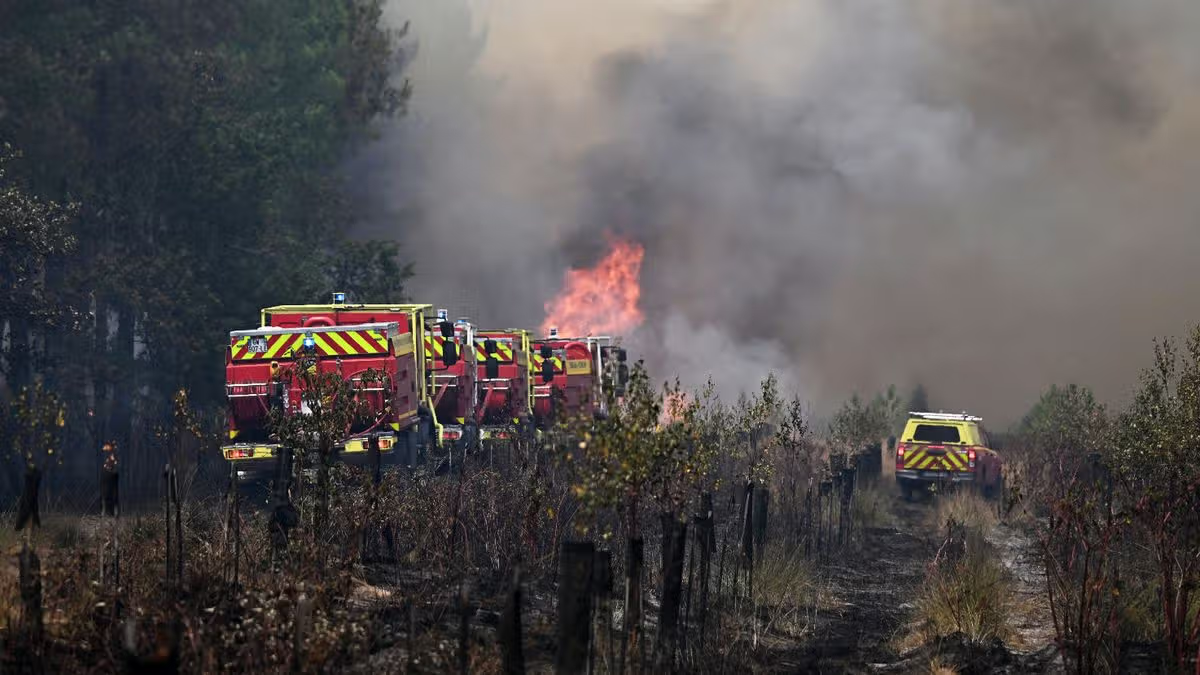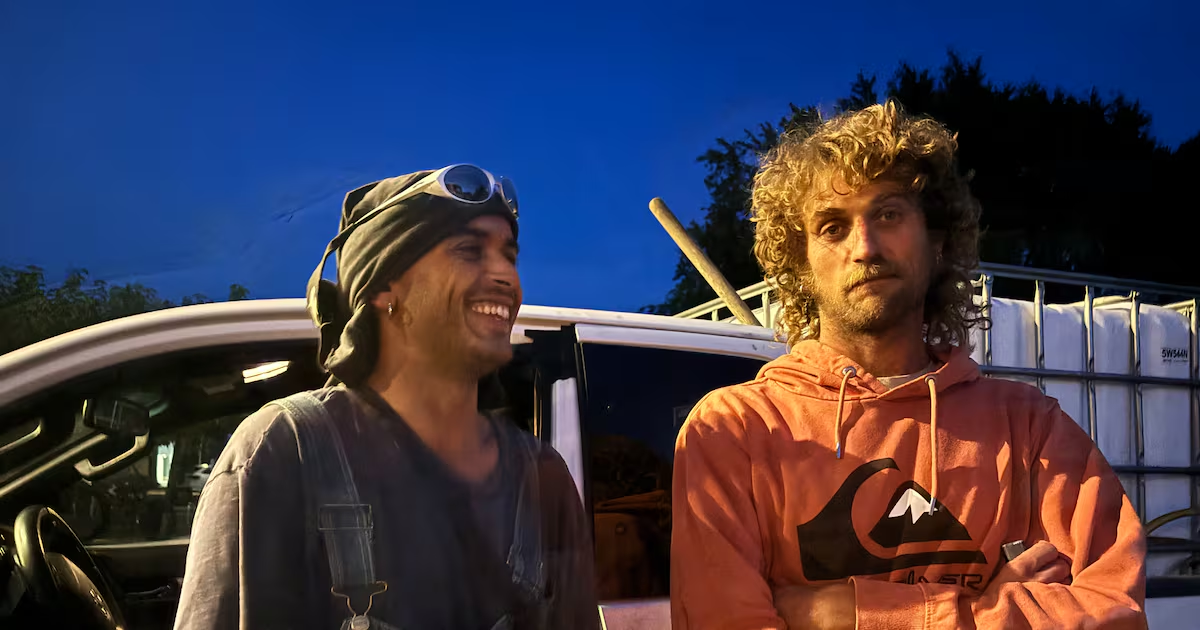
“On the left!” The shout goes up. The two lookouts riding beside the water tank on the back of the pickup truck have spotted a fire flaring in the undergrowth of the scorched and smouldering forest outside Bordeaux.This is the third night that this team of volunteer firefighters – local surf instructors David Tirel and Martin Leroy, carpenter Charles Prat, and retail worker and army reservist Fiona Galaup – have worked until dawn patrolling the ashen and smoky forest tracks to hunt out flare-ups like this one.They jump out of the truck and rush to put out the fire with spades, a makeshift fire hose and watering cans, working by the light of torches and truck headlights, their efforts sending steam and smoke rising into the darkness.“It’s like the night watch. To see if something’s burning again,” Prat (36) explains. “We put water on it and we alert, and if it’s too big we call the firefighters. So we are basically the first to have a look, and if it’s too big they come after. So that’s what we do basically all day long.”Surf instructors David Tirel and Martin Leroy with the pickup truck loaded with water they have been using to fight fires. Photograph: Naomi O'Leary A firefighter uses a metal drip torch to ignite controlled fires in a forest in Le Porge. Photograph: Philippe Lopez/AFP via Getty Images “It’s pretty DIY,” he laughs.They are part of huge volunteer firefighting efforts that have been crucial to getting the largest fire in recent French history under control.Normal life came to a halt here when the fire began raging a week ago, and a surge of volunteer spirit took hold among the mass of locals who suddenly found themselves without work.“I think a lot of people felt: we have to do something,” says Leroy (35). “It’s way harder to feel like you stay home and don’t do anything.”The fire started close to Lacanau, Galaup’s hometown in the forest that runs along the coastline west of Bordeaux, and it developed into an uncontrollable firestorm as it fed on dry pine forest plantations, burning down 183 homes in a neighbouring village.[ The French coastal village where wildfires have claimed 183 homesOpens in new window ]“The fire started right beside us. There were no firefighters in this part of Bordeaux at that point. All of Lacanau started fighting the fire, with two policemen and no firefighters. That’s how the volunteering started,” explains Galaup (24).People in the area with large social media accounts began posting about volunteering efforts, and the response came from miles around: farmers bringing tractors to create firebreaks, off-work builders offering machinery. An army of volunteer medics and caterers formed to keep them all looked after and fed.Locals were determined to stop the fire advancing any further. “If the fire starts burning after Lacanau, everything is going to burn down,” explains Tirel (30), who saw the first smoke rising as he gave surf lessons on the nearby beach.A fire breaks out in a forest in Lanton, near Bordeaux. Photograph: Pierre Crom/Getty Images Local surf instructor David Tirel, who has become a volunteer firefighter, prepares for the night shift. Photograph: Naomi O'Leary Galaup wounded her hand putting out a fire and now sticks to the role of navigator, sitting shotgun while following the WhatsApp volunteer co-ordination groups and directing Tirel while he drives. “It’s very hard to see our forest go up in smoke, the forest that gives us oxygen,” Galaup says.“People lost their homes, animals lost their home as well. There are pictures of them, surrounded by ash, with no food and water. A whole food chain has been destroyed.”[ EU weather records broken as multiple countries battle to contain wildfiresOpens in new window ]The lookouts spot another smouldering patch and Tirel drives the truck into a forest clearing to get close to it. As they are occupied with one blaze, another area of vegetation suddenly ignites 20 metres away.“Even if you think the fire is out, underneath the roots can be burning,” Prat says. Patches of the forest are completely burned and others are still green. It is evident that the monoculture pine plantations burned like tinder, while the forest’s naturally seeded oak trees were much more resistant.Running on adrenaline and coffee, the team has been working through the night each night until 6am, sleeping for a few hours, and then starting again.“Tomorrow is going to be the same thing, and the next weeks, and the next months also,” Tirel says.“It feels really good after Covid, with everything that’s happening in the world, to have a bit of solidarity.”Even as their hometowns come to terms with the fire’s devastating toll, the volunteers feel heartened and inspired by the fight that brought them together.“I feel good, useful in my place, proud to be part of something,” Prat says. “We’re friends for like 15 years, and this was the time to do this, to stick together and to protect the land.”Workers cut down pine trees overnight to create a firebreak along a road in an effort to prevent a nearby wildfire from spreading in Martignas-sur-Jalle, France. Photograph: Pierre Crom/Getty Images
‘We couldn’t just stay home’: On night patrol with volunteer army fighting Bordeaux wildfires
From surf instructors to farmers, residents of France’s Atlantic coast have mobilised to help stop the country’s largest wildfire reigniting
857 words~4 min read