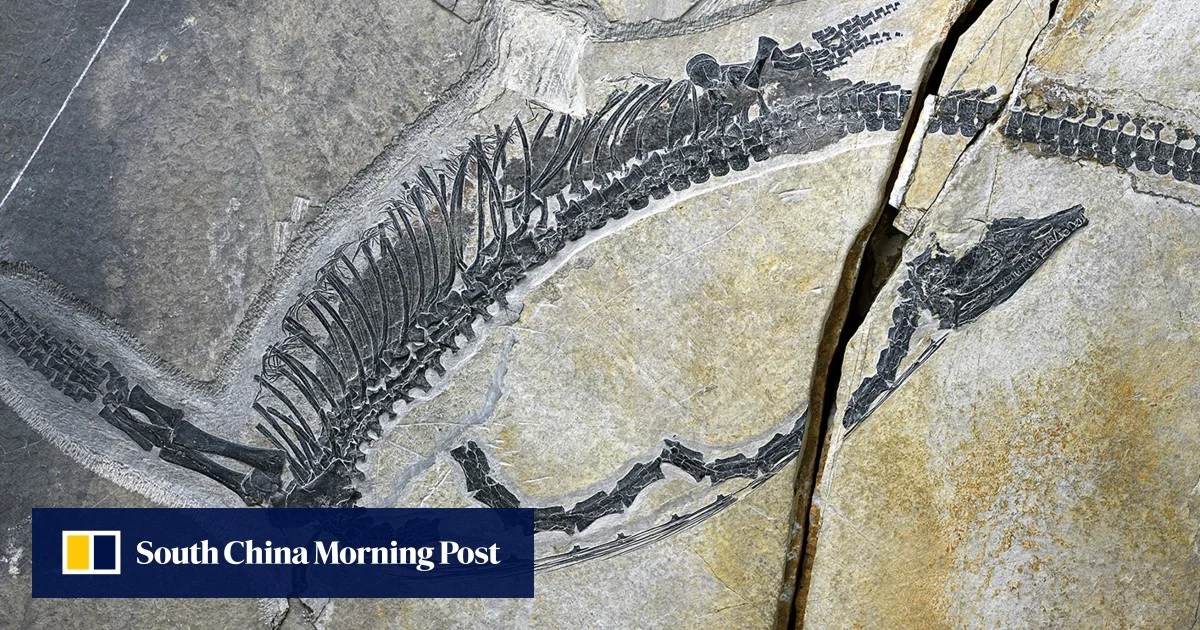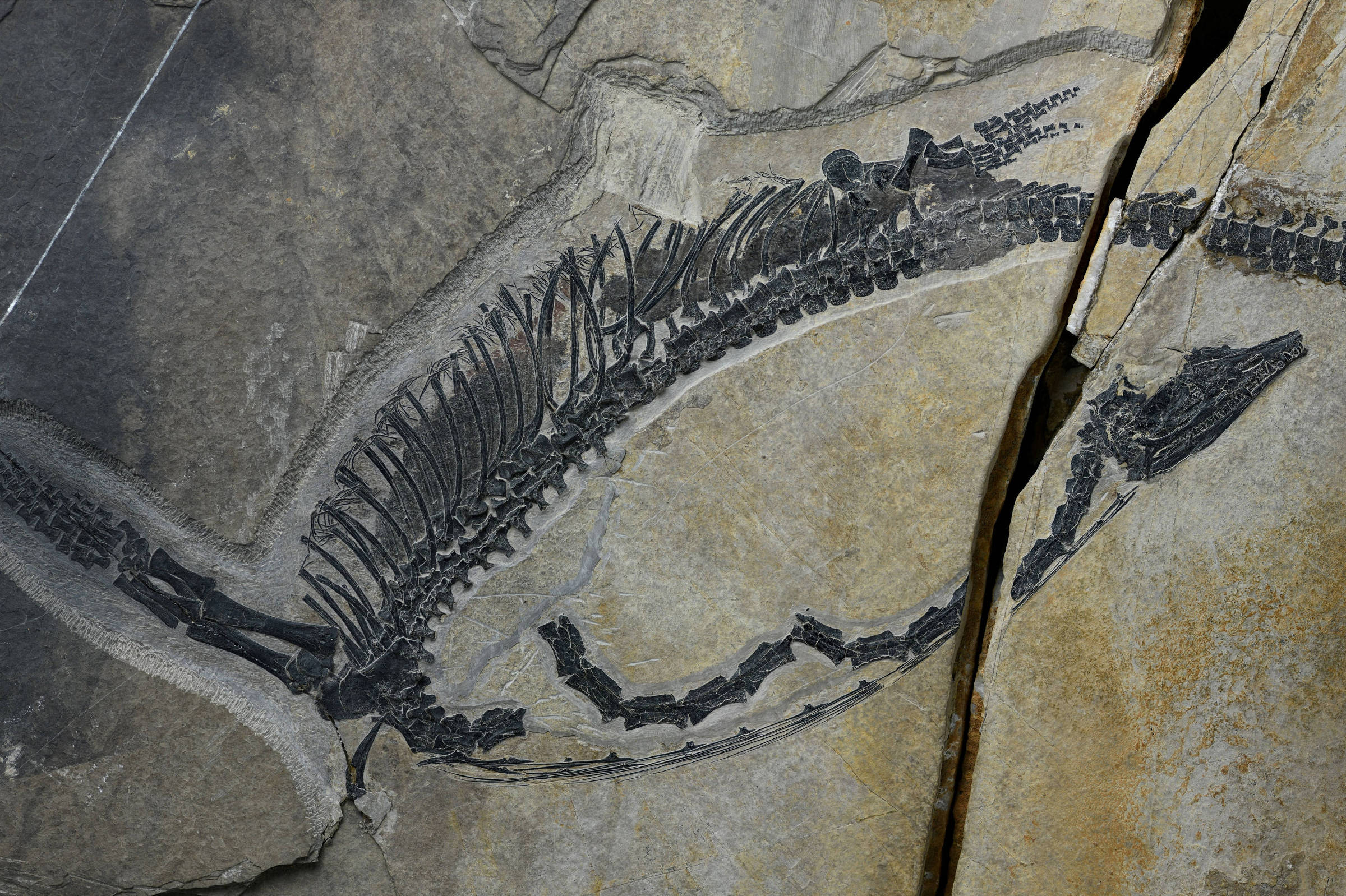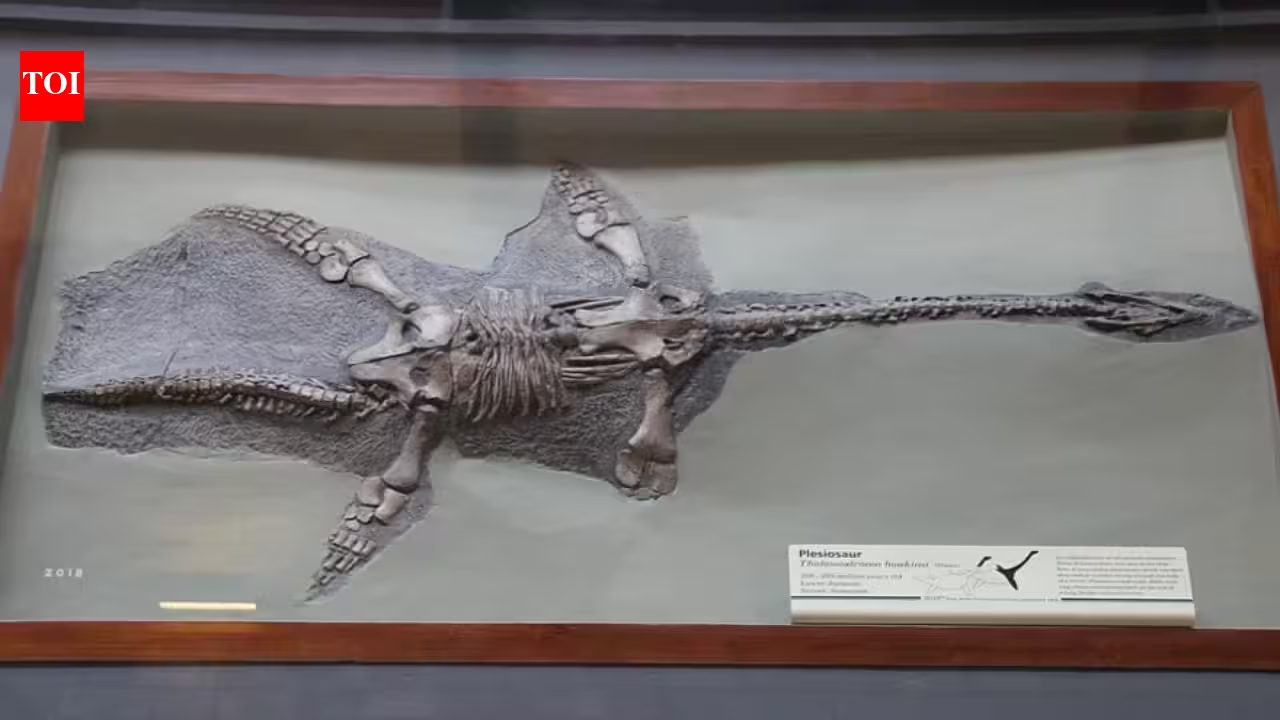
Plesiosaur Skeleton, Credits – Wikimedia CommonsIn China, a small marine reptile died 245 million years ago with a fish still working its way through its gut. That last meal and the digestive system around it survived fossilisation almost intact, giving scientists a rare look at how one of the earliest ocean-going reptile lineages digested its food.According to a press release from the State Museum of Natural History Stuttgart, an international research team described a fossil of the long-necked marine reptile Austronaga minuta, and the specimen turned out to be unique in multiple ways at once. The full findings were published in the journal Science Advances, named "Highly aquatic marine stem archosaur with soft tissue preservation.” Despite measuring only 60 centimetres long, the animal had a long neck and tail, and it was clearly well adapted to aquatic life, using its tail for propulsion and its elongated, fin-like front legs for steering. Its hind legs were reduced and barely useful for swimming. What makes this especially surprising is that Austronaga is not closely related to other famous marine reptiles like ichthyosaurs or giant mosasaurs that also swam this way. Instead, it belongs to the archosaur lineage, the same broad group that includes crocodiles and dinosaurs, a group scientists previously believed had only limited adaptations to ocean life.The oldest largely full digestive tract ever found in a reptileBetween the fossil's ribs, researchers noticed a dark patch that turned out to be a nearly intact digestive tract. Using UV light photography and mass spectrometry, the team identified several organs clearly for the first time in a fossil this old. Dr Wei Wang, the study's lead author at the Institute of Vertebrate Palaeontology and Palaeoanthropology in Beijing, described a large sac-like stomach at the front of the tract and a red liver with traces of haemoglobin. Behind that sat a long, simple tube forming the small and large intestines. Wang noted that despite the animal's highly specialised body shape, its internal organs looked comparatively unmodified, a simple, straightforward digestive plan rather than anything unusually complex.Plesiosaur Skeleton with Mary Anning Story, Credits – Wikimedia Commons What the simple gut reveals about how digestion evolvedDr Nick Fraser of the National Museums Scotland, one of the study's coauthors, pointed out a detail that matters for understanding how digestion evolved. Today's birds and crocodiles, both modern relatives of Austronaga's broader lineage, have a two-part stomach. Austronaga had only a single stomach chamber, suggesting that this more complex, two-part structure evolved later in archosaur history rather than being present from the start. Fraser also noted that the animal's short, uncomplicated gut closely resembles the digestive tract of modern fish-eating reptiles, consistent with the fish remains found preserved inside it. Dr Stephan Spiekman, a coauthor and specialist in long-necked marine reptiles, said the discovery shows that early archosaur relatives had already developed complex adaptations for ocean life, comparable to those seen in better-known marine reptile groups.Why one fossil matters for the bigger picture of reptile evolutionThe research team behind the discovery includes scientists from institutions across China, the United Kingdom, Germany, the United States, and Switzerland, reflecting the international collaboration needed to interpret a single, exceptionally preserved fossil like this one. The study describes the find as part of a broader effort to understand the early history of modern reptile groups and how diverse they had already become in the seas of the Triassic period, the geological era that followed a major mass extinction in Earth's history.Long-necked marine reptiles were not especially rare in this region during the Triassic, and several other species have been recovered as fossils over the years. What sets Austronaga apart is how much of it survived, preserving not just a skeleton but organs and a final meal. Researchers say they hope future fossil finds from the same region will reveal even more about how marine reptiles and their surviving relatives on land evolved during this critical stretch of prehistoric time.
A 245-million-year-old marine reptile fossil in China preserves a rare digestive tract, possible liver traces and remains of its last fish meal
In China, a small marine reptile died 245 million years ago with a fish still working its way through its gut. That last meal and the digestive system around it survived fossilisation almost intact, giving scientists a rare look at how one of the earliest ocean-going reptile lineages digested its food.
655 words~3 min read