Medieval Conditions”
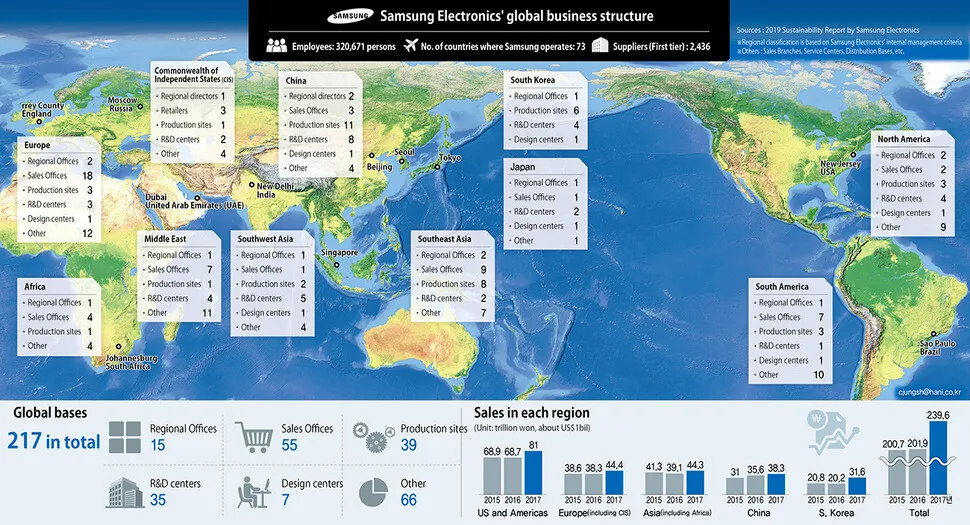
International standards about how companies are handling human rights are changing. The leaders of the G20 countries recently released a declaration about a “sustainable global supply chain,” while there’s a campaign in European countries such as France and Finland to pass laws that would require companies to guarantee comprehensive labor rights in overseas production facilities. Such countries intend to aggressively intervene in multinational firms’ transnational exploitation of workers. For Samsung’s global business model to be sustainable, experts say, a major transformation is needed — retooling systems and bringing attitudes throughout the organization in line with the international focus on bolstering human rights and labor rights at corporations.Transforming corporate standards for human rightsAt the beginning of June, the government of Finland officially announced legislation that would require corporations to conduct “human rights due diligence [HRDD].” According to the Business and Human Rights Resource Centre, Finland will soon begin canvassing the opinions of stakeholders prior to passing the law in question. The Finnish government has also promised to spearhead human rights due diligence legislation at the level of the European Union (EU). Finland takes over its duties as chair of the EU this month.Human rights due diligence is a concept invented by the UN in 2011 to tackle the issue of multinational firms amassing immense wealth by exploiting workers in underdeveloped countries with lax labor regulations and cheap labor, setting up operations that force workers to work for long hours for low wages. While announcing the corporate principles for protecting human rights, the UN asked multinational companies like Samsung Electronics that manufacture products with parts acquired from around the world and then export those products back to those countries to be accountable for ensuring a higher level of human rights through their business management. This principle states that each company has full responsibility to identify and prevent human rights and labor rights infringements that occur in their global supply chain.After the UN declared that companies are responsible for exercising human rights due diligence, several countries in Europe began taking steps to apply this principle to their domestic law. The first was France, which passed a law in early 2017 that required all French-based conglomerates with more than 5,000 employees to perform human rights due diligence and to submit their related plans. Consequently, these companies are required to report violations of labor rights and environmental regulations not only at their headquarters in France but also at factories around the world, and to draft plans for dealing with such violations. If the Finnish government implements this law after the canvassing period, it will become the second country, after France, to make human rights due diligence a legal requirement.“The spread of human rights due diligence legislation through France and other countries of Europe means that human rights-oriented management is moving into the sphere of law-abiding business management. In the future, the question of whether multinational companies are violating human rights in less-developed countries will be an important factor in making their reputation and determining whether consumers and investors trust them,” said Gwak Eun-bi, an attorney with the law firm Jipyong who wrote the report, “The Institutionalization of Human Rights-Sensitive Business Management in France.” Gwak explains that Samsung and other companies based in South Korea will have no choice but to understand and to accept such movements.Labor rights appeared in a declaration by G20 leaders