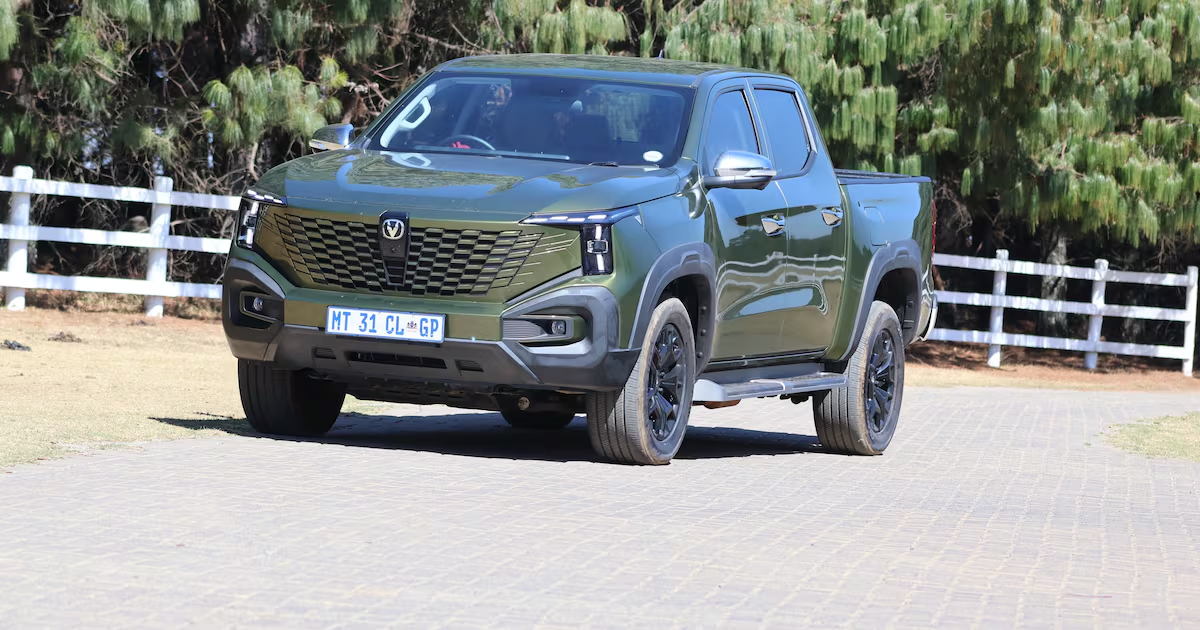
Following an absence of several years, Chinese brand Changan recently returned to South Africa with a lineup of vehicles that include the Hunter REEV, the country’s only range-extended electric vehicle bakkie.Priced at R799,900, the double cab has futuristic styling, a luxuriously appointed cabin and a powertrain that, in the right circumstances, could save a bundle in fuel bills.REEV is a different twist on the hybrid vehicles that are becoming increasingly more common on our roads. Unlike a typical hybrid, which uses a combination of internal-combustion and electric power to drive the wheels, the Hunter REEV uses its petrol engine only as a generator to recharge the 31.18kWh battery. The wheels are directly driven only by the two electric motors — one at the front axle and one at the rear — which provide combined outputs of 200kW and 470Nm. For shorter commutes, the Hunter REEV can prioritise electric driving with its claimed electric-only range of up to 145km. For longer journeys, the petrol range-extender reduces the anxiety that people have with pure EVs, giving the bakkie a claimed combined petrol-electric range of up to 1,000km on a full tank and a full charge. It is a practical concept for a country with big distances.Aside from the novel drivetrain, the Hunter’s futuristic design is another attention grabber, particularly the front view with its prominent grille and T-shaped LED headlamps.It houses a large and luxurious cabin with soft-touch surfaces and leather upholstery radiating a premium feel. As part of a comprehensive equipment list, the modern bakkie has a 12.3-inch infotainment system, digital instrument panel, mobile phone mirroring, wireless charging, keyless entry and start, an electrically-adjusted and ventilated driver’s seat, and a 540-degree panoramic camera.The Changan Hunter REEVA has a high-class cabin, but the lack of a start/stop button annoys. Picture: (DENIS DROPPA) Key safety features include adaptive cruise control, tyre-pressure monitoring, six airbags, a dashcam and lane departure warning — the latter not nearly as intrusive as in some vehicles. Controlling onboard functions is user-friendly for the most part, with a more intuitive digitised menu than many cars. There are also physical buttons for the climate control, making for less driver distraction.The Android Auto and Apple CarPlay weren’t working at first in the test vehicle, though they were back online once we reset the system to its factory settings.The vehicle has no stop-start button, which can become an annoyance as the only way to turn off the petrol engine is by locking the car with the remote — that’s not always convenient, for instance, when filling up with fuel.The Hunter REEV is a pleasant drive with light steering and one of the most comfortable rides in the double-cab segment. Its plush suspension and high-profile tyres provided impressive cushioning on damaged roads, making for a capable long-distance cruiser and off-road vehicle.It has a pleasantly eager performance too, both in urban stop-start driving and open-road cruising. The advantage it has over regular hybrids is that it performs like an electric vehicle. There are no gears, and the electric motors deliver step-free power delivery with no lag as the 470Nm of torque is on tap instantly. The Hunter’s heavy 2.4 tonne weight prevents it from zipping off the line like a hot hatch, but the gratification is in the seamless way the power is delivered without having to wait for revs to spool up.The Hunter REEV is a practical workhorse and off-road vehicle. Picture: (DENIS DROPPA) Refinement-wise the Hunter REEV makes the grade too. You hear the petrol engine in the background when it switches on to charge the batteries, but it isn’t too intrusive.The Hunter REEV makes a practical workhorse and lifestyle vehicle with its 1,010kg payload and 2,200kg towing capacity. It is capable of off-road work too with its raised 220mm ground clearance, 600mm wading depth, hill descent control and selectable 4WD. The default auto driving mode optimises grip between the front and rear axles, but with a selector dial the driver can also choose 2WD and 4WD.Fuel consumption in the test vehicle averaged 9.4l/100km, which is similar to a turbo diesel double cab. However, a lot of the test driving was on the open road instead of the urban environment where electrified vehicles deliver their biggest benefits. The Hunter REEV could potentially save a lot in fuel bills, or run entirely on battery power, if used for shorter daily commutes that fall within its claimed 145km all-electric range — though its real-world range is closer to around 100km. The bakkie has several modes that prioritise either electric or petrol-charging power to suit driving conditions, including a full EV mode. The petrol generator charges the batteries while driving, but we found it doesn’t happen quickly. On a 200km drive from Joburg to Dullstroom on the fastest-charging mode, the Hunter’s batteries were only replenished from 30% to around 70%. To fully top up the batteries in a reasonably quick time, it needs to be plugged into a charger. On a fast charger, juicing up from 30% to 80% takes around 30 minutes.VerdictThe Changan Hunter REEV is a compelling prospect in a crowded leisure bakkie market with its futuristic design, smart cabin and plush ride. Its range-extender drivetrain combines the smooth performance of an electric vehicle with the long-distance practicality of a combustion engine.In long-distance driving its fuel economy is similar to a conventional turbodiesel, but buyers who can regularly recharge at home or work stand to make big savings in running costs, at a price that undercuts most diesel and hybrid rivals.Changan still has to earn the confidence of South African buyers after its earlier withdrawal from the market, but in terms of build quality and polish, the Hunter REEV is a big step up from the brand’s earlier products. It is backed by a comprehensive five-year/150,000km warranty, five-year/90,000km maintenance plan and an eight-year battery warranty. Changan Hunter REEV vs key rivalsChangan Hunter REEV, 200kW/470Nm: R799,900;Foton Tunland V9 2.0TD double cab LTD 4x4, 120kW/450Nm: R799,900;GWM P500 2.0T HEV double cab Ultra Luxury 4x4, 255kW/648NM: R999,900;Toyota Hilux 2.8 GD-6 double Cab Legend 4x4, 150kW/500Nm: R999,900;Ford Ranger 3.0TD V6 double cab Sport 4WD, 184kW/600Nm: R1,001,300.Business Day
REVIEW | Can the Changan Hunter REEV bakkie replace a diesel?
Chinese double cab blends EV driving with petrol-powered range extension
1,020 words~5 min read