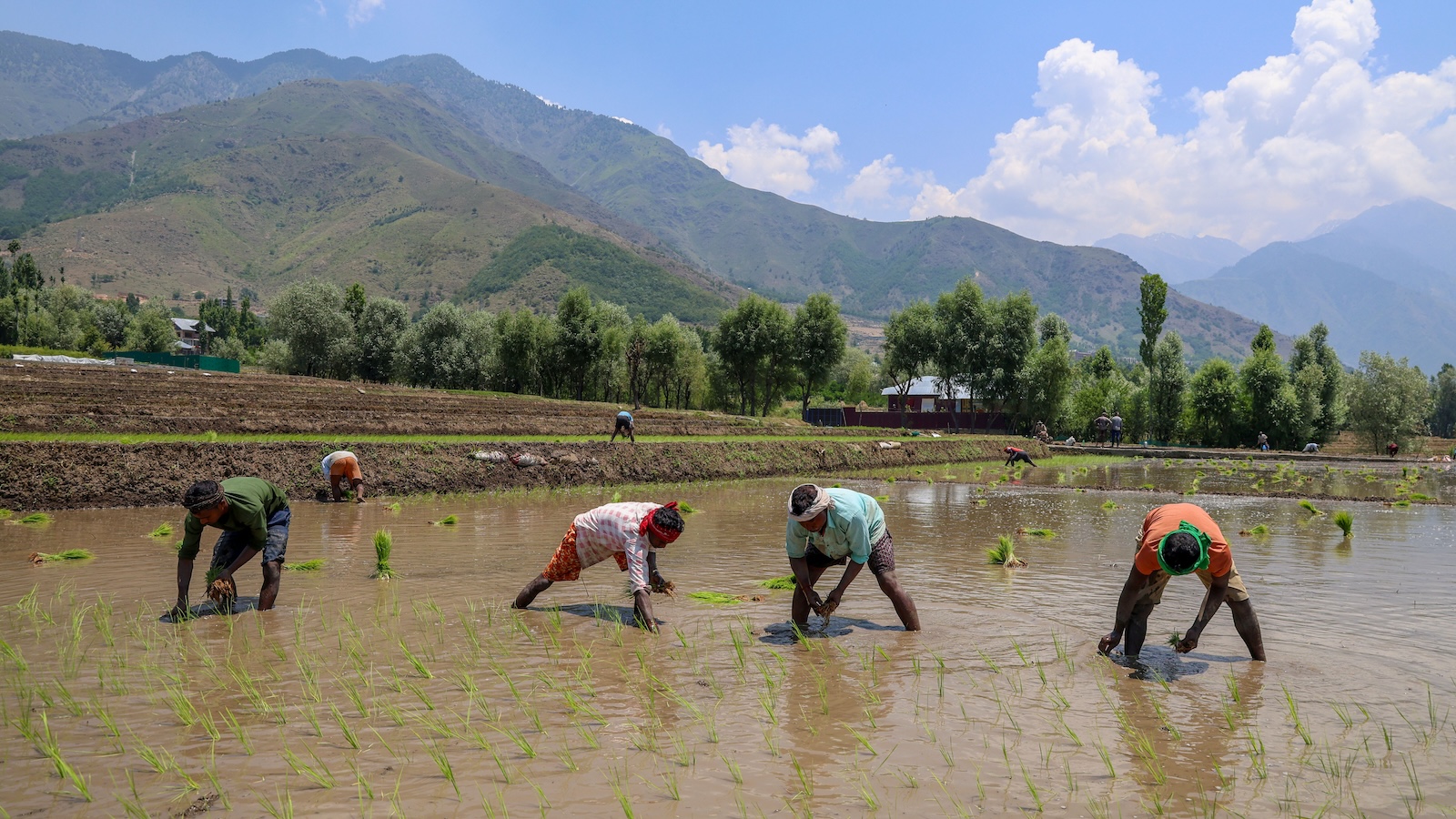
More than half the world’s population depends on rice to survive. But this year’s El Niño weather pattern and the ongoing climate crisis are intensifying dry, hot weather that could cause yields to plummet.
Globally, rice production is set to fall for the first time in more than a decade, according to projections by the U.S. Department of Agriculture. In the U.S., where most rice is grown in the Mississippi Delta, production for the upcoming season is expected to fall by more than half, to the lowest levels in 40 years.
“High temperatures can substantially reduce the rice yield,” said Atul Jain, a professor of climate, meteorology, and atmospheric sciences at the University of Illinois. “Farmers are going to be hit hard during these extreme climate events.”
How much rice farmers can produce depends on a range of weather conditions, such as precipitation and temperature. Climate scientists have predicted that this year’s El Niño will be the strongest on record, describing it as a “super El Niño.” The naturally occurring phenomenon, which happens roughly every two to seven years, will continue to drive extreme weather, including intense drought, in regions across the globe.
Researchers at Columbia University’s Climate School shared this week that the current El Niño has already reached “very strong” levels and will continue to intensify in the coming months. During a given El Niño year, trade winds weaken and warmer ocean water in the Pacific drifts eastward, leading to convection, or warm air rising off the ocean. “That acts like ringing a bell,” said Radley Horton, a professor at the Climate School. “It sends out waves that resonate all across the globe.” The result is that some areas experience much wetter seasons than usual, while others see much drier months.