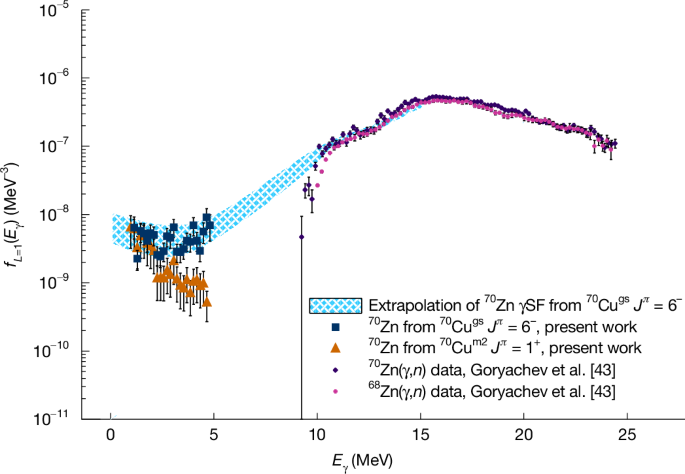
Researchers led by scientists at the Facility for Rare Isotope Beams, or FRIB, have identified the source of a puzzling abundance of low-energy gamma rays released by the zinc-70 nucleus. Their results show that magnetic transitions occurring inside the nucleus produce the unexpected signal.
The findings, published in Nature in the study "Magnetic Character of the Low-Energy Enhancement in 70Zn," resolve a long-standing question in nuclear physics and could improve scientific models of how heavy elements are created in space.
The international collaboration brought together researchers from 25 institutions across the United States, Canada, Italy, Germany, Norway and South Korea.
A Surprising Gamma-Ray Signal
Gamma rays belong to the same broad family of electromagnetic radiation as visible light and radio waves. When an excited atomic nucleus moves to a lower and more stable energy state, it can release energy in the form of gamma rays.