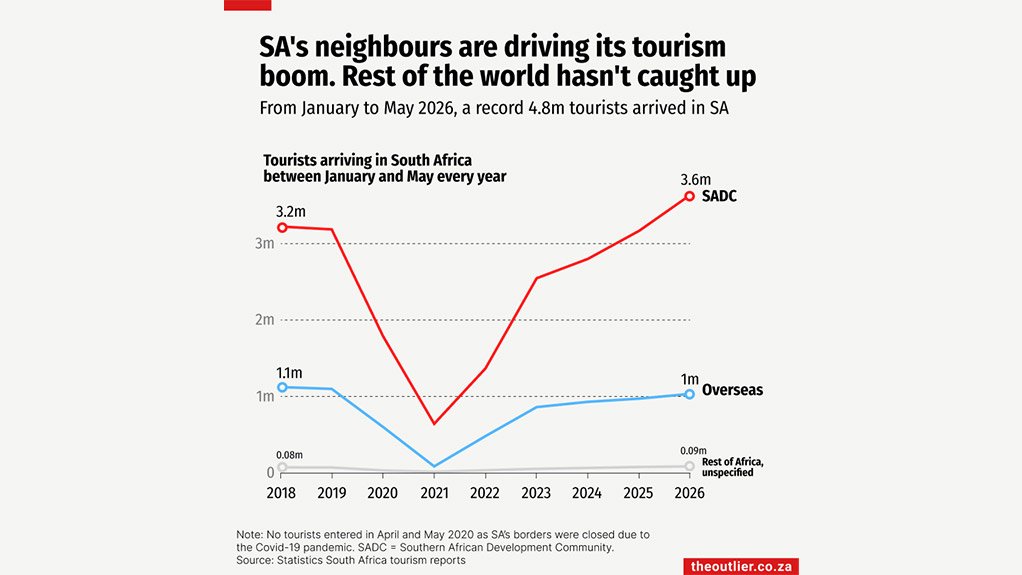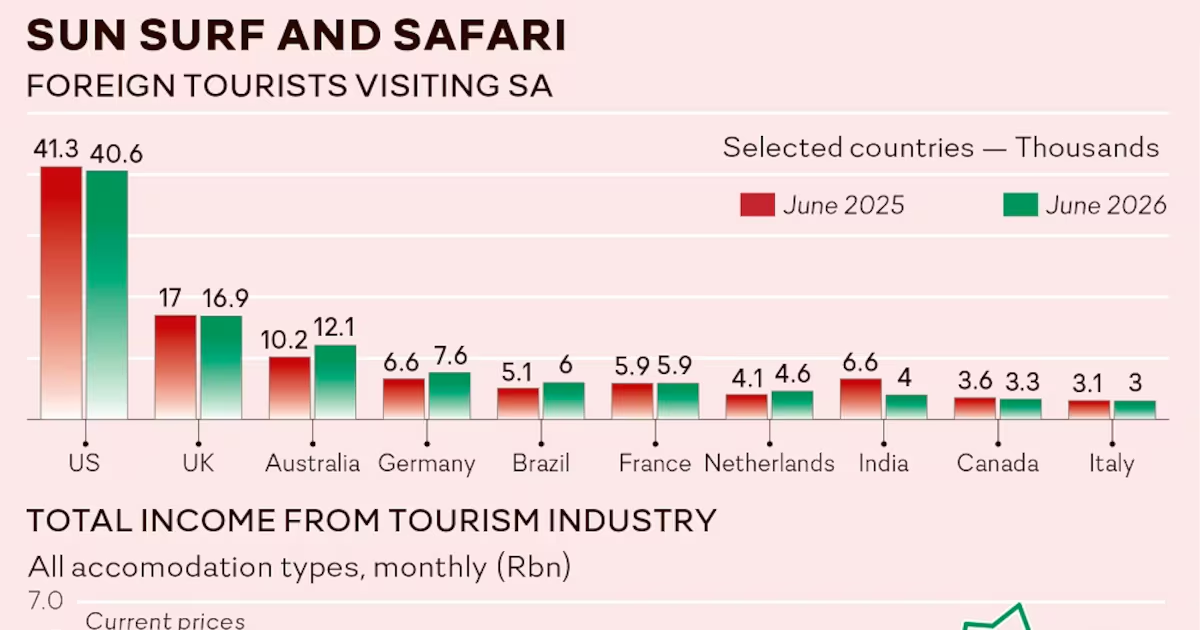
We South Africans spend a lot of time trying to figure out how to grow the economy and create jobs. One of the answers has been hiding in plain sight. Tourism is now one of the fastest-growing economic sectors in the country, creating work ― at scale ― for young people. According to Stats SA, the tourism sector contributed 4.9% of GDP in 2024, up from the previous high of 3.7% before the Covid pandemic. Tourism is taking its place as a serious growth sector. The jobs numbers are even more impressive. Direct employment in tourism reached 954,000 in 2024, up from 745,000 in 2022. Tourism now accounts for roughly one in every 18 jobs in South Africa. Unlike many other sectors, tourism generates entry level jobs that are accessible to young people and creates opportunities in small towns and rural areas. It is well placed for the age of automation. As AI reshapes the labour market the things at the heart of this sector ― warmth, hospitality, food, transport, guiding ― are among the hardest to hand to a machine. The World Travel & Tourism Council expects continued growth in global demand. Last year was a red letter year for tourism in South Africa. It began with the tourism minister releasing the tourism growth partnership plan. In September the home affairs minister announced the pilot phase of electronic travel authorisation (ETA), the revolutionary new digital visa platform. Read: CLAUDIA PIZZOCRI | Schreiber’s home affairs two years on: bold vision and blind spotsThe ETA pilot has worked well and will soon be extended to all visa-requiring countries, creating a platform to drive tourism arrivals from countries such as India and China, which were previously discouraged by a dysfunctional visa system. By the end of 2025 South Africa had broken the international arrivals record with a figure of 10.5-million, a 17.6% jump on the previous year. The majority of these visitors arrive by land and include cross-border shoppers who support wholesale and retail activity. Air arrivals are the most lucrative, creating one permanent job for every 13 tourists. Air arrivals have grown steadily, up by 13% in 2025 and a further 12% in the first five months of 2026, despite the Middle East conflict. But we should not mistake a good run for a job done. South Africa is still underweight on tourism compared with many other countries. To grow further we must implement all the elements of the growth partnership plan. We must improve geographic spread, encouraging international tourists to explore beyond the Cape and Kruger National Park. We must work harder to keep visitors safe and secure. We need to recover lost ground in China and India, two of the world’s biggest travel markets. And we need to co-ordinate a sector that remains fragmented. Perhaps most importantly, we need to market ourselves for the age of AI, ensuring that when a traveller asks ChatGPT where to go, South Africa has the digital presence to be the answer. It is also worth remembering that most of our tourism is homegrown. South Africans took 44.8-million domestic overnight trips in 2025, up 11.5% on the year before. Domestic travel spreads money into local economies and cushions the industry against global shocks. A serious marketing strategy must court our own citizens and open travel new opportunities. For years, some of the greatest obstacles to tourism were of our own making. This is changing fast. Now we need an all-of-society approach. Tourism can become exactly what the economy needs — an industry that creates significant value while showcasing our extraordinary country. In the words of the tourism industry’s new international marketing campaign, led by Trevor Noah: “Don’t say we didn’t tell you!” • The authors are with Genesis Analytics. They write in their personal capacities.
LAEL BETHLEHEM AND SARAH POGRUND | Tourism is an engine of growth
Digital visas and targeted marketing boost arrivals from top global markets
631 words~3 min read