Penn Engineers have developed PeptiVerse, an AI-powered platform that predicts key chemical and biological properties of peptides, the strings of amino acids whose medical potential has been demonstrated by the success of GLP-1 drugs, the widely used weight-loss treatments.
In Nature Communications, the researchers describe how they trained PeptiVerse using a wide range of data sets, allowing it to predict properties that can help determine whether a peptide is worth pursuing as a potential drug, such as the peptide’s likelihood of dissolving, entering cells, avoiding toxicity and lasting long enough in the body to have an effect.
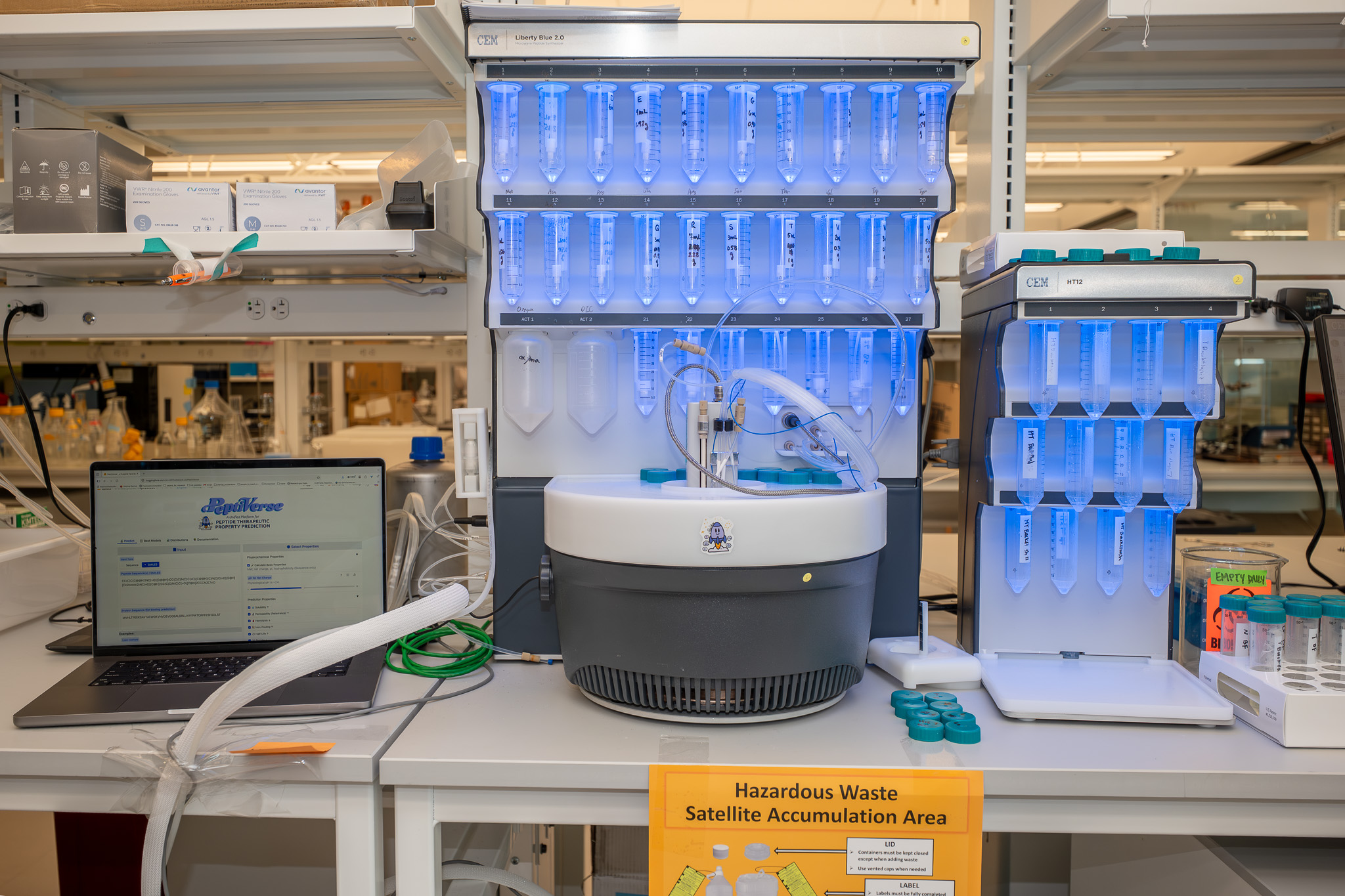
Members of the Chatterjee Lab — Elizabeth Mahood, at right, and Yesol Kim, at left — demonstrate how PeptiVerse, whose web client is open on the laptop, can be used by experimentalists to make predictions about peptides, which can then be synthesized by a machine like the one at right. (Credit: Sylvia Zhang)
While tools for predicting such properties exist, those tools often focus on a narrower set of traits or only one kind of peptide. PeptiVerse, by contrast, brings many of those predictions together in one open-source, easily accessible platform, allowing users to evaluate both ordinary peptides and chemically modified versions designed to work better as drugs.