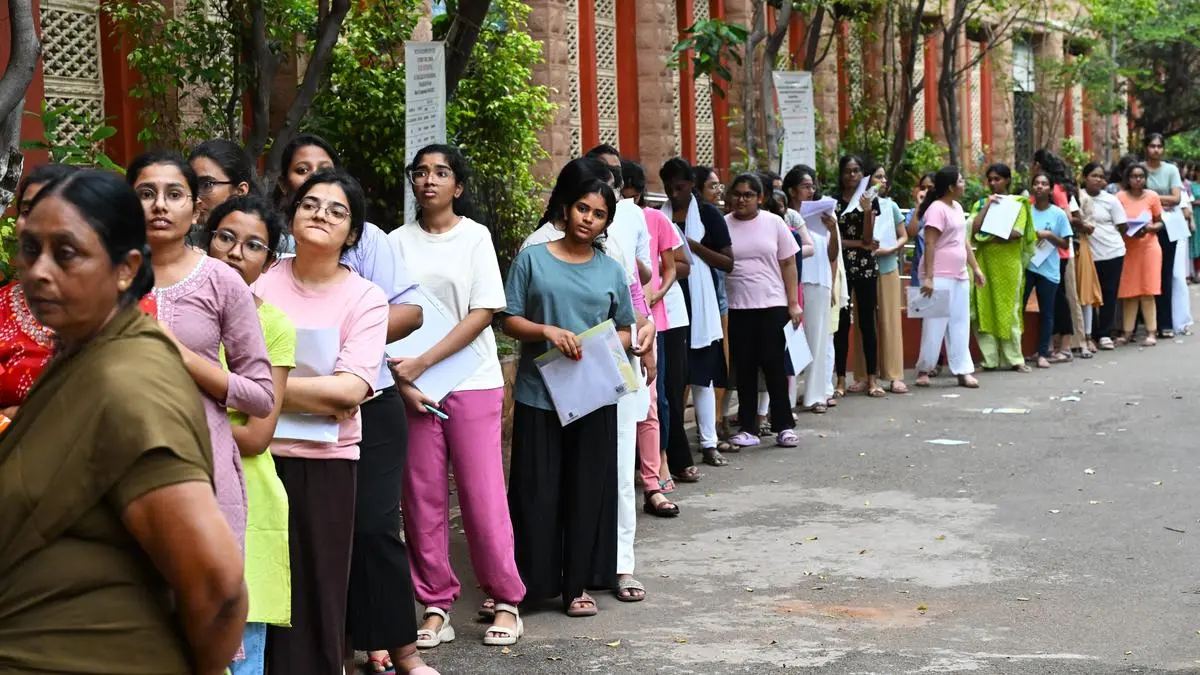
NEET exma: Larger questions
| Photo Credit:
The Prime Minister has constituted a high-powered committee to address the issues that have plagued NEET. Its mandate — to strengthen the examination system, prevent paper leaks, improve security and enhance transparency — is both timely and necessary. However, these measures address only the governance of the examination. They do not confront a more fundamental question that lies at the heart of all professional education.What is the true purpose of NEET? Is it primarily an elimination examination that ranks and rejects candidates, or should it be an eligibility examination that identifies those with the greatest potential to become doctors?The debate surrounding NEET has largely been viewed through the lens of students’ rights. Every applicant deserves a transparent, secure and credible examination. But from society’s perspective, a medical seat is far more than an educational opportunity; it is a societal investment. Society entrusts future doctors with the responsibility of caring for human life, alleviating suffering and making decisions that profoundly affect individuals and families.So, the purpose of a national medical entrance system is therefore much broader than allocating scarce seats. It is to identify young men and women most likely to become competent, ethical and compassionate physicians. This distinction is fundamental. A fair examination is not necessarily an appropriate selection system. Fairness ensures that every applicant is assessed under the same rules; appropriateness determines whether those rules identify the qualities that society expects in its future doctors.Purpose of educationTo understand this distinction, we must first revisit the purpose of education itself. Every society rests on two interconnected strands. The first is the economic and developmental strand, which creates wealth, advances technology and generates prosperity. Doctors, engineers, scientists, entrepreneurs, teachers and countless other professionals contribute to this strand through their knowledge and skills. The second is the civilisational strand, which forms the moral foundation of society. It encompasses values such as integrity, compassion, honesty, justice, empathy and social responsibility.Education is the bridge between these two strands. Its purpose is to ensure that professional excellence is always accompanied by integrity, compassion and social responsibility. Medicine exemplifies this philosophy more than any other profession because it combines scientific competence with a profound moral responsibility towards human life. Medicine is unlike most other professions; it is built on trust. Every patient who seeks medical care entrusts not merely an illness, but often life itself, to the doctor.Medicine and AIThe medical profession is now undergoing the greatest transformation in its history. As artificial intelligence and other digital technologies become embedded in healthcare, the doctor’s role will increasingly shift from being the primary source of medical information to becoming the interpreter, counsellor and trusted guide who helps patients make informed decisions. As the cardiologist and digital medicine pioneer Eric Topol has argued, AI has the potential to restore the human side of medicine by freeing physicians from routine cognitive tasks and allowing them to spend more time listening, communicating and caring for patients.If medicine is changing, then the way we select future doctors must also evolve. A single multiple-choice examination is an excellent instrument for assessing scientific preparedness. However, it is inherently incapable of assessing qualities such as compassion, integrity, ethical judgment, communication, resilience and commitment to service. These qualities cannot be reduced to a multiple-choice answer, yet they increasingly define excellence in medicine. The challenge before India is therefore not to abandon objectivity but to broaden our definition of merit.This does not imply replacing NEET with subjective interviews or discretionary admissions. On the contrary, the task before the high-powered committee is far more ambitious: to develop a scientifically rigorous, transparent and nationally acceptable framework that preserves fairness while identifying a broader range of professional attributes.The success of the high-powered committee should not be measured by whether the next NEET is free of paper leaks. It should be measured by whether it changes the very purpose of medical admissions — from eliminating candidates to identifying future doctors. If that happens, the NEET controversy will have become an opportunity rather than a crisis.The writer is Institute Professor Indian, Institute of Technology MadrasPublished on July 31, 2026