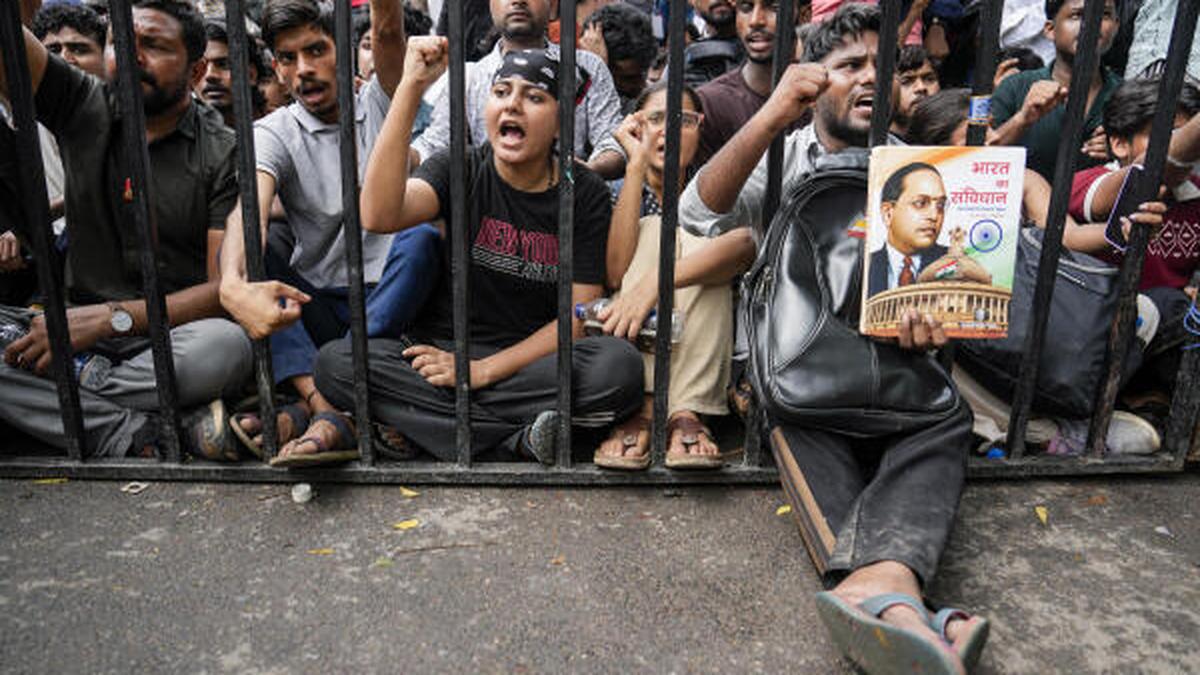
On May 5, 2026, more than two million medical aspirants sat for the NEET-UG examination. Within days, allegations of a leaked paper surfaced, triggering cancellation, an announcement of a retest, and a shift to computer-based testing by 2027. But will digitisation alone restore trust, or are we asking the wrong question?(Sign up for THEdge, The Hindu’s weekly education newsletter.)Indian high-stakes exams, such as IIT-JEE, NEET, and UPSC, mediate access to intensely competitive opportunities and shape professional futures and social mobility for millions. Yet the system is facing a crisis of trust. These assessments demand not just security, but integrity.Doctors’ body barred from Parliamentary panel meeting on NEET after BJP objectionsExam reform as a security problem: A narrow policy lensWhen exam reform is framed primarily as a question of security and operational control, the policy debate becomes unduly narrow, shifting focus from the broader problem of credibility to an immediate task of containment. So, any breach, whether leaks, impersonation, cheating, or administrative failure, predictably triggers demands for stricter enforcement.Yet a response centred principally on surveillance, policing, and punishment risks misdiagnosing the fundamental nature of the problem, limiting legitimacy to malpractice control, while overlooking the fact that the credibility of an examination system is determined by design, measurement, procedural, and equity considerations.Even without security breaches, systems can fail candidates when core conditions of quality and fairness are weak. Under such conditions, an examination may be operationally secure and yet technically invalid and fundamentally unjust. The challenge, therefore, is not simply to prevent malpractices but to design a system whose outcomes are credible, equitable, and publicly defensible.The Psychometric blind spot: The most overlooked gapPerhaps the most overlooked gap in India’s exam reform discourse is measurement quality. Many current high-stakes examinations remain heavily dependent on recall, speed, and coaching-intensive preparation raising questions about whether they capture the broader capabilities required for success, such as situational judgement, communication, and the ability to work under uncertainty.A paradigm shift from exam security to assessment IntegrityWhat India needs is a shift from exam security to assessment integrity. Integrity is a broader and more demanding standard. An assessment integrity framework rests on four interdependent pillars that move beyond security to establish trust, which is engineered into the system, not assumed.Four pillars of the integrity frameworkPillar 1: Measurement integrityHigh-stakes decisions should not rely on a single score from a one-shot test, as all measurements contain error, and a single result is an unstable estimate of ability. Tests must be valid, reliable, and comparable across forms, sessions, and time. Let us consider a critical question: do we have technical evidence that translation differences make one language version systematically harder or easier? In the past, there have been reports on differential difficulty across language versions in different high-stakes examinations, an issue that could have been investigated through comparability analyses or differential item functioning evidence.Equally important is the range of outcomes assessed. Many current tests focus narrowly on textbook recall, rather than the competencies that matter in academic and professional contexts. Additionally, test targeting is essential: overly difficult, memory-based tests restrict what candidates can demonstrate, reducing measurement validity, whereas well-designed assessments enable them to show target competencies more meaningfully.Pillar 2: Security integrityExaminations must be robust against leaks, impersonation, and organised malpractice. However, security is a baseline condition, not the goal.Computer-based multisession testing can reduce dependence on fragile one-day, one-paper logistics by enabling controlled item delivery, dynamic paper generation, and stronger audit trails. Even so, technology is not a substitute for sound design.Adaptive testing further strengthens this approach by delivering unique but equivalent question sets to each test taker based on their ability estimate, improving measurement precision, controlled item exposure - where each student dynamically moves through questions based on their responses, rather than facing the same fixed paper. Well-designed multi-session models enhance comparability across administrations.Pillar 3: Fairness and social justiceFairness is not an add-on; it is a design principle that must be built into the system. The current examination model assumes a level playing field that does not exist. Candidates differ sharply in their access to schooling, coaching, language support, digital access, and even basic travel logistics. This raises a critical question: do the test (and system) serve equally a resource-rich urban student with intensive coaching and a rural candidate travelling overnight to reach an exam centre?A truly fair system must also ensure that test language is culturally responsive, bias-sensitive, and respectful, rather than reinforcing stereotypes or social hierarchies.Embedding fairness requires deliberate inclusion across the entire testing lifecycle, with explicit mechanisms to reduce regional and socio-economic bias. Uniform treatment does not guarantee fairness; in a diverse country like India, fairness demands equitable design.Pillar 4: Legal defensibilityEvery stage of the examination process must be transparent, evidence-based, and capable of withstanding scrutiny. Legitimacy is sustained not by intent, but by the system’s ability to justify its decisions when challenged.Reliance on a single examination event makes high-stakes decisions especially contestable, particularly when irregularities or disputes arise. Judicial systems examine not only whether the process was secure, but also whether outcomes are fair, proportionate, and evidentially justified. More defensible systems, therefore, draw on multiple measures, recognising that reliability, fairness, and validity are strengthened when decisions are not tied to a single score.Rebuilding trust: from urgency to systemic reformRecent reform efforts have shown urgency, but India must move beyond reactive fixes and adopt a systemic approach to high-stakes examinations.What would systemic reform look like in practice? First, strengthen the governance of examination bodies to enhance accountability and transparency. Second, commission psychometric reviews of all high-stakes exams and make validity and reliability evidence available to relevant stakeholders. Third, pilot computer-adaptive testing in controlled settings before national rollout. Fourth, establish a grievance redressal mechanism with clear timelines and judicial oversight. These are not aspirational goals—they are minimum standards for a credible testing system.India now stands at an inflection point. It can continue to respond to each crisis with incremental fixes, stronger checks, tighter rules, harsher penalties, or it can take the more demanding but more consequential path: building a High-Stakes Assessment Integrity Framework that aligns measurement quality, security, fairness, and legal defensibility into a coherent system. Rebuilding trust requires moving beyond one-shot, high-risk decisions towards systems that are demonstrably valid, equitable, and defensible. This is a higher bar than security alone, but it is the standard a credible examination system must now meet.(Priyanka Sharma is an assessment and measurement expert and CEO of Australian Council of Educational Research (India). She has also served as senior research advisor at the National Testing Agency, till 2020. The views expressed are personal.)
NEET after the leak: Why security alone cannot fix exam system
Explore why enhancing India's NEET exam system requires a focus on integrity, fairness, and measurement quality beyond mere security.
1,089 words~5 min read