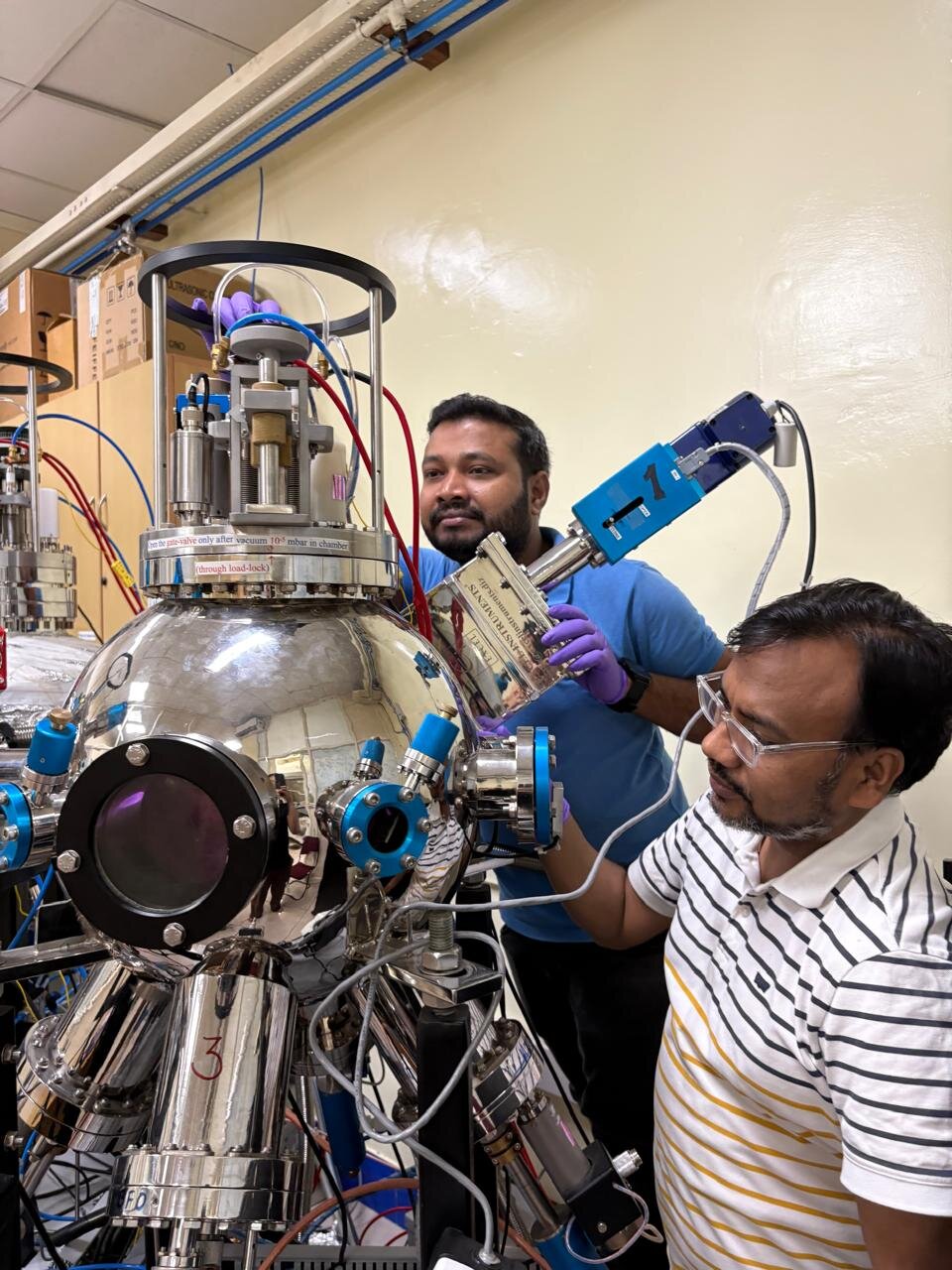
Bhagwati Prasad (right) and Suryakanta Mondal (left) in the DEMAND Lab, where the experimental work leading to this discovery was primarily carried out. Credit: Uma Ganguly
Researchers at the Indian Institute of Science (IISc) have demonstrated a new way of switching a material between two fundamentally different magnetic states using an electric current. The discovery could pave the way for compact, energy-efficient electronic devices that store information, perform logic operations and even interface with future quantum computers.
Published in Nature Communications, the work was led by Bhagwati Prasad, assistant professor in the Department of Materials Engineering, together with first author Suryakanta Mondal, a doctoral student, and a team of national and international collaborators.
Many magnetic memory technologies rely on changing the direction of a material's magnetization. In this study, however, instead of simply flipping the direction of magnetization, the team used an electric current to completely transform the material from one magnetic state to another.
The researchers studied a complex oxide called Sm₁₋ₓSrₓMnO₃, which is known for hosting multiple magnetic states. "Our initial motivation was to understand whether the closely competing magnetic states could be controlled directly using an electrical current," Mondal explains.