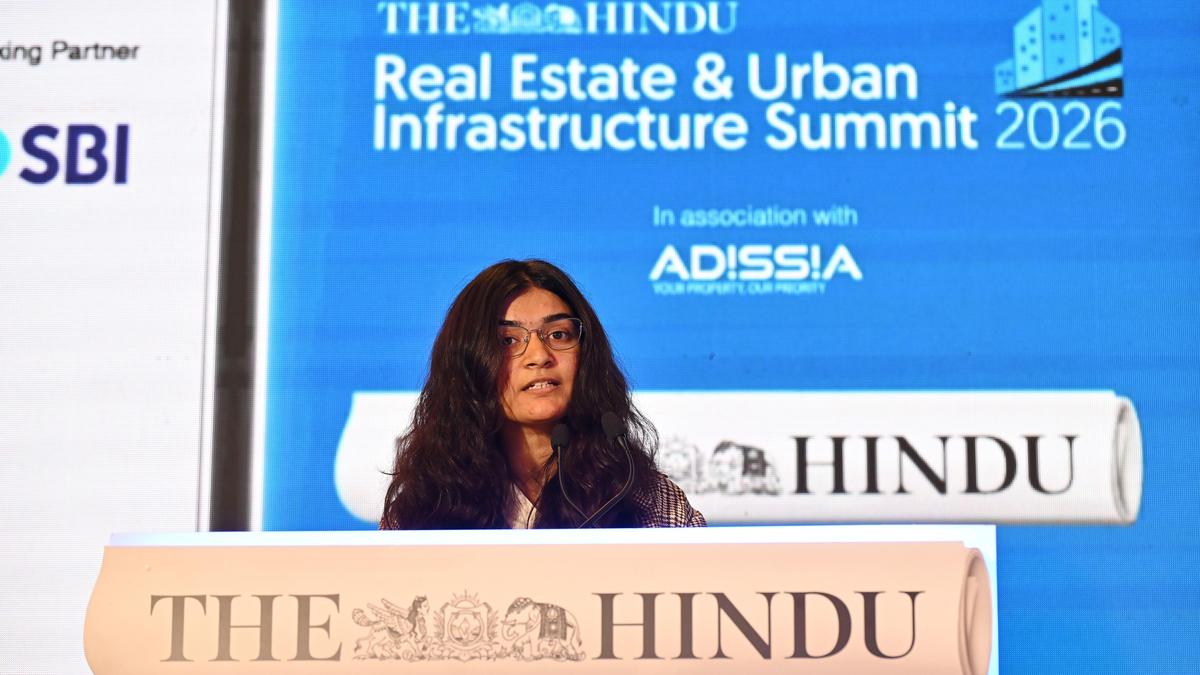
Architecture student Subhapradha presenting a case for skyscrapers integrated with urban farming, biodiversity corridor, carbon sequestration, and cooling landscapes at The Hindu Real Estate and Urban Infrastructure Summit 2026 in Chennai on Thursday.
| Photo Credit: VELANKANNI RAJ B.
As the concrete jungle in Indian cities such as Chennai has outgrown green cover and increased heat stress, these cities need vertical forest cities, integrating skyscrapers with urban farming, biodiversity corridors, carbon sequestration, and cooling landscapes. According to data compiled for The Hindu Real Estate and Urban Infrastructure Summit 2026 by final-year architecture student Subhapradha, Saveetha College of Architecture and Design, dense, built-up areas in Chennai showed rising surface temperature, creating persistent heat spots, as the city’s vegetation declined from 25% in 2014 to 10% in 2024 and built-up area expanded from 36% in 2014 to 67% in 2024. “We need vertical forest cities in India, integrating skyscrapers with urban farming, biodiversity corridors, carbon sequestration, and cooling landscapes. Chennai already has a built example of vertical greenery at scale with 15,000 sq. ft. of landscaped gardens,” said Ms. Subhapradha.“Future high-rise developments should move beyond treating greenery as an amenity. Instead, architecture and ecology need to be designed as one integrated system, where vegetation, water management, and building performance work together. Rather than replicating international examples, my proposal adapts these principles to suit India’s climate, ecology, and urban conditions,” she said.“Approvals reward built up areas over retained open space. Green space and water body norms exist on paper but lack enforcement in many parts of Chennai. No mandated maintenance budget is followed once a green project is inaugurated,” she said.