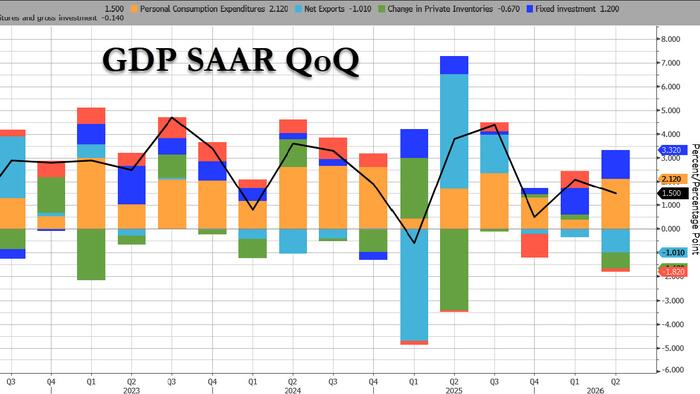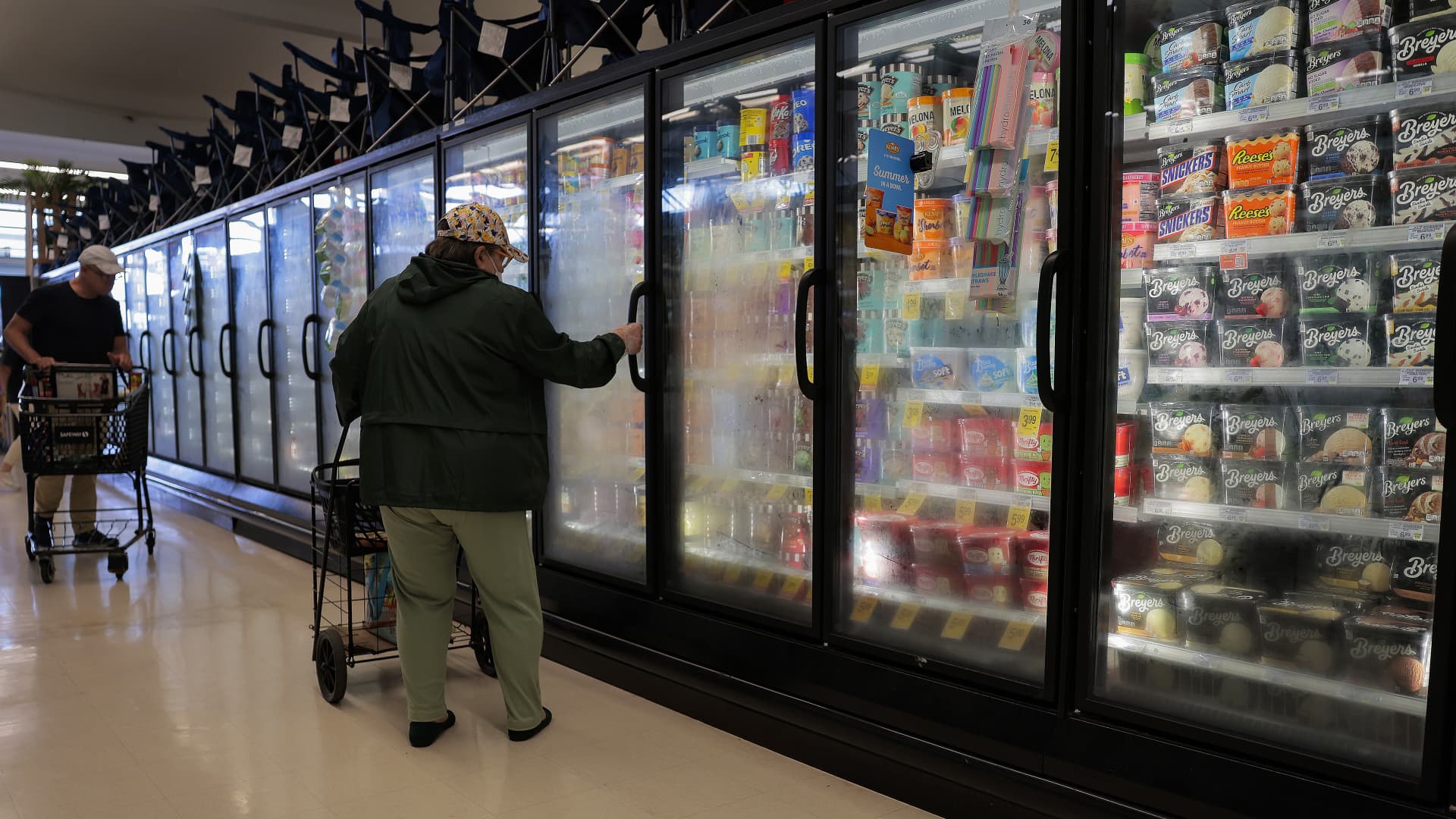
The US economy grew at a weaker-than-expected pace in the second quarter, though a pick-up in consumer spending and solid business investment signalled underlying strength. Inflation-adjusted gross domestic product increased an annualised 1.5 per cent in the three months through June, according to an advance estimate issued on July 30 by the Bureau of Economic Analysis. That marked a deceleration from the start of 2026 in part due to a surge in imports.Consumer spending, which comprises about two-thirds of economic activity, rose at a stronger-than-expected 3.2 per cent rate. Business investment continued to boom amid a rush to invest in artificial intelligence.A narrower metric of underlying demand known as final sales to private domestic purchasers climbed 3.9 per cent in the second quarter, more than double the first quarter pace and the strongest since early 2023. That measure excludes net exports, inventories and government spending. The figures highlight an economy that is so far powering through the fallout of the Iran war. While the conflict has pushed prices higher and weighed on sentiment, a slide in petrol costs at the end of the quarter alongside higher-than-usual tax refunds and sales promotions helped support household spending. Separate data out on July 30 showed inflation-adjusted consumer spending climbed a robust 0.4 per cent in June, matching the strongest since July 2025.The Federal Reserve’s preferred measure of inflation – the personal consumption expenditures price index – fell 0.1 per cent in June. Excluding food and energy, the gauge rose less than forecast. Business investment remained a key driver of growth in the second quarter. The massive AI investment push continued to play a critical role as did demand for industrial and transportation equipment.After the Fed decided to keep interest rates unchanged on July 29, chairman Kevin Warsh described the economy’s resilience as “impressive” but noted its “most striking” feature is the strength of business investment. Big technology firms including Meta Platforms and Microsoft are aggressively building out data centres and investing in AI, despite investors’ concerns about whether it will pay off. The underlying details of the report are “considerably stronger than expected”, said Stephen Stanley, chief US economist at Santander US Capital Markets.“I wouldn’t say that the economy was firing on all cylinders, but it was certainly driven by more than just the AI boom.” Net exports subtracted a percentage point from the calculation of GDP in the second quarter. That likely reflected a mix of factors, including efforts to get goods into the country before a new wave of tariffs and the rapid pace of capital investment. Inventories stripped an additional 0.67 percentage points from GDP, suggesting many businesses drew down their inventories during the war.Consumer strengthThe strength in household outlays was fuelled by spending on durable goods like furnishings and motor vehicles. Within services, consumers ramped up outlays on discretionary categories like recreation and food services and accommodation. The BEA report showed nonresidential fixed investment rose at an 8.4 per cent pace. Investment in industrial equipment surged by the most since 2011, and outlays for transportation equipment jumped by the most in two years.Information processing equipment and software outlays rose at a strong, albeit slower rate. Federal government outlays declined, reflecting sales of crude oil from the Strategic Petroleum Reserve, according to the report. But because sales of the oil are reflected in other components of GDP, there is “no direct effect” on GDP. Even so, spending on national defence increased amid the war with Iran. Residential investment added to growth, though modestly, for the first time since late 2024. Elevated mortgage rates have generally restrained buyer demand and limited construction activity in recent years. Looking ahead, the recent flare-up in the Middle East and President Donald Trump’s new tariffs underscore the uncertainty around the outlook. Though the US central bank opted to keep rates unchanged on July 29, three policymakers voted to raise borrowing costs amid above-target inflation.But with layoffs limited, economists generally expect consumer spending to stabilise in the second half of the year.Executives at companies like JPMorgan Chase and Levi Strauss have underscored shoppers’ resilience, even as some like PepsiCo and General Mills have noted that Americans are growing more discerning in their spending.Consumers “looked through the price pressures and they powered on – the question is how much longer they will be able to do that,” said Pooja Sriram, senior US economist at Barclays.“Tax refunds have run out and income gains are slowing, so that cushion that we point to is getting smaller in the next quarter.” BLOOMBERG
US GDP growth softens despite strong consumer spending, investment
Inflation-adjusted GDP increased an annualised 1.5 per cent in the three months through June. Read more at straitstimes.com. Read more at straitstimes.com.
752 words~3 min read