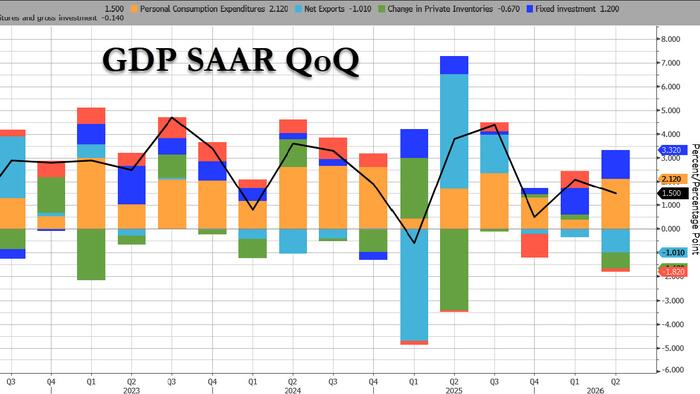
The US economy grew at a far weaker than expected pace in the second quarter despite a pickup in consumer spending and solid business investment. According to the BEA, GDP (inflation adjusted) rose just 1.5% in the period, according to the first estimate issued Thursday by the Bureau of Economic Analysis. This was well below the 2.0% median estimate. The contributors to the increase in real GDP in the second quarter were increases in consumer spending, investment, and exports that were partly offset by a decrease in government spending. A decline in volatile net exports masked strength in underlying demand as imports, which are a subtraction in the calculation of GDP, increased. Consumer spending, which comprises about two-thirds of economic activity, rose at a 3.2% rate. Business investment continued to boom amid a debt-fueled rush to invest in artificial intelligence.A closer look at the underlying data:Business investment remained a key driver of growth in the second quarter. The massive AI investment push continued to play a critical role as did demand for industrial and transportation equipment. After the Fed decided to keep interest rates unchanged on Wednesday, Chairman Kevin Warsh described the economy’s resilience as “impressive” but noted its “most striking” feature is the strength of business investment.
US Grows Only 1.5% In Q2, Badly Missing Estimates, Despite Strong Spending, Investment
The contributors to the increase in real GDP in the second quarter were increases in consumer spending, investment, and exports that were partly offset by a decrease in government spending.
676 words~3 min read