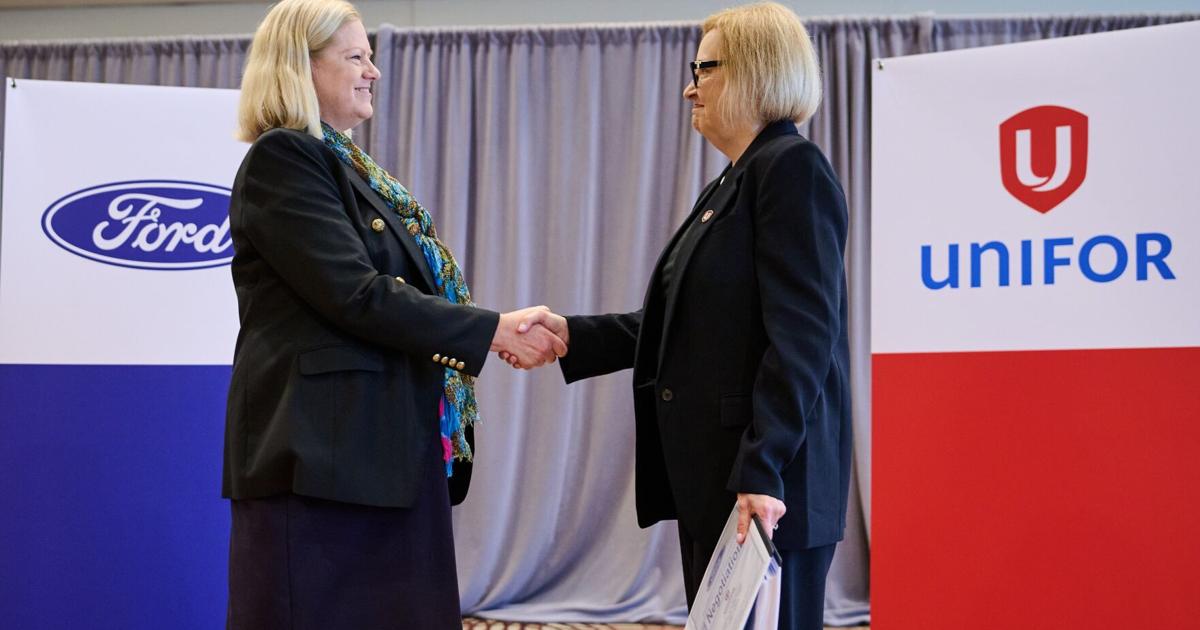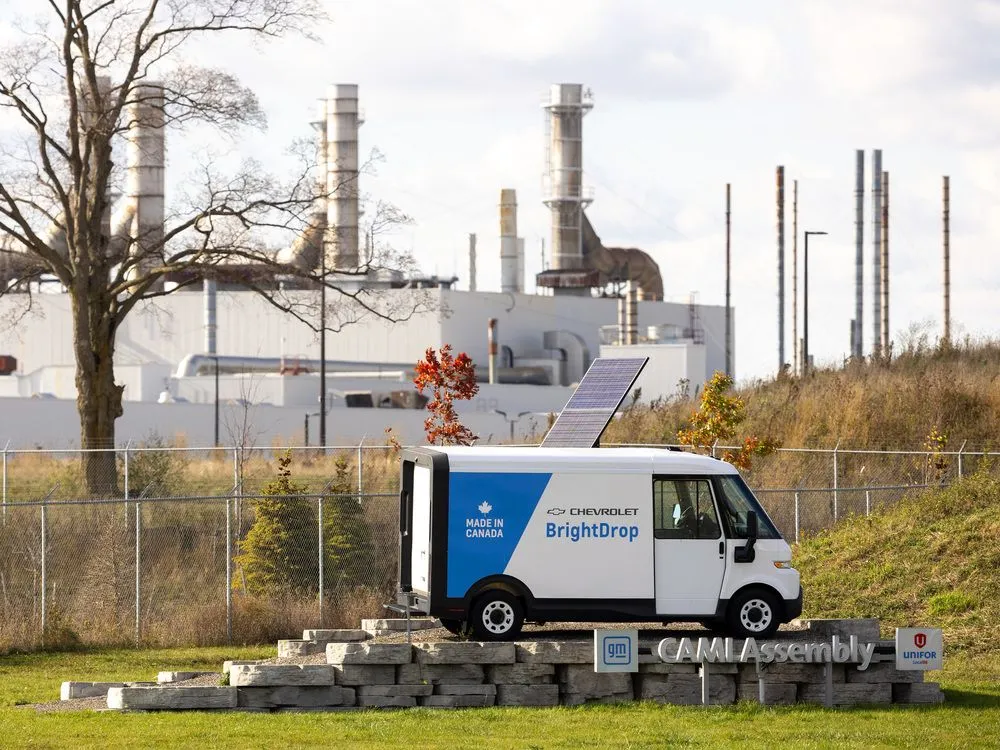
Skip to Content News Archives Economy Energy Oil & Gas Renewables Electric Vehicles Mining Commodities Agriculture Real Estate Mortgages Mortgage Rates Finance Banking Insurance Fintech Cryptocurrency Work Wealth Smart Money Wealth Management Investor Personal Finance Family Finance Retirement Taxes High Net Worth FP Comment Executive Women Puzzmo Newsletters Financial Times Business Essentials More Innovation Information Technology FP500 Podcasts Small Business Lives Told Tails Told Shopping Financial Post Store Obituaries Place a Notice Advertising Advertising With Us Advertising Solutions Postmedia Ad Manager Sponsorship Requests Classifieds Place a Classifieds ad Working Profile Settings My Subscriptions Saved Articles My Offers Newsletters Customer Service FAQ News Economy Energy Mining Real Estate Finance Work Wealth Investor FP Comment Executive Women Puzzmo Newsletters Financial Times Business Essentials HomeNewsTransportationAutosFord deal sets stage for tougher labour talks with GM, StellantisIndustry observers say future investment commitments could prove harder to secure from the remaining automakersLast updated 1 hour ago You can save this article by registering for free here. Or sign-in if you have an account.A BrightDrop electric van is displayed outside GM's Cami auto plant in Ingersoll. Photo taken on Oct. 21, 2025. (Mike Hensen/The London Free Press)The three-year deal reached between Unifor and Ford Motor Co., the first of the Big Three U.S. automakers to bargain with Canadian workers, resulted in an outcome that included wage gains and new investment. But the next rounds with the other automakers may be tougher, industry observers say.Subscribe now to read the latest news in your city and across Canada.Exclusive articles from Barbara Shecter, Joe O'Connor, Gabriel Friedman, and others.Daily content from Financial Times, the world's leading global business publication.Unlimited online access to read articles from Financial Post, National Post and 15 news sites across Canada with one account.National Post ePaper, an electronic replica of the print edition to view on any device, share and comment on.Daily puzzles, including the New York Times Crossword.Subscribe now to read the latest news in your city and across Canada.Exclusive articles from Barbara Shecter, Joe O'Connor, Gabriel Friedman and others.Daily content from Financial Times, the world's leading global business publication.Unlimited online access to read articles from Financial Post, National Post and 15 news sites across Canada with one account.National Post ePaper, an electronic replica of the print edition to view on any device, share and comment on.Daily puzzles, including the New York Times Crossword.Create an account or sign in to continue with your reading experience.Access articles from across Canada with one account.Share your thoughts and join the conversation in the comments.Enjoy additional articles per month.Get email updates from your favourite authors.Create an account or sign in to continue with your reading experience.Access articles from across Canada with one accountShare your thoughts and join the conversation in the commentsEnjoy additional articles per monthGet email updates from your favourite authorsSign In or Create an AccountorThe union representing thousands of autoworkers, many of them in Southwestern Ontario’s auto belt, not only reached a deal with Ford within its self-imposed deadline but also secured annual wage increases of three per cent, cost-of-living protections and a nearly $1-billion investment commitment – a big win, industry watchers say, given the existential threat U.S. tariffs pose to Canada’s auto sector.“There’s a reason that Ford went first, and that reason was validated,” said Jim Stanford, economist and director of the Centre for Future Work. “And that key reason was Ford has been clear in its continuing commitment to Canadian investment and Canadian production, despite (U.S. President Donald) Trump’s tariffs.”Breaking business news, incisive views, must-reads and market signals. Weekdays by 9 a.m.By signing up you consent to receive the above newsletter from Postmedia Network Inc.A welcome email is on its way. If you don't see it, please check your junk folder.The next issue of Posthaste will soon be in your inbox.We encountered an issue signing you up. Please try againUnder Unifor’s pattern bargaining system, the agreement with Ford will then establish a framework for subsequent talks with General Motors Co. and Stellantis NV.The next round of bargaining is scheduled to begin Aug. 10 with General Motors Co.The union has already said it will seek similar agreements with the other two companies.“The message is that we’re here to support our workers, but at the same time, we’re looking for investment, and there better be investment on that table,” Unifor Ford master bargaining chair John D’Agnolo said after workers ratified the Ford deal earlier this month.“No different than Ford, both GM and Stellantis have to understand that Canadians buy these vehicles, and they should be supporting us at the same time.”But while GM may be able to live with the core elements of the agreement, future investment may be a different proposition, Stanford said.“Unlike Ford, General Motors has already walked away from a couple of its commitments in Canada,” he said.Last fall, for example, GM announced it was ending production of its slow-selling BrightDrop electric delivery van, leaving its Cami Assembly plant in Ingersoll idle and the future of more than 1,000 workers in limbo. Earlier this year, the company also cut a shift at its Oshawa assembly plant, where Chevrolet Silverado light- and heavy-duty pickup trucks are produced, affecting about 500 workers.Of the two plants, Cami faces the biggest hurdles to securing future investment, said Charlotte Yates, president of the Automotive Policy Research Centre and former president of the University of Guelph.Not only has GM not announced a new product for the plant, but the fact Cami was retooled to produce an electric vehicle “makes it almost impossible to assemble a regular (internal combustion engine) vehicle,” Yates said.“Quite frankly, I can’t imagine GM is going to invest in Cami to produce a new product,” she said.“So, I think anybody watching the industry would expect that negotiations with GM will be much more difficult than the ones with Ford . . . and that the union, if they can’t get a new product (for Cami), they are going to try to get improved rights for those workers who were laid off, such as jobs in other GM facilities or longer-term commitment to those workers in terms of supplemental pay while they try and figure out what the future of that plant is.”Michael Robinet, vice-president of forecast strategy at Mobility Global, a U.S.-based automotive data and analytics company, echoed those concerns about Cami’s future.He said GM faces greater “facility challenges” than Ford because of trade tensions between Canada and the United States and a broader decline in demand for EVs across North America.“Ingersoll is going to be challenging trying to find a solution that works for not only Unifor but certainly for General Motors,” Robinet said. “Keeping an open mind to what the future could hold for Ingersoll is critical.”Robinet said he still believes Canada, the United States and Mexico will reach an agreement on the future of the trilateral free-trade agreement, better known in Canada as CUSMA, which entered a process of annual reviews earlier this month after the U.S. decided not to renew it.But the uncertainty created by the pact’s non-renewal will hang over the negotiations.“This is a complication that, frankly, we’ve never had to deal with before. We’ve had unencumbered free trade between the U.S., Canada and Mexico since 1994, and between the U.S. and Canada since 1965,” Robinet said. “So this is all new territory for both the union and the company to negotiate.”Robinet also said it will be challenging, at least in the short term, for GM to commit to production levels similar to those before the Trump tariffs, particularly if a new agreement with the U.S. includes changes to vehicle content requirements.“I don’t believe that (GM) is going to be pulling out (of Canada) anytime soon. I just don’t believe that’s in the cards,” he said. “But I think there are still a lot of open issues, and both the company and the union are conscious of that and will try to keep as much flexibility as they can to react to whatever might come from the trade agreements.”With files from Windsor Star reporter Madeline Mazak Join the Conversation This website uses cookies to personalize your content (including ads), and allows us to analyze our traffic. Read more about cookies here. By continuing to use our site, you agree to our Terms of Use and Privacy Policy.
Ford deal sets stage for tougher labour talks with GM, Stellantis
Industry observers say future investment commitments could prove harder to secure from the remaining automakers.
TL;DRAI
Ford won $1B investment and 3% wage hikes from Unifor, establishing a benchmark for GM and Stellantis. The agreement signals weakness in Canadian auto commitments under Trump tariffs, especially as GM already cut investments, raising supply-chain risks.
1,376 words~6 min read