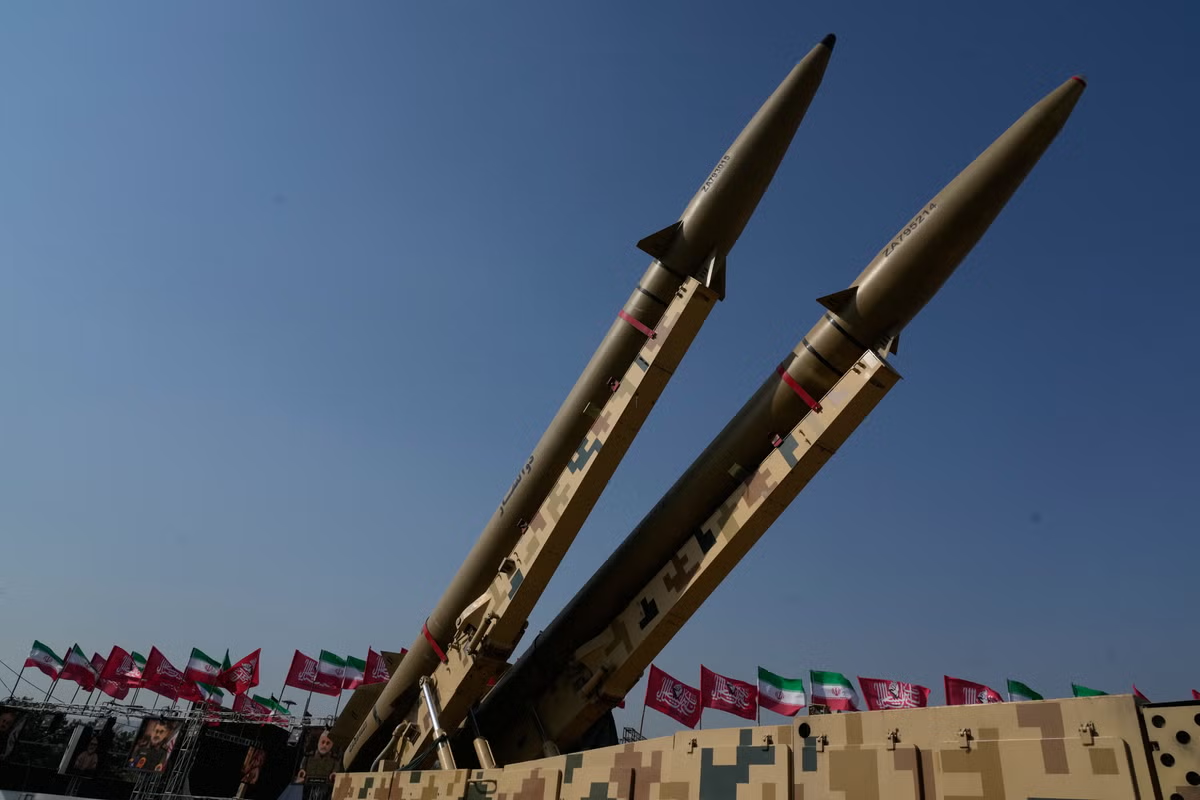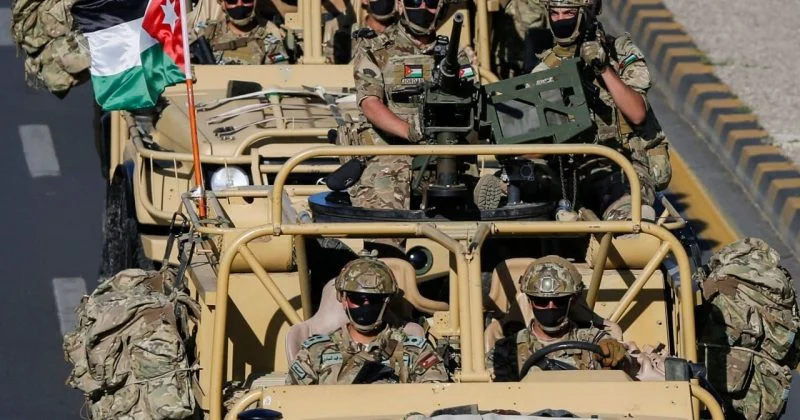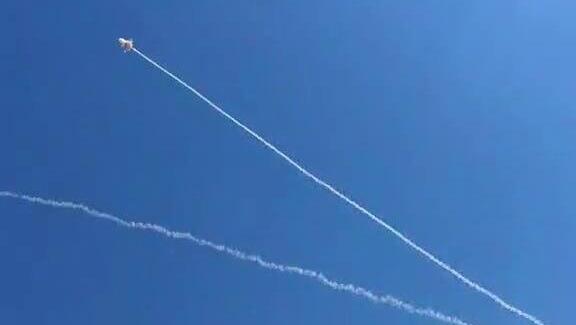
Jordan says it intercepted five Iranian missiles targeting US forces, as renewed American strikes hit military sites across Iran and a residential building on Qeshm Island, killing three members of one family and wounding two young childrenJordan’s armed forces said Thursday that they had foiled an attempt to target the kingdom with five missiles launched from Iran, according to the state-run Petra news agency. Jordanian officials said all five missiles were successfully intercepted. The attack reportedly targeted U.S. forces stationed at Muwaffaq Salti Air Base, a key military installation in the kingdom.The missile barrage marked the end of six days of relative calm following the United States’ previous wave of strikes on Iran overnight between last Thursday and Friday. Iran’s Islamic Revolutionary Guard Corps launched the missiles overnight Tuesday into Wednesday, targeting U.S. forces in Jordan. Two hours later, the United States and Saudi Arabia carried out airstrikes against Iran-backed militias in Iraq.Trump: 'We’re going to be hitting them very hard'The New York Times reported that about 20 Iranian advisers were killed in those strikes, including members of the Revolutionary Guard and technical personnel. A U.S. official told the newspaper that the targets were selected both to eliminate personnel and to reduce the militias’ ability to launch missiles and drones.Iranian state television said the attack on Muwaffaq Salti Air Base followed intelligence gathered by Iran’s Khatam al-Anbiya Headquarters after the United States redeployed A-10 and F-15 aircraft to the base.“The U.S. forces in the region are under surveillance,” Iranian television said. “If necessary, the Revolutionary Guards and the army will strike the targets as quickly as possible.”President Donald Trump described the Iranian barrage as a surprise attack and said U.S. forces had only a few minutes to intercept the ballistic missiles.“So, we had five rockets shot going 8,500 miles an hour, and all five rockets were knocked down to the ground, but they nevertheless took a shot,” Trump said at the White House. “So, it’s our turn.”Trump warned that Iran would face a severe response. “We’re going to be hitting them very hard because it’s our turn to hit them,” he said. “They know it’s coming. They’re asking us not to do it.”Iranian television reported explosions in Bushehr and Bandar Abbas, as well as on the islands of Abu Musa and Kish. Additional strikes were reported around Abadan and the cities of Shadegan, Ahvaz and Arvandkenar. Iran’s Tasnim news agency reported that launches toward Iran had been carried out from Kuwait.US strikes in Iran (Video: CENTCOM)A missile also struck a residential building on Qeshm Island, according to Iranian reports. Authorities in Hormozgan Province initially said five members of one family had been trapped beneath the rubble and that rescue teams had pulled out two injured children while searching for three others.A reporter for Iran’s state broadcaster later said three children had been rescued from the ruins following what he described as a U.S. strike on a residential area. Iranian authorities subsequently reported that three members of the family, the parents and one of their children, had been killed. Two other children were reported wounded.A U.S. official also told Axios overnight Wednesday into Thursday that the United States had launched a new wave of strikes inside Iran. The renewed fighting followed a period in which Washington had largely suspended attacks on Iran.According to Axios, CENTCOM chief Adm. Brad Cooper had recommended ending the bombing campaign around the Strait of Hormuz after concluding that the operation had reached the limits of its effectiveness. Cooper reportedly argued that continued strikes would have little value unless the United States launched a broader campaign aimed at achieving its objectives in Iran.The Wall Street Journal reported that Trump was weighing several possible military responses, including a broad air campaign lasting 10 to 14 days and intended to severely damage Iran’s missile capabilities. The plan was developed by Cooper, according to the report.Trump was also considering a more limited strike that would preserve room for diplomatic negotiations. A senior U.S. administration official told the newspaper that Trump had not yet decided where to strike or how extensive the campaign would be, but described the president as being in a “mood for escalation.”US president Donald Trump (Photo: Ken Cedeno / AFP)The renewed hostilities have also placed Israel and Saudi Arabia on heightened alert. Prime Minister Benjamin Netanyahu met Tuesday night with U.S. Defense Secretary Pete Hegseth, one day after meeting Trump.Netanyahu said Hegseth had praised Israel’s willingness and ability to fight alongside the United States.“He said, ‘We look around the world and see countries that have the will to fight alongside the United States but lack the capability. Then there are countries with the capability but not the will. Only in Israel do we see both the will and the capability,’” Netanyahu said.Saudi Defense Minister Prince Khalid bin Salman also met Vice President JD Vance in Washington, where they discussed the joint strikes and Saudi Arabia’s response to attacks on the kingdom’s infrastructure.Saudi officials believe Iran may seek leverage by escalating through allied militias in Iraq and the Houthis in Yemen. Riyadh’s response is intended to signal that attacks on civilian infrastructure are a red line, while stressing that Saudi Arabia does not seek to be drawn into the wider war.The Iranian attack on Jordan and the renewed U.S. strikes across Iran further demonstrated how rapidly the conflict could spread beyond the two countries, pulling neighboring states into direct military confrontation despite their efforts to avoid escalation.
Jordan foils Iranian missile attack as US launches new wave of strikes
Jordan says it intercepted five Iranian missiles targeting US forces, as renewed American strikes hit military sites across Iran and a residential building on Qeshm Island, killing three members of one family and wounding two young children
909 words~4 min read