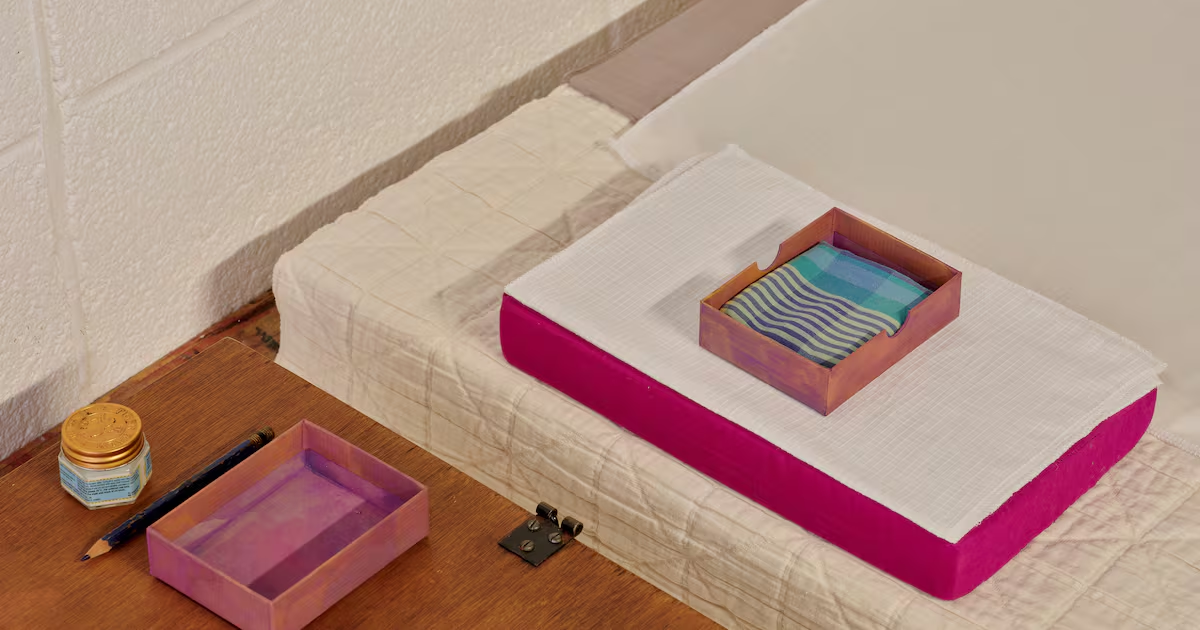
Aleana Egan: A Maritime ChildInterface Inagh/Galway Arts Festival★★★★☆Hidden among the trees on the shore of a lake in Connemara’s spectacular Inagh valley stands an arresting flat-roofed building, all I-beam, glass and rusting corrugation. Designed in the 1980s by architects Scott Tallon Walker as a state-of-the-art salmon hatchery, it is now home to Interface, an exhibition, studio and residency programme exploring the intersections between scientific research and artistic practice.With its concrete reservoirs, enormous circular green tanks and richly suggestive history, it’s a location filled with texture, particularity and a resonance that echoes through the shadows of its former life. Among these shadows a series of nine works by Aleana Egan, curated by Michael Hill, sit comfortably and suggestively, each in their own way responding not only to the physical space in which there are presented, but also to the mood of this remote place, its associations, aspirations and its actuality.The majority of the works are presented across two indoor gallery spaces. Lit clos (2026), a sculptural assemblage in four parts sits near the centre of the first room. The title refers to the traditional Breton box bed and each part has the appearance of a diminutive bed, the largest of which is screened on three sides in hessian. All display a wonderful sensitivity to materials – felted wool against beech wood, cloth of varied hue and pattern arranged in a highly tactile manner with interventions of paint here and there. These bed forms, along with that of another nearby work, Bruno (2026), which incorporates boxes and neatly folded fabrics, have a strange and powerful emptiness about them. They seem to register the location’s history as a former birthing site of sorts without pressing the point too heavily and their proto-architectural forms nicely echo the modernist flavour of the hatchery building itself.The second, more expansive gallery space is darker, illuminated only by the entrance way and lighting fixtures that comprise parts of two of the three sculptures on show there. The tone of works here is more industrial but yet also more mysterious, with Egan presenting older and new work in combination. A Social Edge (2015), an assemblage of upright pipes, steel frames and belt-like objects is both floor and wall work, combining delicacy and rigidity in a manner that brings to mind the work of Carol Bove. Remote Sense (Isuzu Trooper) (2019) amplifies these material contrasts, an engine part presented side by side with a curvy light fixture and a block of coloured polystyrene. In Home and the World (2026) a lamp sits on a chair draped in clothing but here the light bounces off the reflective sequins of a jacket, letting them glitter like the scales of a fish.Three outdoor sculptures complete the show, each quietly merging into and detaching from their surroundings as one moves through them. In particular, Earlier Things (2026), utilises the vocabulary of the site so fluently – tensile rods, cabling and rope – as to be almost indistinguishable from the features of the concrete covered water tank over which it sits. Understudy (2014/2026), on the other hand, brings a dash of colour with it, tubular powder coated steel in red and blue rising above what almost feels like a bench offering a prospect of the lake it faces.[ Testament review: A grippingly intense Mary in new opera with libretto by Colm TóibínOpens in new window ]In A Maritime Child, Egan’s great success lies in her ability to literally embed her works within the history and vernacular of this evocative post-industrial landscape. One might quibble about the number of works presented, the gallery spaces in particular being spacious enough to accommodate additional works. Yet it would be equally fair to say that the artist’s restraint is admirable and probably for the best. Ultimately the viewer is left wanting more.A Maritime Child, presented as part of Galway International Arts Festival, is open on Saturdays and Sundays (noon-6pm) until August 16th
Aleana Egan: A Maritime Child review – Powerful sculptural forms in an evocative setting
Visual art: Artist’s work at the Interface exhibition site in Connemara ultimately leaves the viewer wanting more
653 words~3 min read