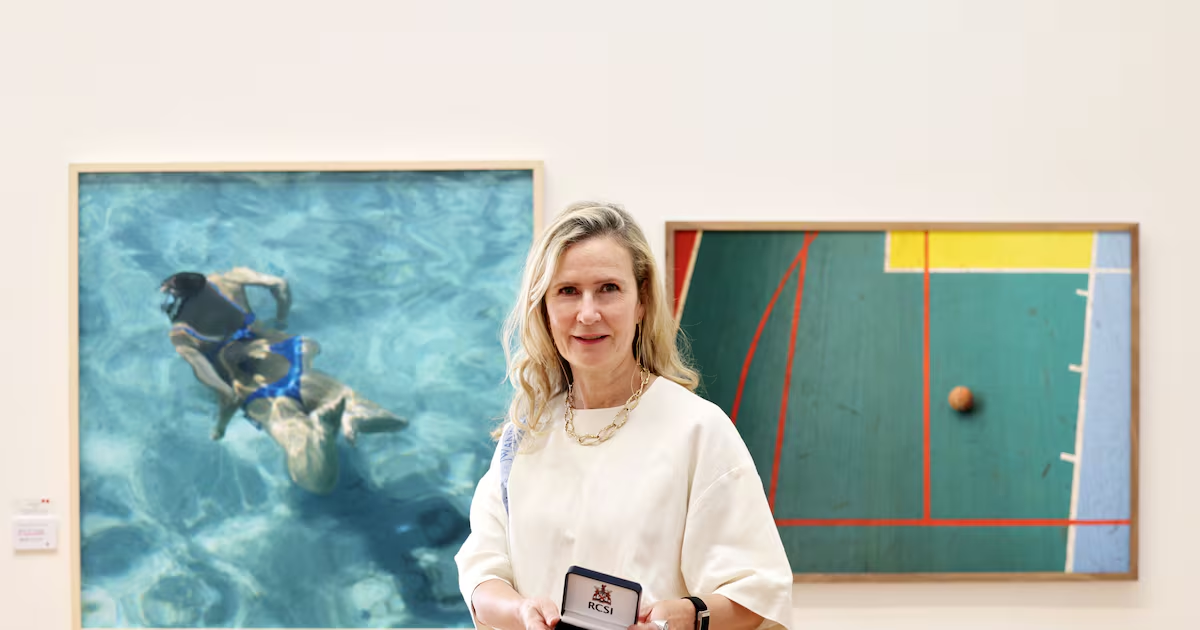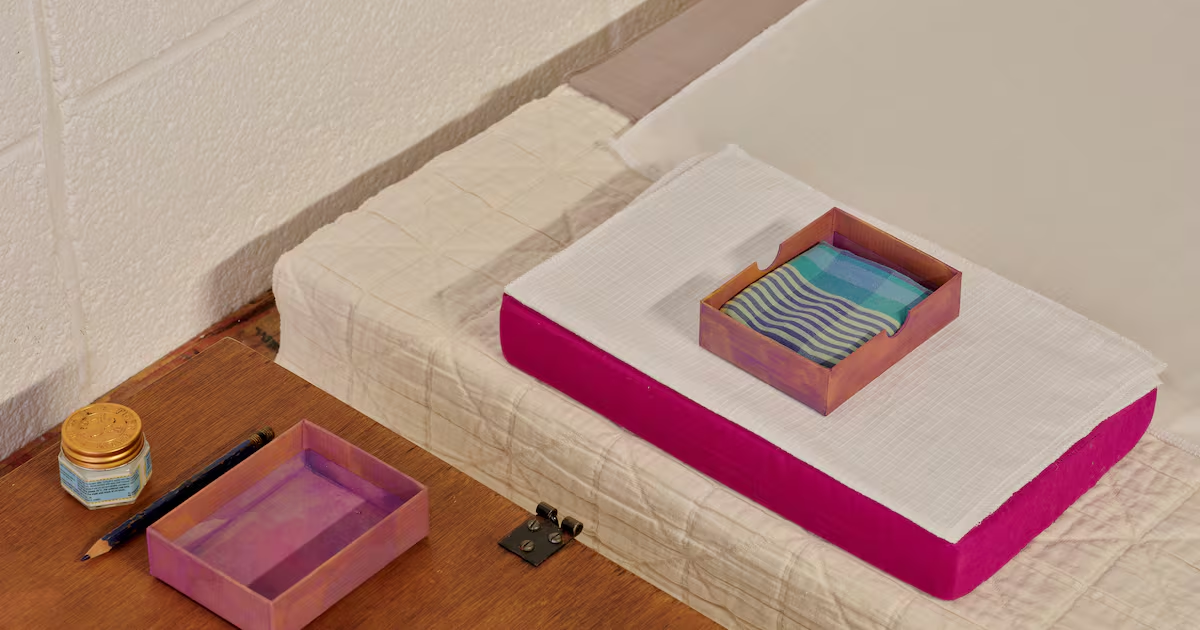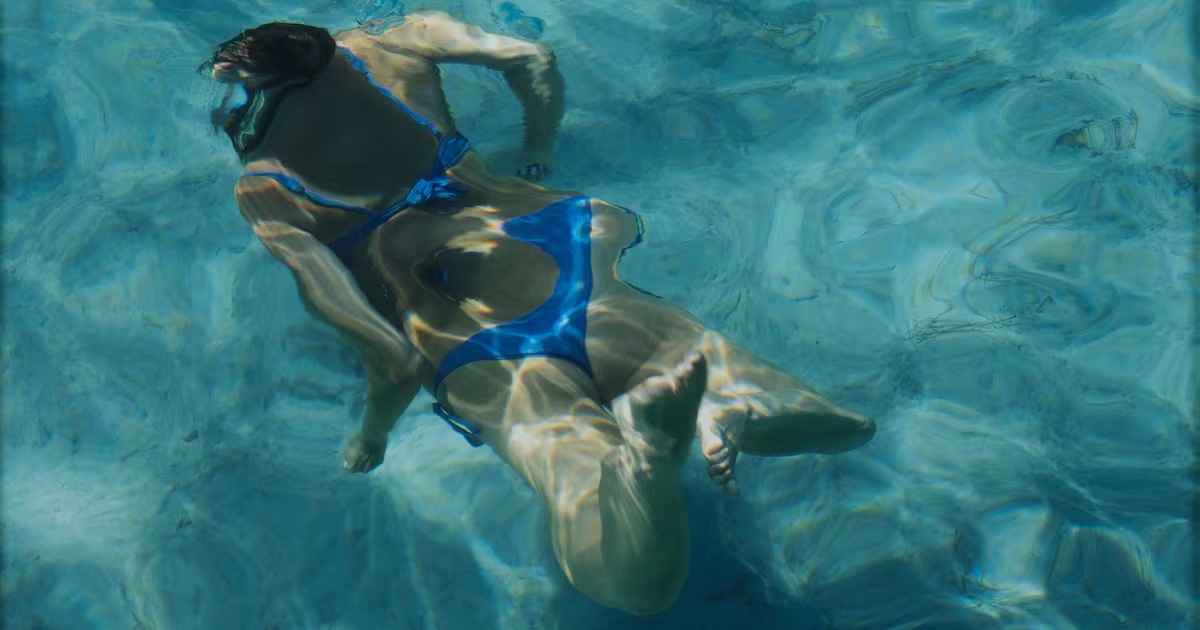
A woman in a blue bikini swims in a turquoise pool. The image is inviting to the eye, refreshing as iced water on a hot day. You could half-imagine diving in. It looks as if the woman may be doing the breaststroke. It also looks as if she has become extraordinarily distorted, layers of light and water refracting to create a shape that doesn’t quite seem human. The image, Alessia by Elaine Byrne, won this year’s Royal College of Surgeons in Ireland Art Award at the 196th RHA Annual Exhibition, and with it a €5,000 prize, the RCSI’s silver medal and a €10,000 commission.Byrne joins a line-up of previous winners that includes Donald Teskey, Amelia Stein, Domino Whisker, Miranda Blennerhassett, Mary A Kelly, Colin Davidson and Stephen Murphy.Over the 11 years of the award their commissioned artworks have become part not only of the RCSI collection but also, as with Blennerhassett’s window decals, part of the fabric of the buildings themselves. For her commission Stein made nine photographic portraits of women in the college. Whisker was inspired by her father’s diagnosis with Alzheimer’s disease to create a woven textile piece based on brain-scan imagery.What was it about Byrne’s image of a swimmer? What can a photograph of a woman in water have to do with teaching the next generation of medical practitioners about their craft? “In a historical collection full of portraits commemorating the past, and mostly of men, these commissions have become an important way of representing the present and future of RCSI,” says Aíne Gibbons, chair of the RCSI’s art committee, who was instrumental in setting up the award in 2016. (This writer was also on the judging panel for the 2026 award.)“They are a reminder that the health sciences aren’t practised in isolation in labs, clinics or hospitals. They exist in the relationships and encounters between humans. The commissions keep those human connections visible.” [ The 196th RHA Annual Exhibition is full of escapism. Where’s the rage?Opens in new window ]Byrne’s work, she says, is a reminder of the value of looking beneath the surface of things. “Medicine begins with observation,” Prof Michael Kerin, the president of the RCSI, said at the award presentation. “Before diagnosis, before treatment, there is the act of looking closely.” Drawing parallels between clinicians and artists, he noted that both “are trained to notice subtle variations in colour, texture, movement, expression and form”. Byrne’s work “invites us to consider the body not as a fixed object but as something changing, vulnerable and constantly shaped by its surroundings.”Elaine Byrne: 'I wanted to develop a more abstract way of thinking and research.' Photograph: Thierry Bal Alessia is part of a series of images of swimmers, and Byrne adds to these ideas. “Maybe the work isn’t really about a distortion,” she says. “Perhaps it is about a revelation, like the photograph was revealing something that had genuinely happened but had escaped perception.” That “maybe” and “perhaps” are interesting. After all, surely artists always know exactly what’s going on in their work? Not necessarily. Byrne took a degree in art history and philosophy at University College Dublin but an interest in sculpture led to night classes in London, where one of the tutors, who also made waxworks for Madam Tussauds, suggested she apply to the Frink School of Figurative Sculpture in Stoke-on-Trent. After studying there Byrne applied to do the more conceptual master’s degree in visual arts studies at Dún Laoghaire Institute of Art, Design and Technology. “I wanted to develop a more abstract way of thinking and research,” she says, describing what she does today as “research-based practice”, making work that may emerge as sculptures, films, photographs and texts.Losing All Sense of Time by Elaine Byrne Mina, by Elaine Byrne, a photographic print on archival paper What is a research-based practice? “It starts with questions. You follow concepts and ideas. You may spend more time researching than making the work.” Does that mean those coming to view the work must also spend a long time reading to understand it? Is there loads of words, and not much art? Not at all, Byrne says. “There may be some text – that’s a balance to get right – but you want people to make their own conclusions. “I’m not saying that people have to think in the same way I do. I want to keep it open. Sometimes I’ll give a talk and explain how I got to where I got to, and what was the jumping-off position, but the jumping-off position may not necessarily be where I landed.” Sometimes the process leads to complex work but frequently it is elegantly simple. A residency at Galway University Hospital in 2009, as part of the Tulca visual arts festival, led to a multicoloured neon installation that may hint at her process for the RCSI commission. “I like to spend time in a place, to get a feel for it. In Galway I took a line from the Clark Gable and Marilyn Monroe film The Misfits. Monroe’s character has got a divorce in Reno, and she asks Gable: ‘What am I going to do now?’ He says: ‘Just live.’ And she asks him how. He tells her to start by getting up, fry an egg, throw stones at a can, whistle ...” So Byrne made a neon list of words: whistle, fry, rise, throw. “I kept it simple. When you’re in hospital, most people just want to go home. To their own bed, their own chair, their own cup of tea.”From The Houyhnhnms for Swiftian Drift by Elaine Byrne Abandoned Basketball, Pyramiden (Svalabard) by Elaine Byrne Byrne was a fellow of the Whitney Independent Study Programme in New York and has a PhD in film and media from Temple University in Philadelphia; the beauty of her work is that it can be visually appreciated as well as intellectually grappled with. For Swiftian Drift, in 2025, which she made to mark the 300th anniversary of Jonathan Swift’s Gulliver’s Travels, she focused on the final section of the book, dealing with the Houyhnhnms, the ultrarational horses that contrast, in Gulliver’s eyes, so strongly with the savage Yahoos. Showing images of horses alongside text, the work initially seems to favour the rational side, yet it also chips away at the idea of a pure state of immutable fact. “Opinions aren’t really a thing,” one text runs. “If someone thinks differently, it’s assumed they’ve missed a bit. Usually a fact. Or the point.”In 2018 her Borderline – like Swiftian Drift, at the Kevin Kavanagh Gallery, which represents her in Ireland – included arresting images of land borders in Melilla, an enclave on the North African coast, bordering Morocco, that remains under Spanish ownership; and of prototypes for Donald Trump’s much-vaunted wall at the border between the United States and Mexico.It would be easy, in less assured and thoughtful hands, for such images to come across as glib opportunism, but instead Byrne’s work gives rise to ideas of truncated relationships, nationalistic political fantasies, economic inequalities and the impoverishing results of cutting people off from one another. Frequently she uncovers telling inconsistencies, or absurdities. Exploring James Joyce’s novel Ulysses, Byrne had originally gone to Szombathely in Hungary, hometown of the fictional Leopold Bloom’s father, to record Hungarian children singing street rhymes mentioned in the novel. Elaine Byrne photographing border walls in Mexico “I was interested in translation,” she says. “But I never showed that work because it became about something else. It became about untranslatableness.” In the Cyclops passage in Ulysses, Joyce writes of the playing of The Rakoczy March, “the unofficial national anthem of Hungary”, on the uilleann pipes. Except, as Byrne found out, the uilleann pipes lack the range to play the piece. “It’s a hidden joke. Joyce would have known it was unplayable on the pipes because he was a musician. That’s the beauty of it.” Through this she opens up a wealth of connections and disconnections, of reaching for understanding, and missing it by an inch – or a mile. “It is also about citizenship, which ties in to borders. Maybe it’s all connected.”As an artist, Byrne is exceptionally resourceful and determined. Trips to Svalbard, where the Arctic and Atlantic Oceans meet, revealed the intricate and increasingly militarised geopolitics of the region, and resulted in Common Work, a 2023 series of videos, photographs and sculptures. “Did you know the Northwest Passage was discovered by an Irish person?” she says as an aside, referring to Robert McClure, in 1850. “And China has invested in three icebreakers. There is no ice around China. There are two Russian towns there, Barentsburg, and Pyramiden, which is abandoned. There’s a caretaker [at Pyramiden] and a hotel that people say is haunted. If you go, you need a guide with a shotgun licence because of the bears. I haven’t got a shotgun licence yet.”She recently concluded a course at Oxford University on AI, “so I could understand it more. I’m not interested in making an AI artwork, but I am interested in how it is going to affect us, how humans and humanity are going to be formed in the future.” Byrne has also enrolled in a “hostile-environment training” course in the UK, in preparation for a proposed project to go to Lebanon. “Forty-seven years of peacekeeping is coming to an end there. I’d love to go and capture the legacy of Camp Shamrock. But you don’t want go and be a burden or a headache to anyone.” Hence the survival course.[ Sian Costello: It’s All About You review – Remarkably skilful painter is an artist to watchOpens in new window ]Byrne’s studio, formerly at the Temple Bar Gallery and now at her home in Dublin, is full of projects in development and what you might call sleeping projects: those ideas and strands of research waiting for a spark to reignite. Her mind is similarly full of connections in the process of being made. “Sometimes,” she says, “you just don’t know. You go and make a film, you take the footage, but the film is actually made on the editing floor.” Just as we don’t always know what we’re thinking until the words come out, Byrne’s work emerges in the making of it, and in the viewer response. “You need that openness,” she says. That brings us back to the connections between her swimmer, Alessia, and medical practice. “Doctors,” she says, “have to listen behind the words people are saying. The work is a little bit like that. What is happening isn’t necessarily what’s really happening. You need to go beyond the obvious.”Gemma Tipton was a member of the 2026 RCSI Art Award judging panel. The 196th RHA Annual Exhibition continues until August 9th
Elaine Byrne: ‘Doctors have to listen behind the words people are saying. Art can be like that’
The winner of this year’s RCSI Art Award on her research-based practice and the parallels between clinicians and artists
1,787 words~8 min read