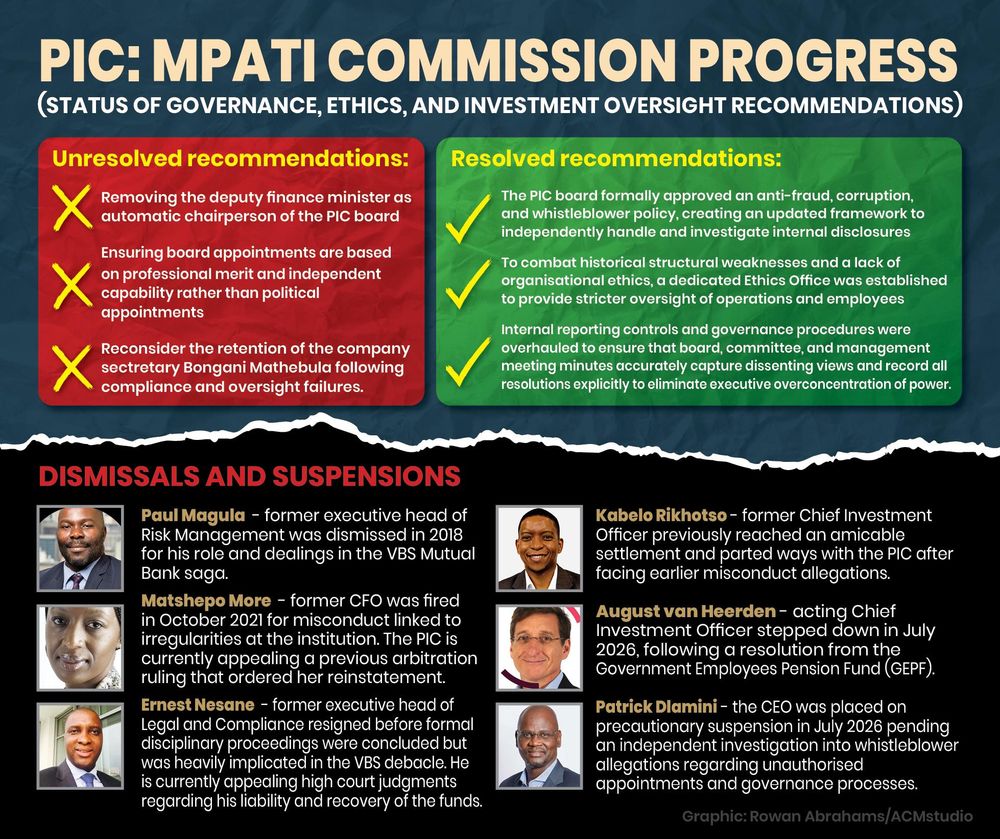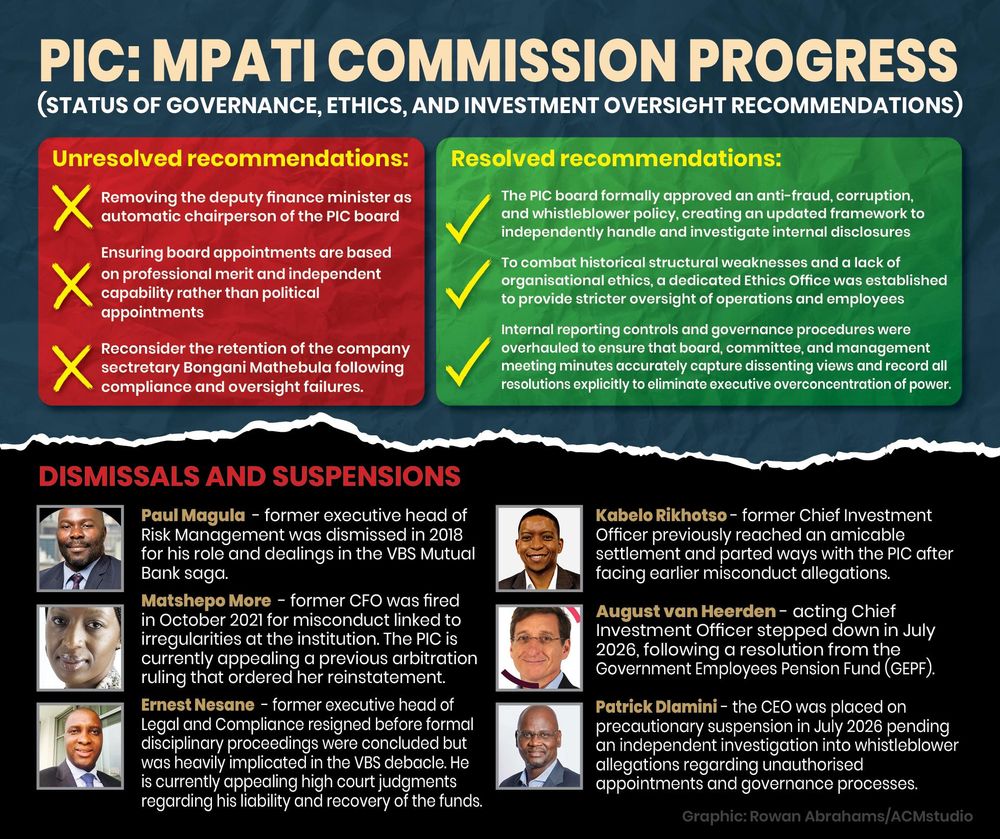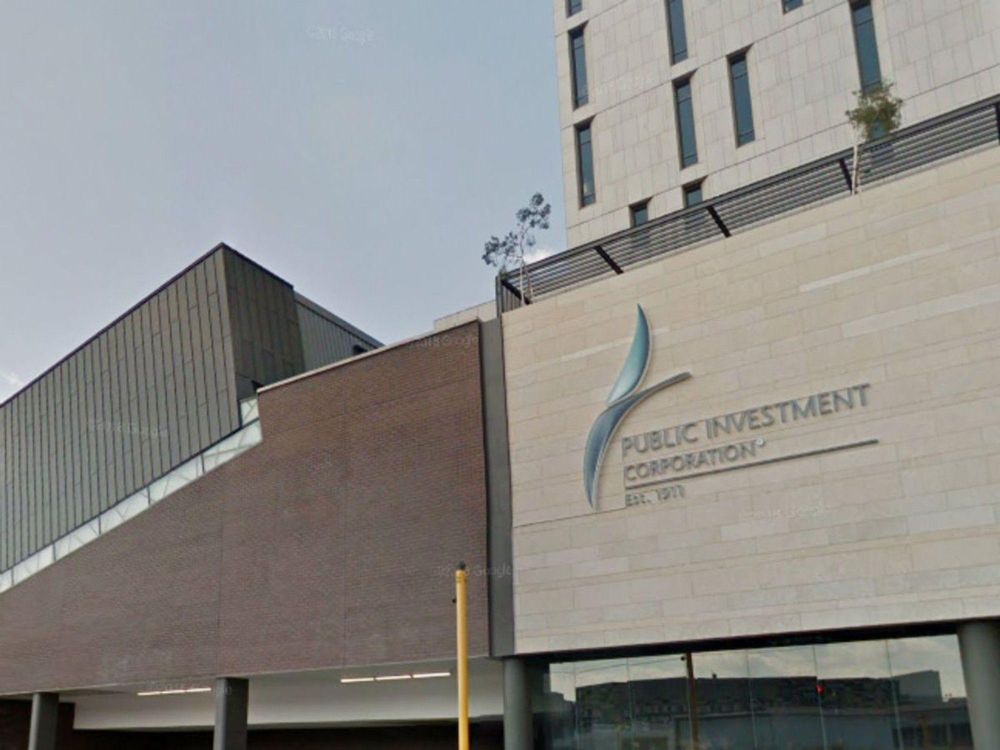
Why is the Public Investment Corporation (PIC) such a poor example of governance? It operates in a field in which governance matters most, with the possible exception of banking. Fund managers deal with other people’s money, after all.As Warren Buffett said, there are two rules of money management: do not lose other people’s money and remember rule one.When it was turned into a corporation in 2005 the PIC was supposed to operate along private sector lines. But instead of appointing a seasoned private sector executive the job was given to Brian Molefe, a Treasury golden boy and golfing buddy of then finance minister Trevor Manuel.Molefe had done a good job managing assets and liabilities at the Treasury, which mainly involved running the debt issuance. But I am not sure if that made him qualified to run the PIC. There was no attempt to recruit from the private sector.Instead of a properly constituted independent board the chair was also an ANC loyalist as the deputy finance minister automatically took the chair. This was back in the days when the ANC had a clear majority in parliament.The only commercial characteristic of the PIC’s culture was the remuneration, which was ― and is ― well ahead of civil service pay scales. It has attracted talented people, at CEO level, such as Abel Sithole and Elias Masilela, and at chief investment officer (CIO) level, such as Dan Matjila and Kabelo Rikhotso.Read: JABULANI SIKHAKHANE | PIC structure fuels integrity crisisMuch as it pains me to say as a Gauteng resident, it would make sense to move the PIC to Cape Town, which has a far deeper pool of fund management industry talent to recruit from.As it turned out, both CIOs were suspended, though Rikhotso’s case still has to be completed. In my personal dealings with him I have found him to be a person of integrity, but time will tell.The PIC has experience managing vanilla fixed income from inception as the Public Debt Commissioners in 1911. Its main client, the Government Employees Pension Fund (GEPF), held no equities, not even domestic equities on the JSE until 1991. Even then, the PIC did not manage them internally. It gave out mandates to the large managers attached to life companies ― Liberty, Old Mutual, Sanlam, Momentum (which traded as RMB Asset Management) and Southern Life (later Futuregrowth).None of today’s big three asset managers got an allocation from the PIC. Allan Gray was still a boutique manager in 1991, Ninety One had only just been formed as the name suggests, and Coronation was only founded in 1993.After corporatisation in 2005 it made sense to move to a two-pronged strategy. Logically, to keep costs down it made sense to run the GEPF’s core equities on a bland but cheap quasi-index basis. It’s so big that it owns about 10%-12% of the JSE.Around the satellite it made sense for the PIC to run higher risk portfolios. The PIC is the country’s largest asset manager, excluding the global, South African-born Ninety One.The PIC can play a part in building up a black-owned asset management sector. It has acted as a lifeline for fledgling black asset managers, some of which have been highly successful.The problems regarding the PIC have arisen almost entirely in the private markets area through its Isibaya Fund, such as the co-investment into Lanseria International Airport. The opportunities for corruption and favouritism seem endless and new examples keep being uncovered.The failure of governance is at two levels: the PIC board itself and among GEPF trustees. For much of the Molefe era, Manuel was the GEPF’s sole trustee. There were eventually elections and two highly credible independents were appointed: former Liberty Asset Management CEO Sidney Place and veteran asset consultant Rhonda Stewart.The problems regarding the PIC have arisen almost entirely in the private markets area through its Isibaya Fund, such as the co-investment into Lanseria International Airport. The opportunities for corruption and favouritism seem endless and new examples keep being uncovered.Place was especially blunt and prepared to bring up uncomfortable topics. Stewart was a little more tactful, but Molefe was not prepared to be challenged. These two heavyweights were discreetly removed. No-one of their calibre has been appointed as an independent GEPF trustee in the intervening 20 years.The GEPF has to use the PIC as its primary asset manager, but there are exceptions. For example, Harith Partners runs an infrastructure fund directly for the GEPF.Any reasonable person would accept that the PIC has done a satisfactory job running its public market portfolios, as fixed income and equity returns have been much in line with the market, at a low overall cost.It is not up to the GEPF trustees to get into the weeds of the day-to-day decision-making, such as stock picking. But the trustees have tolerated the appalling PIC track record on unlisted assets for far too long. There have been numerous exposes of corruption, so they can’t plead ignorance.The GEPF trustee board needs to comprise predominantly management and member trustees, but they should be prepared to choose some heavy hitters as independents.The PIC board should be purged almost entirely of politicians and get the best and brightest from the private sector and civil society to join it. Just no tenderpreneurs who can feed at the trough.Maybe it’s time to think out of the box. It might be time to close down the PIC and let the GEPF itself ― with the other PIC clients such as the Unemployment Insurance Fund ― outsource their assets to the private sector. • Cranston, a veteran financial journalist, is author of ‘The Mavericks’, a new book about South African fund management.
STEPHEN CRANSTON | PIC governance overhaul is long overdue
Reforms should include appointing independent board members from the private sector and civil society, and considering outsourcing asset management to private firms
938 words~4 min read