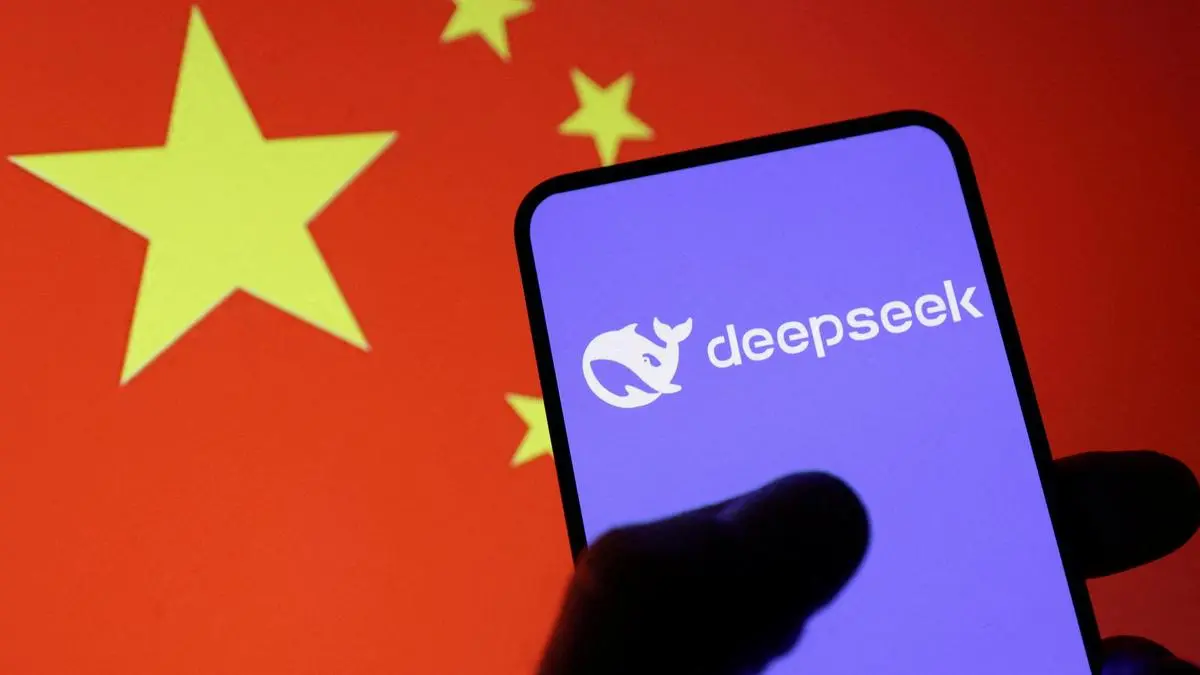
China’s AI token exports are emerging as a new global technology export, with affordable open-weight models such as DeepSeek, Qwen and GLM attracting growing interest from Indian enterprises.
| Photo Credit:
Dado Ruvic
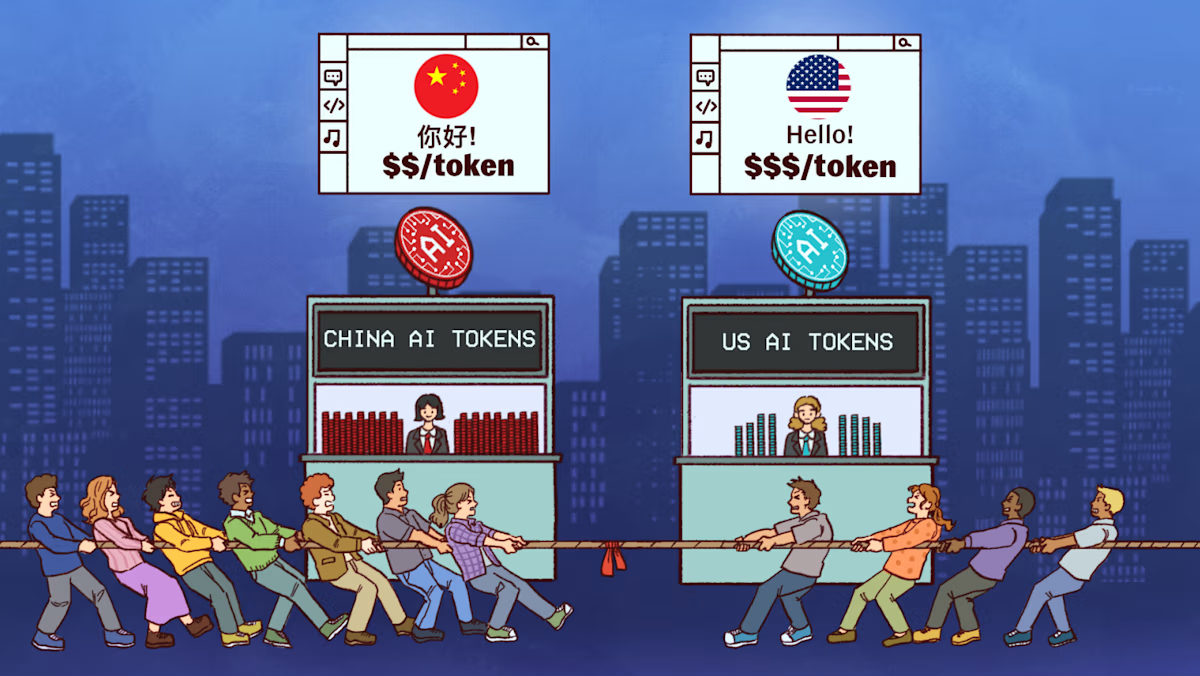
China’s newest export boom is no longer containers packed with electronics or machinery. Increasingly, it is artificial intelligence tokens—billions of AI-generated words, lines of code and responses delivered across borders through application programming interfaces (APIs). The trend is quietly finding takers in India.In January 2025, Bhavish Agrawal announced that Krutrim had deployed DeepSeek R1, the Chinese open-weight AI model, on Nvidia H100 GPUs hosted in India. Krutrim is unlikely to be the only Indian company using Chinese-origin models, although few enterprises are willing to acknowledge it publicly.Globally, the shift is already visible. Cryptocurrency platform Coinbase has disclosed that it uses Chinese models GLM 5.2 from Zhipu AI and Kimi 2.7 from Moonshot AI, with CEO Brian Armstrong saying the move nearly halved the company’s AI costs while allowing token usage to continue rising. Coinbase India declined to comment.The economics are difficult to ignore. Chinese open-weight models such as DeepSeek, Alibaba’s Qwen, GLM and MiniMax are increasingly approaching the performance of leading Western models while costing a fraction as much. Depending on the workload, they can be 20 to 170 times cheaper than proprietary models from OpenAI, Anthropic, or Google.According to OpenRouter, the world’s largest AI model aggregation platform, Chinese models recently processed 4.1 trillion tokens in a week, overtaking US models for the first time at 2.94 trillion tokens. They now account for 61 per cent of token consumption among the platform’s 10 most-used models. Analysts estimate China’s AI token exports are already worth more than $10 billion annually and are growing rapidly.Performance gap narrows as Chinese models gain enterprise acceptanceDr Kanishk Agrawal, Chief Technology Officer, Judge Group India, explained that the gap between leading models in America and China has narrowed over the last year.“Even if the latest models still rank higher than others in many aspects like reasoning, multi-purpose application, safety guidance, and overall development, many Chinese open-weight models have shown impressive results in terms of programming abilities and efficiency of decision-making. At this point, when it comes to enterprises, the discussion becomes not so much about whether the model comes from the U.S. or China but more about the capability to get the most out of the chosen model,” he said.Indian companies balance cost savings with data governance concernsYet Indian enterprises remain cautious. No large listed Indian company has publicly disclosed purchasing inference tokens directly from Chinese AI providers. Analysts say companies serving US and European customers are wary of raising questions around data governance and regulatory compliance.Instead, many are adopting a middle path—running Chinese open-weight models on Indian infrastructure, as Krutrim has done, while some startups are believed to be accessing Chinese models through global cloud marketplaces or APIs.“The economic impact of Chinese AI models depends entirely on deployment,” said Biswajeet Mahapatra, principal analyst at Forrester. Hosted APIs imply recurring foreign exchange outflows, whereas local hosting helps contain costs while giving enterprises greater control over data. The bigger strategic concern, he argues, is whether inexpensive imported models discourage investment in India’s own foundation models.Jaishiv Prakash, principal analyst at Gartner, said organisations should evaluate every externally developed model as an untrusted component of the technology supply chain, irrespective of its country of origin.Meanwhile, Greyhound Research founder Sanchit Vir Gogia added that a Chinese-origin model running within an Indian-controlled private cloud presents a fundamentally different legal and operational proposition from sending confidential enterprise data to a Chinese-hosted public API.Deployment strategy emerges as the defining factorFor Indian enterprises, the debate is therefore moving beyond performance. It is increasingly about where the models run, who controls the data, and whether the country’s AI future is built on imported intelligence or homegrown capabilities.Agrawal echoed this, adding that cybersecurity and data governance remain important regardless of whether a specific organisation uses an American, Chinese, or European AI model.“The point of concern is how the model is deployed, governed, and applied. For organizations operating with sensitive or regulated data, best practices suggest deploying AI models in controlled environments, practicing strict access control, encrypting data both at rest and in transit, monitoring model behavior consistently, and conducting periodic audits for compliance and security. Businesses should evaluate any AI models by conducting rigorous security evaluations, compliance audits, and risk evaluation procedures before using them in production,” he noted.(with inputs from BL intern Siddhi Patil)Published on July 30, 2026