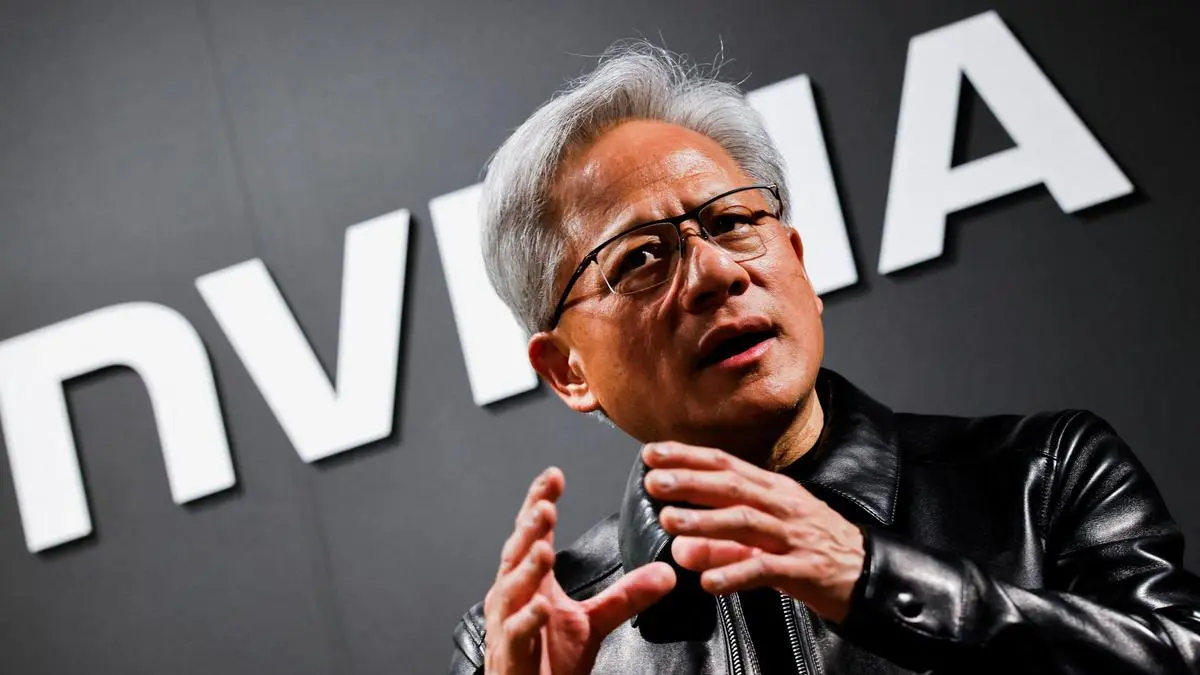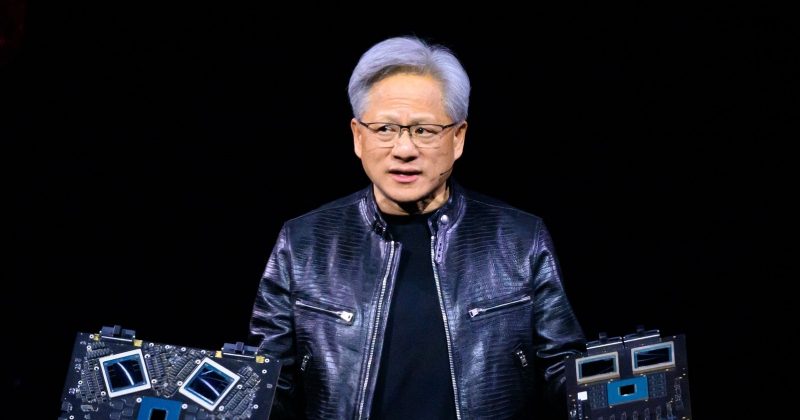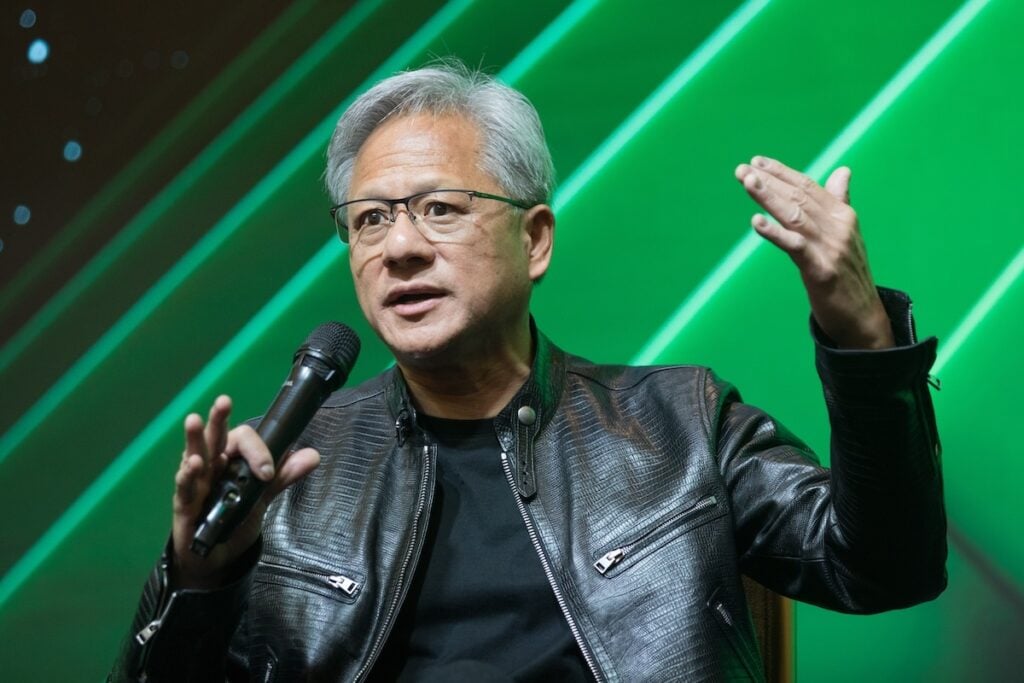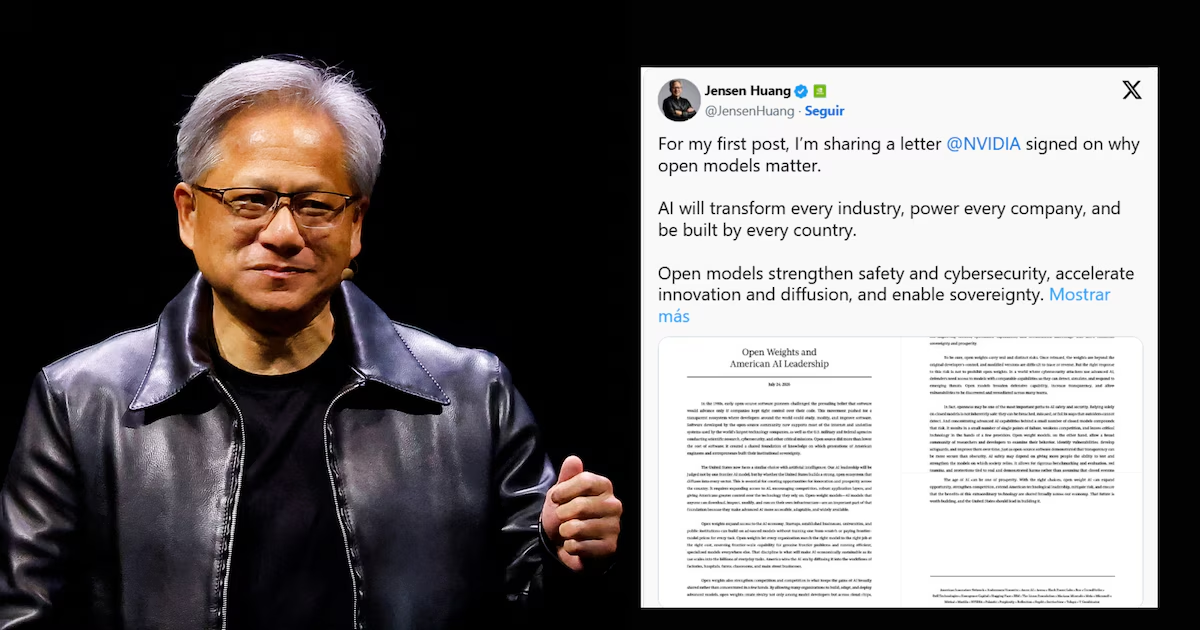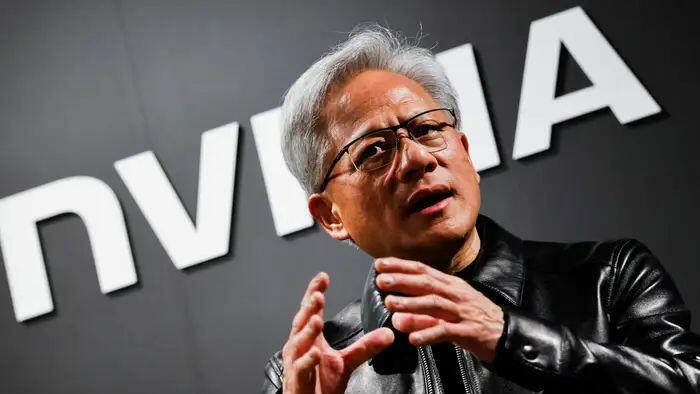
Nvidia CEO Jensen Huang.AFP via Getty ImagesThere’s one argument important enough for Jensen Huang, CEO of Nvidia, to open an X account. Not for the memes. Rather to share a policy letter titled "Open Weights and American AI Leadership," aimed squarely at Washington. Huang’s message? America’s AI leadership depends on models that anyone can download, inspect and build on, and regulators should think hard before restricting them.The most important warning in Huang’s letter is not actually aimed at Washington. It is aimed at every CEO buying AI. If one vendor controls the models, pricing, access and institutional knowledge behind your AI systems, that vendor increasingly controls your business.The companies that win the AI era will own their data, workflows and accumulated intelligence, while keeping the models underneath interchangeable.Within a day, the letter had drawn 11 million views, and the signatory list had doubled from 25 companies to about 50. Sam Altman replied that he was "glad to see this” and Elon Musk (perhaps the only thing these two agree on these days) offered his full support. OpenAI and Google added their names to the list of signatories, alongside Microsoft, Meta, IBM, Dell and most of the venture and infrastructure world.So, what exactly are the most powerful companies in the world seemingly agreeing on?Here’s a quick primer on the topic and Huang’s positioning A model’s weights are the billions of trained parameters that make it work. An open weight model is one whose developer publishes those weights, so any company can download the model, run it on its own servers, and tune it on its own data, the way Meta’s Llama 4 and Thinking Machines’ Inkling work today. In contrast, a closed model lives behind its developer's API, and the lab controls the pricing, the terms and your access.MORE FOR YOUThe letter makes a geopolitical case for open weights, comparing them to the open-source software movement and warning policymakers against premature restrictions. But its most important argument for businesses is simpler: Companies should not become permanently dependent on a single AI provider. I agree with much of Huang’s positioning, but the message I keep coming back to is less about geopolitics, and more about ownership. Organizations investing in AI, the letter says, “want to know that they will not become locked into a single provider or lose the knowledge and capabilities they build over time.”That is the practical risk every CEO should understand: A provider can raise prices, change its terms, restrict access or leave a company’s most important workflows dependent on technology it does not control. For 50 of the leading AI companies, including closed-source labs, to agree that customers should not be locked into a single provider is a sign of where we’re heading. Even the closed frontier labs are on boardWhy would OpenAI and Google, two of the leading frontier labs building closed-source models, sign this? Because the letter’s premise, that no single model is going to power the whole economy, has become industry consensus. Companies will keep running a mix of models, some open, some closed, and swap them out whenever something better or cheaper comes along. Open weight models are already so widely used that Washington would struggle to effectively ban them even if policymakers tried. By signing Huang’s letter, the signatories are now part of the conversation around open weight models. And while the letter had one notable holdout, Anthropic, the company shortly after published a statement softening its position. Anthropic CEO Dario Amodei clarified the company’s position on open weight models, writing that the company "has never advocated for a ban on open weights models" and called open models without dangerous capabilities "a public good." He then continued, “But I don’t agree with the letter’s assertions that open-weights models necessarily make it easier to develop safeguards or that broad access to capabilities necessarily helps defenders more than attackers.”Even Anthropic, with every incentive to push back on open weights, has conceded there will be no winner-take-all. The future is multi-model.Open source already ran this experimentHuang’s letter reflected on the 1980s and open-source software, an analogy whose outcome we’re living today. Open source didn’t make software worthless.Linux was free, and enormous value flowed to everyone who built on it: established businesses that stopped writing seven-figure checks for licensed systems, startups that could launch because their software cost nothing, and eventually the cloud itself, most of which runs on Linux to this day.The free layer became the foundation everyone shared. A company’s competitive advantage came down to what it built on that foundation and the proprietary data it had.What buyers actually wantThe demand side is already moving in that direction. Inside most institutional AI deployments today, several frontier models are working side by side, because different models are better at different jobs (and leapfrog each other frequently).Over the past year, the questions I hear from credit firms have changed: less about which model sits underneath, more about where their data goes, how their own deal history gets put to work, and whether the capabilities that power their workflows today will still belong to them next year.Organizations want to own their use of AI:To control their data.To fine-tune models to their proprietary information.To avoid a disruption to their business if a single model provider changes the terms.Here’s what I think will happen. Within a few years, the standard infrastructure setup at a credit firm will be built around ownership:Workflows the firm controls.Institutional knowledge that compounds in systems the firm keeps.Models underneath treated as swappable parts, some of them eventually running on infrastructure the firm hosts itself.Firms won't build their scaffolding alone, and they shouldn't have to. The application layer companies that succeed will be the ones that build it around each client's own data and leave the ownership with the client. Where the value livesThe most important line in Huang’s letter is about ownership. As companies build with AI, they should be able to retain the value they create: the specialized workflows, institutional knowledge, and capabilities that improve over time.That value does not live in the underlying model alone. It lives in what a company builds around the model: its proprietary data, accumulated experience, and the systems that put both to work.We are already seeing this play out in private markets. Two credit funds can run the same model on the same deal and produce very different results. One treats AI like a chatbot and starts every analysis from scratch. The other connects the model to the firm’s deal history, comparable investments, underwriting standards, and every lesson its team has learned.The second firm’s advantage compounds with every new deal. The model may change next quarter, but the firm’s knowledge remains and becomes more valuable.That is why vendor lock-in is so dangerous. A company should not lose access to its accumulated intelligence because one provider raises prices, changes its terms, or falls behind a better model. The data, workflows, and institutional knowledge must remain under the company’s control, while the models underneath remain replaceable.Every CEO should demand that from their AI strategy: own the data, control the workflows, and preserve the ability to switch models without rebuilding the business.Use the best AI vendors. But never let one of them own your AI.
Jensen Huang’s Warning To Every CEO: Don’t Let One Vendor Own Your AI
Jensen Huang warns CEOs against AI vendor lock-in, arguing open-weight models help companies retain control of their data, workflows and institutional knowledge securely.
TL;DRAI
Nvidia CEO Huang co-signed a letter with 50+ tech leaders warning CEOs: single-vendor AI dependency means losing control of critical workflows and data. Organizations should own data and treat models as interchangeable components to avoid lock-in.
1,203 words~5 min read