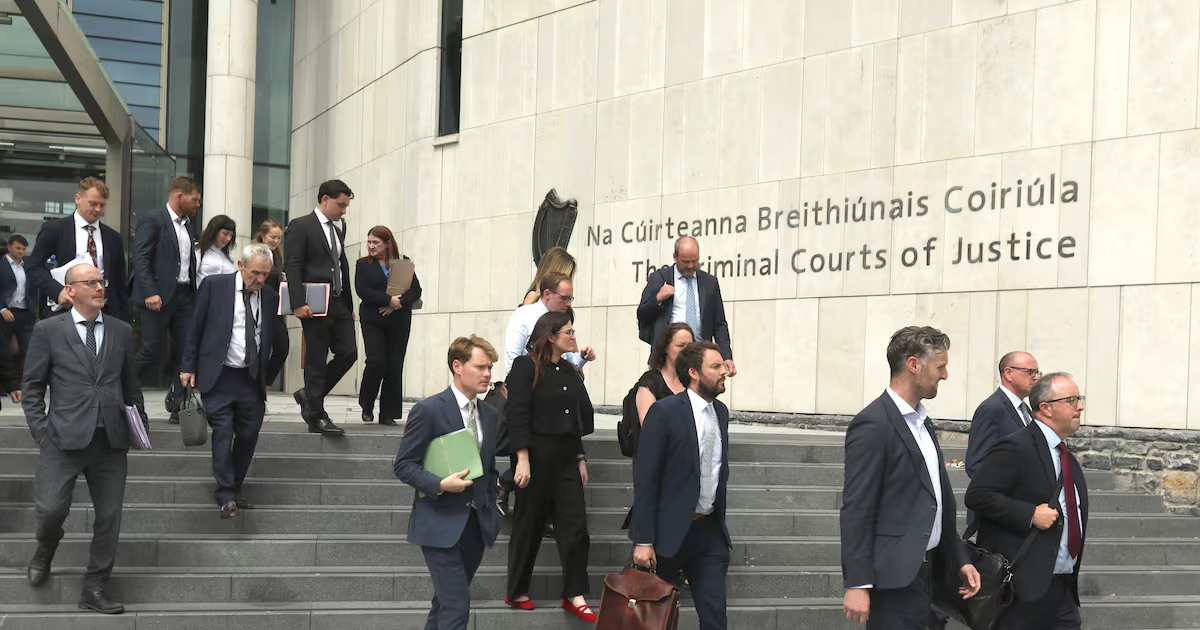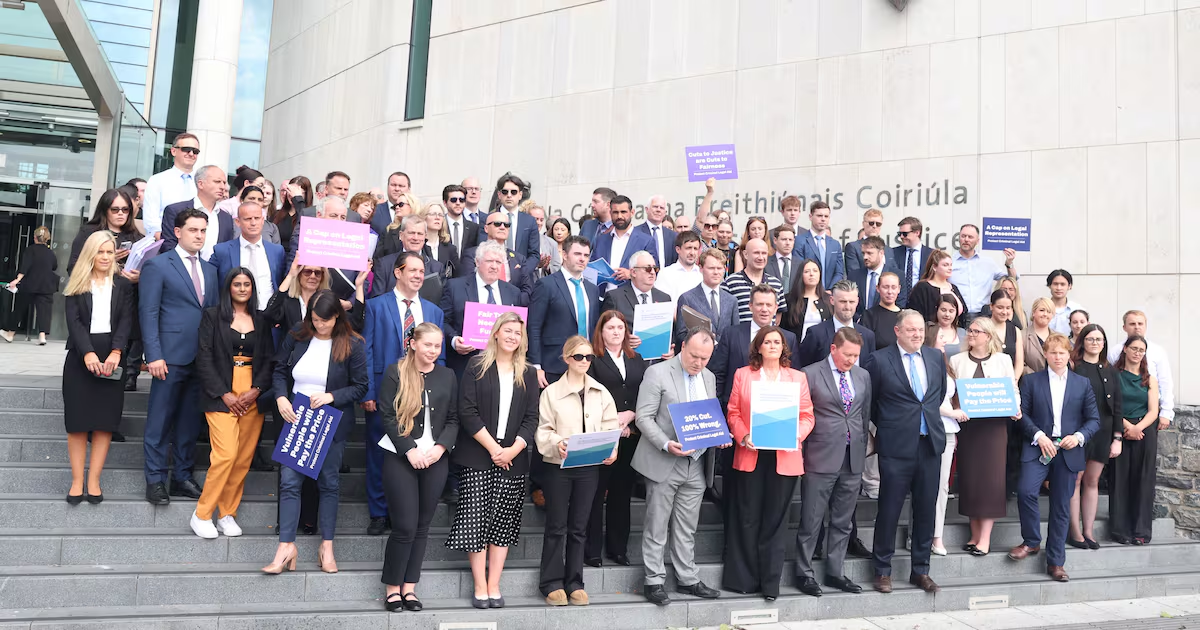
Some division has emerged among solicitors before a crucial meeting over whether to accept amendments to a controversial new payment model for criminal legal aid work in the District Court.Most criminal defence solicitors remain unhappy with the one-flat-fee payments introduced by the Minister for Justice Jim O’Callaghan, with many indicating determination to continue with a widespread withdrawal of services, ongoing since last month and escalated since July 1st when the new model came into effect. However, the financial impact of that withdrawal, some believe, could yet affect the outcome of a meeting on Friday convened by a Law Society committee. The financial impact is particularly significant for solicitors whose practice is strongly reliant on criminal legal aid.Frank Buttimer, who was among solicitor and Law Society representatives who met O’Callaghan on Monday to discuss the scheme and put forward their own reform proposals, said on Wednesday he would be recommending the minister’s amended proposals should not be accepted. [ High Court rules 11 people entitled to ‘immediate release’ over lack of legal representation ]“I believe a majority of solicitors will be extremely disappointed with the minister’s failure to make any changes to the issues of concern,” the Cork-based solicitor said. Dublin-based solicitor Colleen Gildernew, while welcoming the minister’s meeting with the Law Society, said “it’s clear that he hasn’t listened to the concerns of practitioners”. “Solicitors are now in the invidious position of being unable to represent their clients, who tend to be some of the most vulnerable and marginalised people in society,” she said. “We are conscious of the knock-on effects this has on witnesses and victims of crime. It is clear that justice cannot be administered when the concerns of criminal defence practitioners have not been addressed.” [ Department of Justice received 78 legal aid invoices for individual’s theft charges ]Her concerns about the amended proposals included about the minister’s precise position in relation to the issuing, following a first day hearing of charges, of a second, subsequent legal aid certificate for separate charges. She queried if the minister was referring to further charges arising out of the same incident or to distinct and separate charges. But Meath-based solicitor Maurice Regan, while also expressing unhappiness with aspects of the minister’s response, said he believed the problem was “fixable”.“I want this fixed. I want to get back to work,” he said. “It is very fixable. We’re not being unreasonable and I believe we can come to an agreement. I didn’t get into criminal legal aid work to get rich, but I want to be paid for the work I do.”Dublin-based Phelim O’Neill, one of a small number of criminal defence solicitors who have not participated in the withdrawal of services, said the minister’s proposals “resolve the matter for me entirely”.The proposals are “perfectly fair and equitable” and “collapse any reason for solicitors to continue with their action”, he said. “It is completely intolerable that vulnerable people and children are being left without legal representation.”His practice was mostly in serious crime in the Central Criminal Court, but all his work emanated from the District Court, O’Neill said. The widespread withdrawal of criminal legal aid services has caused thousands of adjournments affecting accused persons, lawyers, witnesses and victims and adding to backlogs across the criminal courts. Unless a solution is found, there is mounting concern the problems will be considerably worse when the courts resume full hearings in autumn. The present law terms ends on Friday. Under the minister’s amended proposals, core elements of the new payment model remain in place, particularly a single flat fee of €520 per client, based on an average five appearances, irrespective of the number of court appearances. That replaced the previous system of about €239 for the first appearance and €60 for each subsequent appearance.Many solicitors remain resolutely opposed to a single flat fee, saying it did not reflect the amount of work involved, but have welcome the proposal to front-load payment of two-thirds of the €520 fee at the outset of a case, with the remainder paid at the end or after 12 months since the case began, whichever is sooner. Two other elements of the new payment model, which remain in place, amount to red lines for a considerable group of solicitors. The first is a provision for a new legal aid certificate to issue for an accused person where the charges arising are distinct and separate to any previous court appearance made by that person. Solicitors say that does not reflect work involved in cases where, for example, an accused person is subject of three separate charges in three separate courts involving three different prosecuting gardaí. Their second concern is the minister’s statement his department will “review” the operation of the new scheme in the Children’s Court and for cases where more than 20 appearances are required. They want a more concrete commitment they will be adequately paid in such cases.The Law Society has sought clarification from the department about some matters before Friday’s meeting.
‘I want this fixed and to get back to work’: Solicitors split on criminal legal aid reform
Most unhappy at single flat-fee payments, but adjustments to address concerns have pleased others
832 words~4 min read