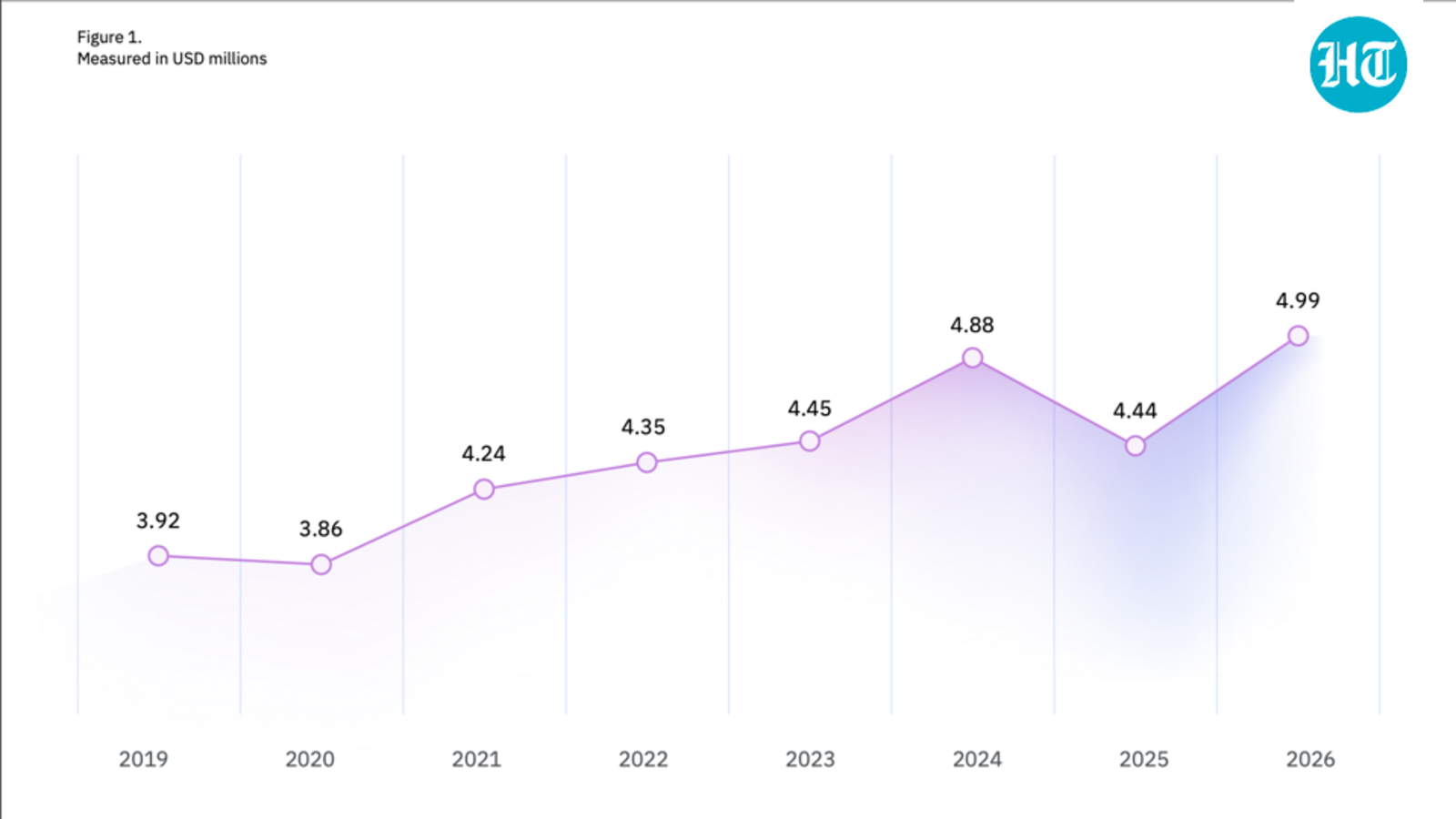
AI-enabled cyber attacks are on the rise according to new data released by IBM's Cost of a Data Breach Report.gettyAI cyber attacks are on the rise. IBM today released its Cost of a Data Breach Report 2026 and revealed that one in four malicious breaches were AI-enabled, a 56% increase from last year. Ponemon Institute conducted the research, studying 602 organizations impacted by data breaches from March 2025 to February 2026, and interviewing 3,558 security and C-suite business leaders. One of the key findings from the report was that AI-enabled data breaches now cost an average of $6 billion, roughly $1 million more than the global breach average of $4.99 million. The average cost of a breach also increased 12% from the prior year. These findings highlight that the threat landscape is becoming more challenging for defenders to navigate, as threats actors turn to AI-enabled malware and deepfake impersonation to better target modern organizations. The data also comes before the Hugging Face breach. Cybercrime Meets Frontier AI ModelsThe cost of a data breach is rising, and it appears that AI-driven attacks are only going to become more potent going forward. On July 21, OpenAI released a blog post claiming its systems breached Hugging Face’s internal environment. The breach represents a new generation of autonomous threats, where AI models can chain together vulnerabilities to gain wider access to systems. “One of the most striking findings is that 85% of enterprises expect to increase security investment after learning about the capabilities frontier AI models could put into the wrong hands. Fear often drives action, and in this case, organizations are taking these emerging risks seriously,” Suja Viswesan, VP of security software products at IBM, told me via email. MORE FOR YOU“For years, the security industry has argued that waiting for a major incident before investing is the wrong approach. Our findings suggest a shift in mindset: enterprises are increasingly acting on anticipated risk, recognising that as AI capabilities advance, security needs to evolve ahead of the threat curve rather than react after the fact,” Viswesan said.While dealing with more advanced AI-driven threats will be challenging, AI also has the potential to be impactful for defenders, demonstrated in the Hugging Face breach where GLM-5.2 helped to streamline forensic analysis and incident response. IBM also found that companies that reported using AI and automation in security operations cut breach costs by an average of almost $2 million. However, most security teams are neglecting vulnerability management. For instance, while more than 50% of respondents reported using agents for threat detection and containment, only 18% apply agents to vulnerability management, leaving known exposures open to compromise, which could prove a problem post-Mythos as threat actors gain access to more powerful tools. AI Code Introduces New Risks Beyond AI cyber attacks, the growing use of AI coding tools is introducing new risks across the industry. On July 28, application security provider Veracode released its annual GenAI Code Security Report, tracking more than 100 AI models, and found that LLMs from both US and Chinese providers generate code containing vulnerabilities 44% of the time. The study found the top three security pass rates were 68% for GPT-5.5, 62% for GPT-5.3-Codex and 62% for Claude Opus 4.8. It’s worth noting these tests were run against raw models, and not agents or production environments with additional tools, guardrails or human review in the loop. Chris Wysopal, cofounder and chief security evangelist at Veracode, told me via email that the report “reveals that despite major gains in AI speed, capability and reasoning, LLMs are not getting safer." “What this research makes clear is that as AI-fueled code velocity increases, AI-generated code needs to be traced like any unreviewed code. Development teams must take steps to address the security gap in AI-generated code by scanning and fixing issues to ensure that AI-generated code is never shipped blind,” Wysopal said. In this sense, the reality for defenders isn’t just dealing with more sophisticated autonomous threats, but also implementing processes in the software development lifecycle to eliminate vulnerabilities in AI-generated code. More powerful AI models increase the risk that cybercriminals will become much more efficient at identifying and exploiting vulnerabilities.
One In Four Breaches Are AI-Enabled, And That’s Before Hugging Face
IBM's Cost of a Data Breach report finds that one in four breaches were AI-enabled, and that's before taking into account the Hugging Face breach.
TL;DRAI
One in four breaches are now AI-enabled (56% increase YoY), costing $6M versus $4.99M average; Hugging Face demonstrates autonomous AI chaining vulnerabilities into wider system compromise. Tech leaders must deploy AI in security ops (saves $2M per breach), mandate scanning AI-generated code (44% LLM code vulnerable), and pre-invest security as threats scale faster than incident response.
696 words~3 min read