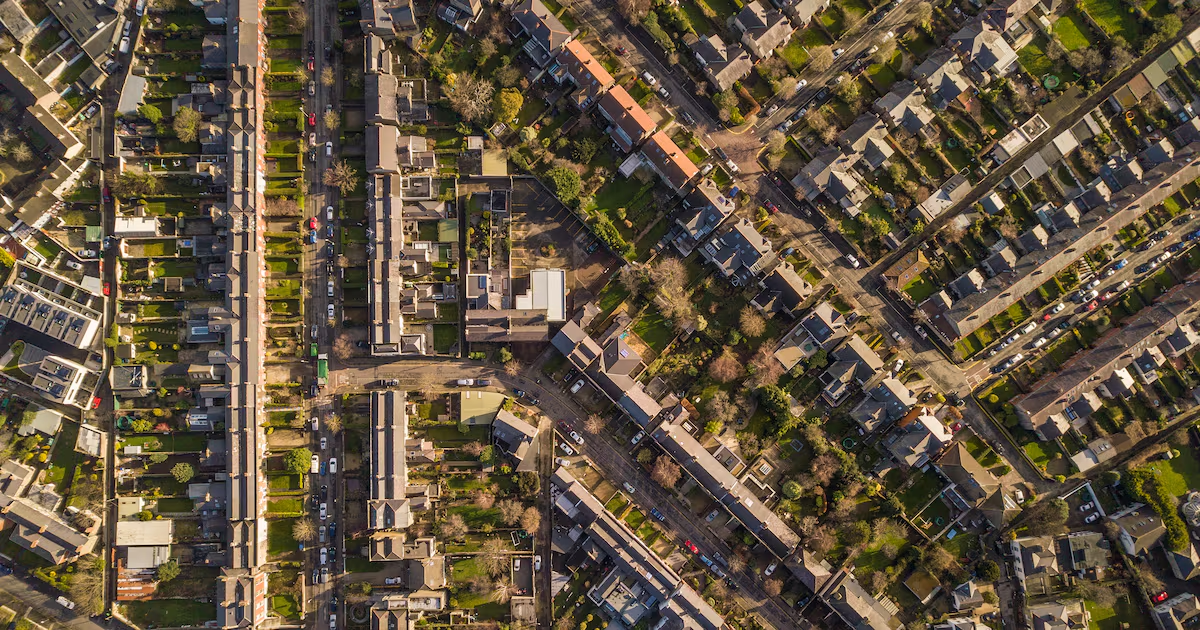
One of the moms in one of the moms’ groups (it always get Americanised on WhatsApp) shared an advert for new-builds for sale in our area. Not homes that are for sale now, but from the time when the houses were first built in the early 1970s. Three-bed semi-detacheds with central heating, an insulated attic and rust-proof windows. Interestingly, the advert contained no adjectives: nothing about them being “charming” or “spacious”. Instead, it explained that purchasers could get a 90 per cent mortgage and that the repayments would be about £6 a week. There was no mention of interest rates, and the phrase “asking price” was also absent. The price was just the price: £3,925.Fadó fadó. Those houses are still there. Many now sprout solar panels and have extensions and external insulation. A few (from the outside) seem unchanged, which must be chilly in the winter. But prior to their construction five decades ago, the area I live in consisted mostly of fields. In the late 1960s, Dublin Corporation decided to create a new suburb, and curiously, seemed to have had an idea about the right way to go about it. There was even – gasp – a touch of innovation. The first few streets were deliberately curved, with blocks of three houses set at angles to each other. The garage for each house was set further back or even across the road. It’s wider and much more visually interesting than the usual, straight, long stretch of homes: the expansive feel acting as an encouragement for people to spend time outside their front doors. Which they do.And while the homes were being built, the planners seemed to think it was important that this new suburb have a centre, consisting of a church, a pub, a community centre and various shops. It was located beside a park, which you walk through to get to the train station: amenities that were all put in place at around the same time the houses were being constructed. I don’t know who devised all this, but it often strikes me that they must have been mindful of the fact that they weren’t just designing a suburb, but a community: and for that to develop properly, there have to be opportunities for people to have casual interactions, to bump into each other and chat. The shopping area (which has since been redeveloped) is striking for exactly that reason. Weather permitting, there are as many people outside the supermarket as inside.It’s one of those things that you don’t fully appreciate until afterwards, until you’ve lived elsewhere and have something to compare it to. There are people who grew up in my suburb who would like to move back and raise their kids here. But – of course – they can’t afford to. The market has decided that for them. [ Seán Moncrieff: In the not-too-distant future four of my five children may live overseasOpens in new window ]It often reminds me of when I was a young reporter working on a local Dublin newspaper. I spent an inordinate amount of time writing about Tallaght. Ignoring advice about the importance of community facilities, the then Dublin County Council proceeded with building thousands of homes. But the residents of those homes had nowhere to go in terms of communal amenities. For many years, it was a disaster.At the edges of Dublin and in various towns around the country, similar developments with aspirational titles are being constructed. It’s perhaps too soon to say whether enough thought has been given to shaping communities in these places, though the anecdotal evidence isn’t encouraging. Such is the rush to put roofs over heads, a lot of it seems to be soulless urban sprawl. And while the building goes on, established places that used to have a centre are becoming hollowed out. Large multiples establish themselves in shopping centres on the edges of towns. The main streets start to wither. Neighbours don’t bump into each other any more. The market decides who your friends are. Or whether you have any friends at all.
Seán Moncrieff: Dublin seemed to know how to create new suburbs in the 1960s. Now, there’s soulless urban sprawl
While the building goes on, established places that used to have a centre are becoming hollowed out
679 words~3 min read