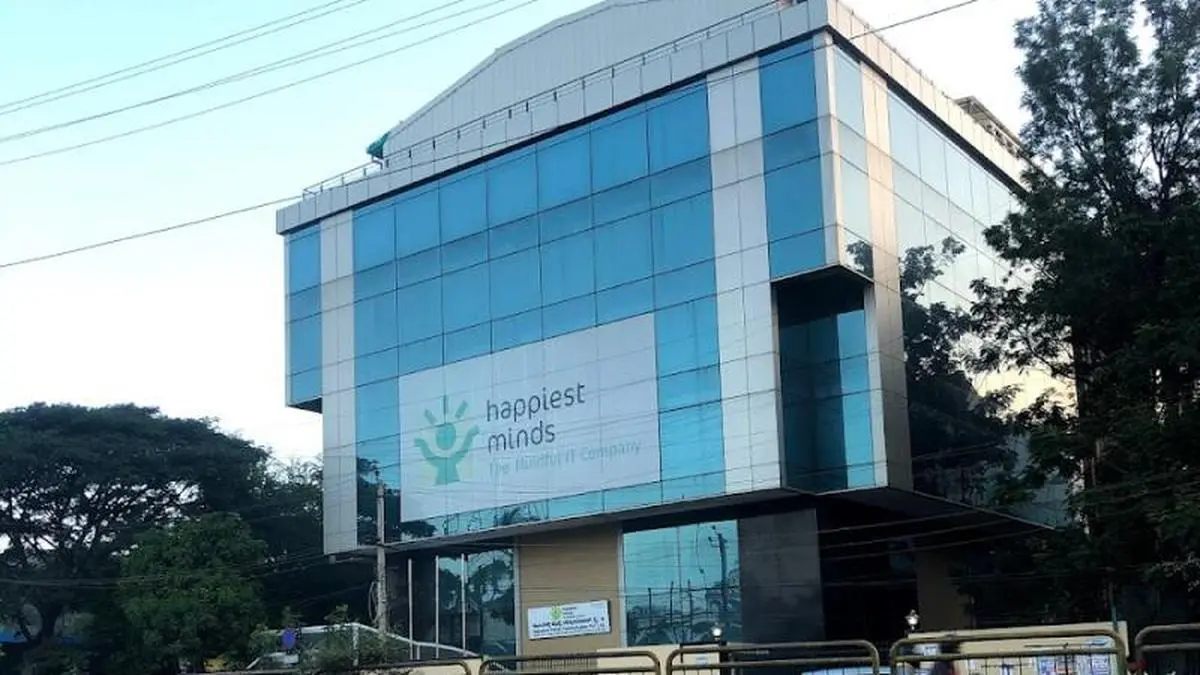
Happiest Minds reported revenue of ₹628.5 crore for Q1FY27, up 4 per cent quarter-on-quarter (QoQ) and 14.3 per cent year-on-year (YoY).In constant currency (CC) terms, revenue grew 2.6 per cent QoQ and 6.7 per cent YoY. Adjusted profit after tax (PAT) stood at ₹80.5 crore, rising 12.9 per cent QoQ and 14.7 per cent YoY, while operating profit increased 2.3 per cent QoQ and 11.8 per cent YoY to ₹108.7 crore.Joseph Anantharaju, Co-Chairman & CEO, and Venkatraman Narayanan, Managing Director, discuss the company’s Q1 performance, demand environment, AI strategy, vendor consolidation, hiring trends, and outlook for the rest of FY27.
Any key highlights from the quarter?
VN: We delivered a strong performance in Q4FY26, and that momentum has continued into this quarter. Some of the key highlights include 14.5 per cent year-on-year revenue growth and a 17 per cent increase in EPS to ₹5.34. This has also translated into improved return on capital employed (ROCE) and return on equity (ROE).Following the QIP around two years ago, these ratios had moderated, but as we deploy that capital more effectively, we’re seeing returns improve. If you adjust for some one-time costs during this quarter, our operating margin is about 18.5-19 per cent. With that, we are entering the second quarter, where we typically see an increase in costs due to wage hikes and other factors. However, we are entering the fiscal year with strong revenue growth potential, supported by a healthy pipeline.Profitability-wise, the investments that we made are paying off. GBS has become profitable. And the new business pipeline is doing well. Our guidance for the year is 12.5 per cent, and our task for the rest of the year is to focus on that growth.JA: Growth was driven by three geographies, while others were flattish. India grew 9 per cent, APAC 10 per cent, and West Asia by around 6 per cent. APAC and West Asia were driven by a few large banks where we saw good growth during the quarter. Across verticals, BFSI and healthcare & life sciences posted growth during the quarter.EdTech recorded its second consecutive quarter of growth after several quarters of decline, while the hi-tech segment grew 10 per cent quarter-on-quarter. Industrial and manufacturing remained largely flat, whereas media and entertainment declined by around 4–5 per cent sequentially. The demand environment is holding up despite all the headwinds -- the war, the political situation, and inflation.We are seeing customers redirect savings generated from optimising their software development lifecycle — primarily through productivity tools in support and maintenance functions — towards AI initiatives and innovation.