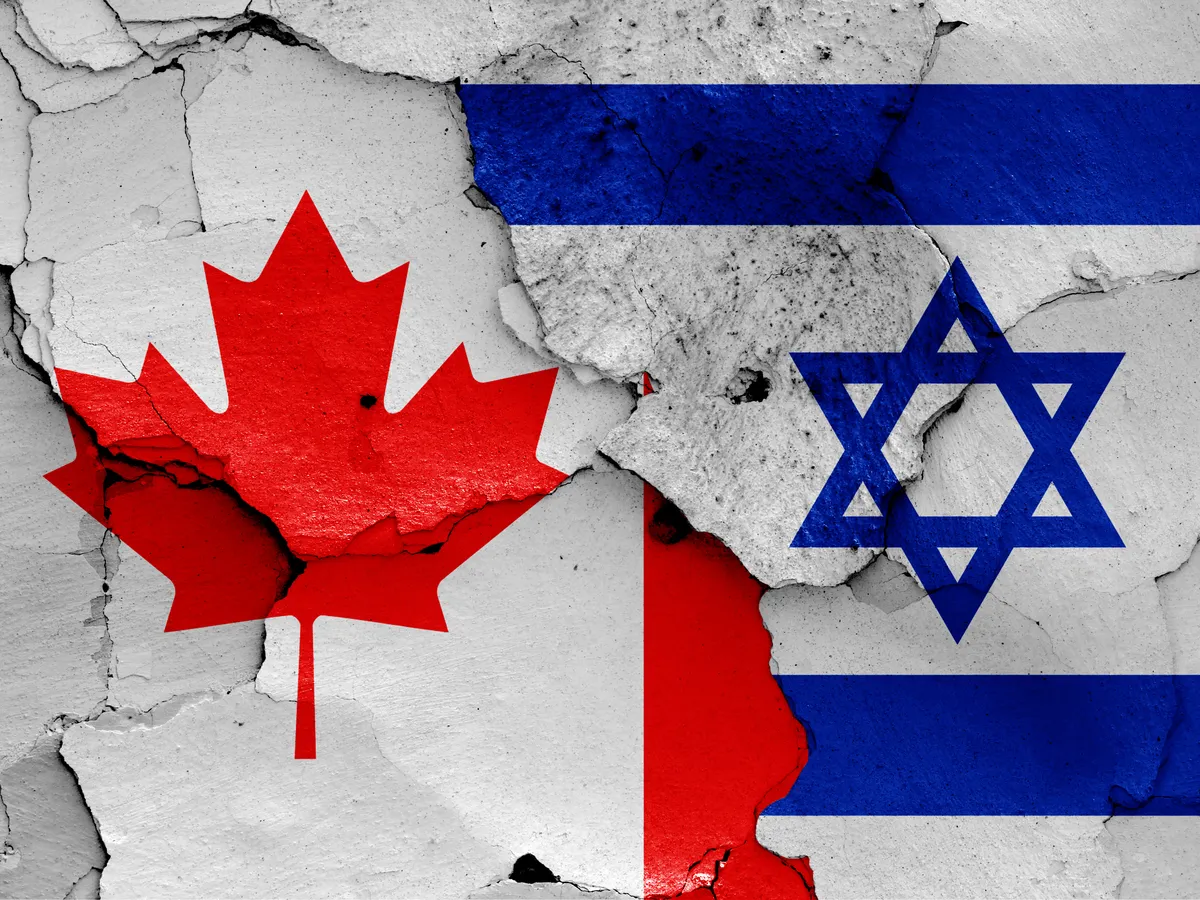
Skip to Content News Archives Economy Energy Oil & Gas Renewables Electric Vehicles Mining Commodities Agriculture Real Estate Mortgages Mortgage Rates Finance Banking Insurance Fintech Cryptocurrency Work Wealth Smart Money Wealth Management Investor Personal Finance Family Finance Retirement Taxes High Net Worth FP Comment Executive Women Puzzmo Newsletters Financial Times Business Essentials More Innovation Information Technology FP500 Podcasts Small Business Lives Told Tails Told Shopping Financial Post Store Obituaries Place a Notice Advertising Advertising With Us Advertising Solutions Postmedia Ad Manager Sponsorship Requests Classifieds Place a Classifieds ad Working Profile Settings My Subscriptions Saved Articles My Offers Newsletters Customer Service FAQ News Economy Energy Mining Real Estate Finance Work Wealth Investor FP Comment Executive Women Puzzmo Newsletters Financial Times Business Essentials HomeNewsEconomyIsrael was Canada's first free-trade partner outside North America. It's time to rekindle that relationshipHoward Fremeth: When it comes to defence and AI, Israel has technology and know-how that Canada needs nowLast updated 55 minutes ago You can save this article by registering for free here. Or sign-in if you have an account.The question for Canadian leaders is not whether Israel matters. It is whether we can afford to neglect that partnership, writes Howard Fremeth. Photo by Getty Images/iStockphotoThirty years ago, then–international trade minister Art Eggleton helped usher in Canada’s first free trade deal with a partner outside North America.Subscribe now to read the latest news in your city and across Canada.Exclusive articles from Barbara Shecter, Joe O'Connor, Gabriel Friedman, and others.Daily content from Financial Times, the world's leading global business publication.Unlimited online access to read articles from Financial Post, National Post and 15 news sites across Canada with one account.National Post ePaper, an electronic replica of the print edition to view on any device, share and comment on.Daily puzzles, including the New York Times Crossword.Subscribe now to read the latest news in your city and across Canada.Exclusive articles from Barbara Shecter, Joe O'Connor, Gabriel Friedman and others.Daily content from Financial Times, the world's leading global business publication.Unlimited online access to read articles from Financial Post, National Post and 15 news sites across Canada with one account.National Post ePaper, an electronic replica of the print edition to view on any device, share and comment on.Daily puzzles, including the New York Times Crossword.Create an account or sign in to continue with your reading experience.Access articles from across Canada with one account.Share your thoughts and join the conversation in the comments.Enjoy additional articles per month.Get email updates from your favourite authors.Create an account or sign in to continue with your reading experience.Access articles from across Canada with one accountShare your thoughts and join the conversation in the commentsEnjoy additional articles per monthGet email updates from your favourite authorsSign In or Create an AccountorIt was a moment not unlike the one we are facing now. Canada was emerging from the deep recession of the early 1990s and adjusting to a rapidly changing post-Cold War world. Building new economic partnerships wasn’t simply good policy — it was essential to Canada’s future.“Both governments look forward to a much stronger and richer economic relationship that will be significantly strengthened by this agreement,” Eggleton said.SUBSCRIBER EXCLUSIVE: FP West: Energy Insider brings you behind the oilpatch’s closed doors with exclusive insights from insiders every Wednesday morning.By signing up you consent to receive the above newsletter from Postmedia Network Inc.A welcome email is on its way. If you don't see it, please check your junk folder.The next issue of FP West: Energy Insider will soon be in your inbox.We encountered an issue signing you up. Please try againSome may have forgotten that the partner in that deal was Israel, a country of six million people at the time.Like any trade agreement, it required compromise from both sides, including the removal of long-standing barriers, such as Canadian restrictions on defence-related goods.The agreement was supported by the Palestinian leadership, because it extended to the Palestinian Territories, providing important economic benefits to Palestinian businesses and workers.Since the Canada-Israel Free Trade Agreement went into force, bilateral trade has more than tripled. Many of Canada’s largest companies have established a presence in Israel and firms from both countries have built partnerships in technology, cybersecurity, health care, agriculture, clean energy and environmental innovation.The examples stretch across sectors and regions, from Israeli water-management solutions that were tapped in the oil sands to advanced radar systems manufactured in Quebec.Today, despite record bilateral trade of $2.15 billion in 2025, relations between the Canadian and Israeli governments are at a low point, straining the broader relationship.That is a missed opportunity.As Prime Minister Mark Carney and his ministers travel the world in search of new markets and investors, Israel offers something few countries can: a fast-growing economy built on cutting-edge technology, rapid commercialization and a young, highly innovative workforce.That is particularly true in defence and artificial intelligence, two sectors where the Canadian government has made significant bets.Canada is now embarking on the largest military build-up in generations, with billions of dollars earmarked for new equipment.But as Robert Asselin, the CEO of U15, an association of fifteen leading Canadian research universities, has asked: once the spending is over, what will Canada actually have to show for it? How will it translate these investments into new technologies, intellectual property and globally competitive companies?Israel, which leads the OECD in research and development spending at 6.76 per cent of GDP, offers one answer.Its defence sector does far more than produce military equipment. It is a powerful engine of commercialization, helping develop technologies that spill over into the civilian economy from healthcare and telecommunications to agriculture.Today, Israel is home to hundreds of defence-tech startups. They account for roughly 30 per cent of private investment in the country’s high-tech sector and attracted nearly US$3 billion in funding in the first six months of 2026 alone.The same is true in artificial intelligence.Canada has real advantages in AI. Abundant, low-cost energy is helping attract major investments in data centres, including Meta Platforms Inc.’s new facility in Alberta.Israel’s strength lies further up the value chain. It has the world’s highest concentration of AI-native startups and is home to research and development centres for many of the world’s leading AI companies, including Nvidia Corp.’s largest facility outside the United States.The opportunity for Canada is not to replicate Israel’s model, but to partner with it.Other countries have already recognized this opportunity.Germany recently signed a security and cybersecurity agreement with Israel, citing its “innovative strength” as it builds a cyber dome to defend against emerging threats.India has elevated its relationship with Israel to a strategic partnership in peace, innovation, and prosperity while pursuing a free-trade agreement.Even countries that once viewed Israel as an adversary are now deepening economic and security ties. Trade between Israel and the United Arab Emirates, for example, has grown by double digits annually and this month Crown Prince Mohamed bin Zayed announced the establishment of a US$10 billion fund aimed at high-tech sectors in Israel.Thirty years ago, Canada made a strategic decision to look beyond geography and politics. It did so because it believed the partnership with Israel would advance Canada’s interests.That logic deserves a fresh look.The world is more competitive than it was in 1996. Economic security, technological leadership and national security have become deeply interconnected. Few countries have navigated that reality more successfully than Israel.The question for Canadian leaders is not whether Israel matters. It is whether we can afford to neglect that partnership.Howard Fremeth is vice-president of communications at the Centre for Israel and Jewish Affairs Join the Conversation This website uses cookies to personalize your content (including ads), and allows us to analyze our traffic. Read more about cookies here. By continuing to use our site, you agree to our Terms of Use and Privacy Policy.
Israel was Canada's first free-trade partner outside North America. It's time to rekindle that relationship
When it comes to defence and AI, Israel has the technical capabilities that Canada needs now, writes Howard Fremeth. Read more.
1,283 words~6 min read