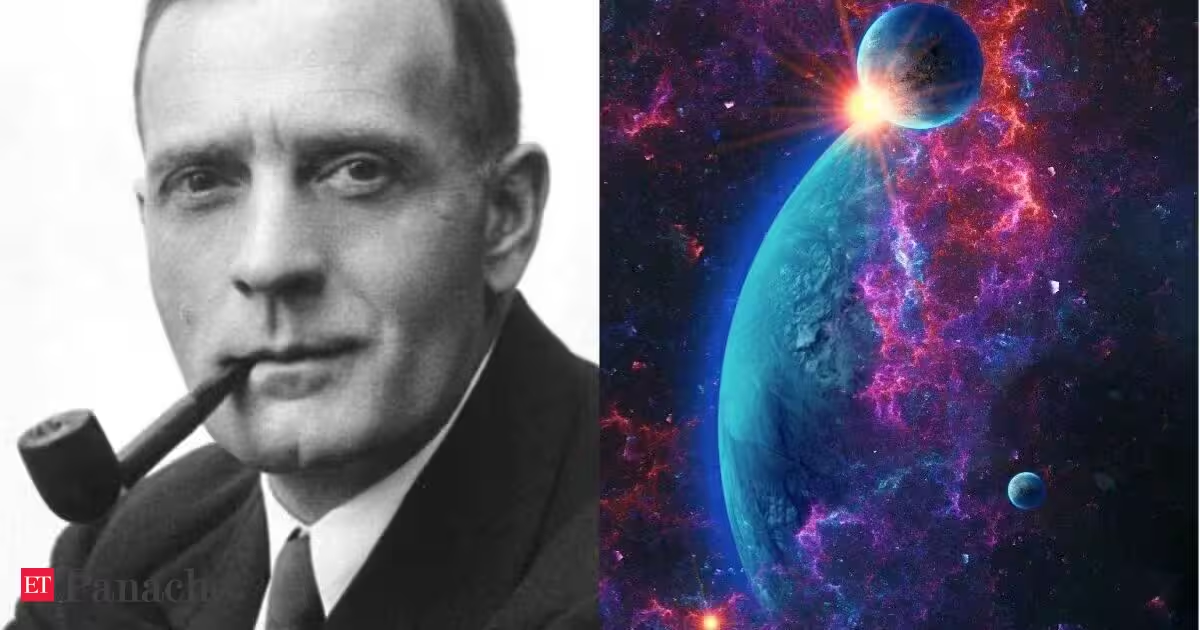
Two people can look at the same stretch of time behind them and ahead of them and describe it in completely different terms. One treats the past and the future as mirror images, equally vast, equally unknowable. The other insists the two are not symmetrical at all, that one has a hard edge and the other does not. Edwin Hubble, the astronomer whose observations first showed that the universe itself had a beginning, made exactly that distinction in his own field. "Past time is finite, future time is infinite," he wrote, describing not a personal philosophy but a conclusion his own telescope had forced on him.Quote of the day by Edwin Hubble"Past time is finite, future time is infinite."What Edwin Hubble actually meantHe was not writing about lifespans or memory in any personal sense. His point was narrower and more technical than that, coming directly out of the cosmology he had spent years building evidence for. If the universe is expanding, as his own observations of galactic redshift had shown, then running that expansion backward leads to a definite starting point, a moment before which there was no "before" to speak of. The past, in other words, has an edge. The future, by contrast, has no equivalent boundary visible from where we stand. It simply continues.Two people can hear that the universe had a beginning and draw very different conclusions from it, because one assumes a beginning implies an eventual, matching end, while the other recognises that nothing in the observed expansion actually requires that symmetry. Hubble was not speculating about how the universe might end. He was stating something closer to a measurement: the past, as far as the evidence reached, was bounded, while the future, as far as the evidence reached, showed no sign of being bounded in the same way.Written by the astronomer whose measurements gave the universe an ageWhat gives this line extra weight is that Hubble was not repeating an old philosophical position; he was reporting a genuinely new one, built directly out of his own data. Working from Mount Wilson Observatory through the 1920s, he had already shown that many of the "nebulae" once thought to be part of our own galaxy were in fact separate galaxies entirely, and had gone on to observe that these galaxies were receding from us at speeds proportional to their distance, the relationship now known as Hubble's Law.Run in reverse, that relationship implied that everything now spreading apart had once, at some finite point in the past, been much closer together, an idea that eventually developed into what we now call the Big Bang. This quote appears in his 1937 lectures on cosmology, published only a few years after that implication had first become clear, at a moment when the very idea of the universe having an age at all was still new and, to many scientists at the time, deeply unsettling. Hubble was not offering a comforting metaphor. He was describing, plainly, what his own telescope had just told him about the structure of time itself.Why this idea keeps coming backThe basic claim in this quote, that the past is bounded while the future remains open, still sits at the center of modern cosmology, where the estimated age of the universe, now put at roughly 13.8 billion years, gives the past a hard, measurable edge, while questions about the universe's ultimate fate, endless expansion, eventual collapse, or something else entirely, remain genuinely unresolved.Hubble was stating, from direct observation, something that continues to define the boundary of what science can and cannot yet say about time. That distinction is a large part of why the line still gets quoted outside astronomy. It is not describing a quirk of one telescope's data. It is describing a genuinely unusual asymmetry: one direction in time that has been measured and closed, and another that, by every available measurement so far, has not.A simple way to actually use this idea in daily lifeThe useful move here is noticing how differently people treat the past and the future even though both are, strictly speaking, unknown to us in the present moment. The past feels fixed and finished because it is bounded by what actually happened. The future feels different precisely because nothing yet limits what it could still become.A fair test is to ask, when a decision feels weighed down by the past, whether the future actually inherits that same fixed shape, or whether it remains as open as the evidence suggests. That question will not undo anything that has already happened. It usually stops a closed past from being mistaken for a closed future.Other famous quotes by Edwin Hubble"Equipped with his five senses, man explores the universe around him and calls the adventure Science.""The history of astronomy is a history of receding horizons."
Quote of the day by Edwin Hubble: "Past time is finite, future time is infinite" - a powerful reminder that the future is never fixed
Two people can look at the same stretch of time behind them and ahead of them and describe it in completely different terms. One treats the past and the future as mirror images, equally vast, equally unknowable.
801 words~4 min read