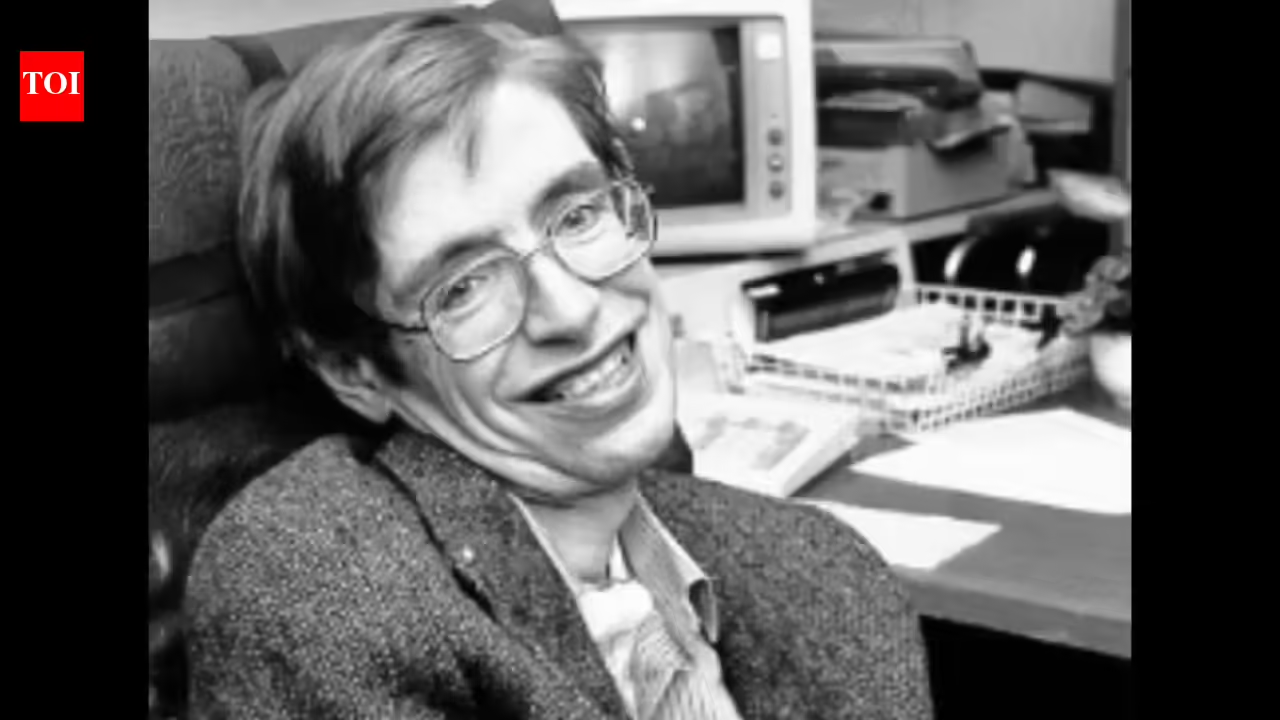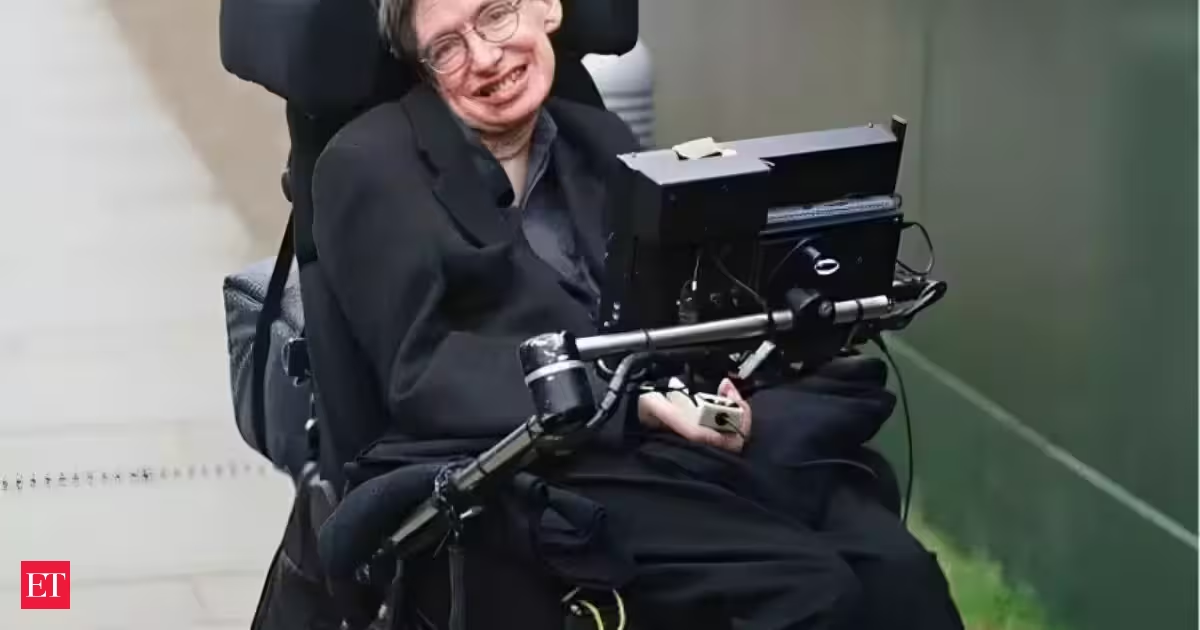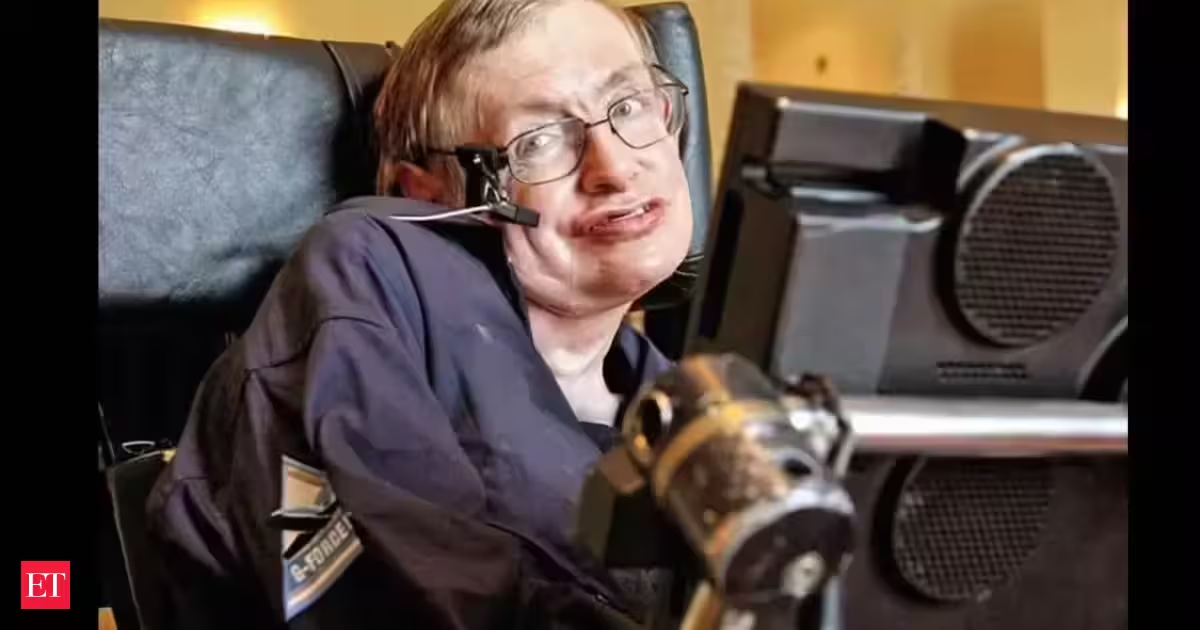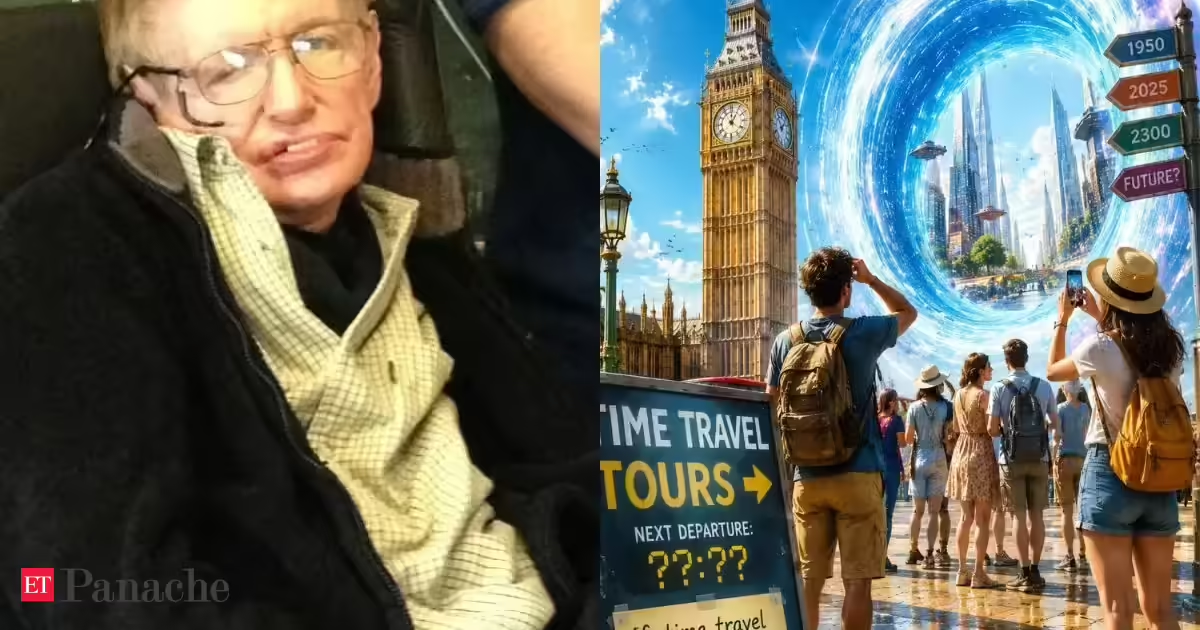
When people talk about time travel, it usually stays in the world of films and fiction, but theoretical physicist Stephen Hawking once brought the idea into a very serious scientific discussion. He raised a simple but sharp question that has continued to be repeated in science debates and pop culture for years. This quote of the day, often linked to his writings and lectures, reflects Hawking’s skeptical view about the possibility of moving backwards in time. He used it as a way to challenge the idea in a practical sense, not just a theoretical one.The quote of the day by Stephen Hawking goes: “If time travel is possible, where are the tourists from the future?”This phrase is not just meant as a joke or casual remark. It connects directly to how Hawking looked at physics, causality, and the limits of the universe. His point was simple on the surface, but it carries a deeper argument about how reality might work.The idea behind the quote is based on a simple form of logic. If time travel to the past were possible and even slightly easy, then in theory, visitors from the future should already have reached our present time. We should have at least some signs of them, even if they were subtle or hidden.But since there is no such evidence in everyday life or scientific observation, Hawking suggested that this absence itself is important. It becomes a kind of indirect argument against backward time travel. Not a perfect proof, but something that raises doubt about whether it can ever actually happen.You Might Also Like:Another way to understand it is through the idea of cause and effect. Time travel to the past creates complicated problems like paradoxes, where actions can change history in confusing ways. Hawking was pointing toward the possibility that nature itself may prevent such situations from ever occurring, even if mathematics allows certain models.In simple terms, he was saying that if something as extreme as time travel were real, it would already be obvious in some form. Since it is not, maybe the universe has built-in limits that stop it from happening in the first place.Stephen Hawking’s scientific outlook and curiosityMuch of this thinking comes from the way Stephen Hawking approached science throughout his life. He was not only focused on solving equations but also on asking questions that tested the limits of human understanding. His work often connected deep theory with simple real-world reasoning, like in this time travel argument.He also explored these ideas more formally in his discussions on what he called chronology protection, where the laws of physics may prevent time loops or backward travel. This idea appeared in his lectures and later in his scientific writings, including essays and discussions collected in his work on black holes and cosmology.You Might Also Like:What the quote of the day really tries to sayAt its core, the quote is not about tourists or travel in a literal sense. It is about evidence. Hawking was pointing out that scientific ideas need some form of observation or consequence in the real world. If time travel were possible, it would likely leave traces, even accidental ones.The absence of such traces becomes part of the argument. It is a way of using everyday logic to question a complex theory. Instead of relying only on equations, Hawking often used examples that people could easily imagine.This makes the idea more accessible. Even someone without a background in physics can understand the basic question: if something is possible, why have we never seen it happen in any form?The bigger scientific concern behind itThere is also a deeper concern behind this line of thinking. Time travel into the past is not just about moving between years. It creates serious problems for physics, especially when it comes to causality, where cause and effect must follow a fixed order.If that order breaks, it could create situations where events contradict each other. For example, changing past events could erase the very reason for that change in the first place. Hawking often pointed toward these issues when discussing why the universe might prevent such scenarios.So the quote works like a simple doorway into a very complicated topic. It takes a difficult scientific idea and turns it into something easy to question and think about.Early life and rise of Stephen HawkingStephen Hawking was born in 1942 in Oxford and later became one of the most recognised scientists in the world. He studied physics at Oxford University and later moved to Cambridge for his research in cosmology and theoretical physics.During his early twenties, he was diagnosed with a serious motor neuron disease. Doctors initially gave him only a few years to live, but he continued working for decades despite severe physical limitations. Over time, he lost most of his mobility and speech but continued his research using assistive technology.His personal journey often became part of how people understood his scientific work. It showed a level of persistence that matched the complexity of the universe he was studying.Work on black holes and the universeOne of his most important contributions was related to black holes. He showed that black holes are not completely black and can emit radiation, a concept now known as Hawking radiation. This changed how scientists think about these objects.He also worked on ideas about the origin of the universe, including how it may have started from a very dense state often referred to as a singularity. These ideas are part of modern cosmology and are still studied today.His book A Brief History of Time helped bring many of these complex topics to a wider audience. It became one of the most widely read science books globally and introduced millions of readers to ideas like black holes, space-time, and the expansion of the universe.Time, physics, and chronology ideasHawking also explored whether time itself could behave in unusual ways. His discussions on chronology protection suggested that the laws of physics might naturally prevent time travel to the past.This was not presented as a final answer but as a working idea based on mathematical reasoning. He often combined physics with thought experiments, using simple examples to explain very complex problems.The famous question about future tourists fits into this broader thinking. It reflects his habit of turning abstract physics into something people can visualize.Stephen Hawking remains one of the most influential scientific figures of modern times. His work continues to shape research in cosmology, black hole physics, and theoretical models of the universe.Beyond science, he also became a public figure who showed that physical limitations do not necessarily limit intellectual contribution. His voice, writings, and lectures continue to be studied and shared widely.
Quote of the day by Stephen Hawking: “If time travel is possible, where are the tourists from the future?” - How a simple question by the genius scientist challenges the possibility of time travel in real life
Stephen Hawkings famous question is the quote of the day, as it reflects his skepticism about traveling backwards in time. He used this idea to argue that if time travel were truly possible, there should already be evidence of visitors from the future in our present world. Since no such signs exist, it raises doubts about whether backward time travel can ever happen, and ties into his broader ideas about physics and the limits of the universe.
Hawking proposed "chronology protection"—physics may itself prevent backward time travel—using the simple absence of future visitors as indirect evidence. The same absence-of-evidence logic applies when evaluating emerging tech: if a capability were real at scale, its effects would already be observable.