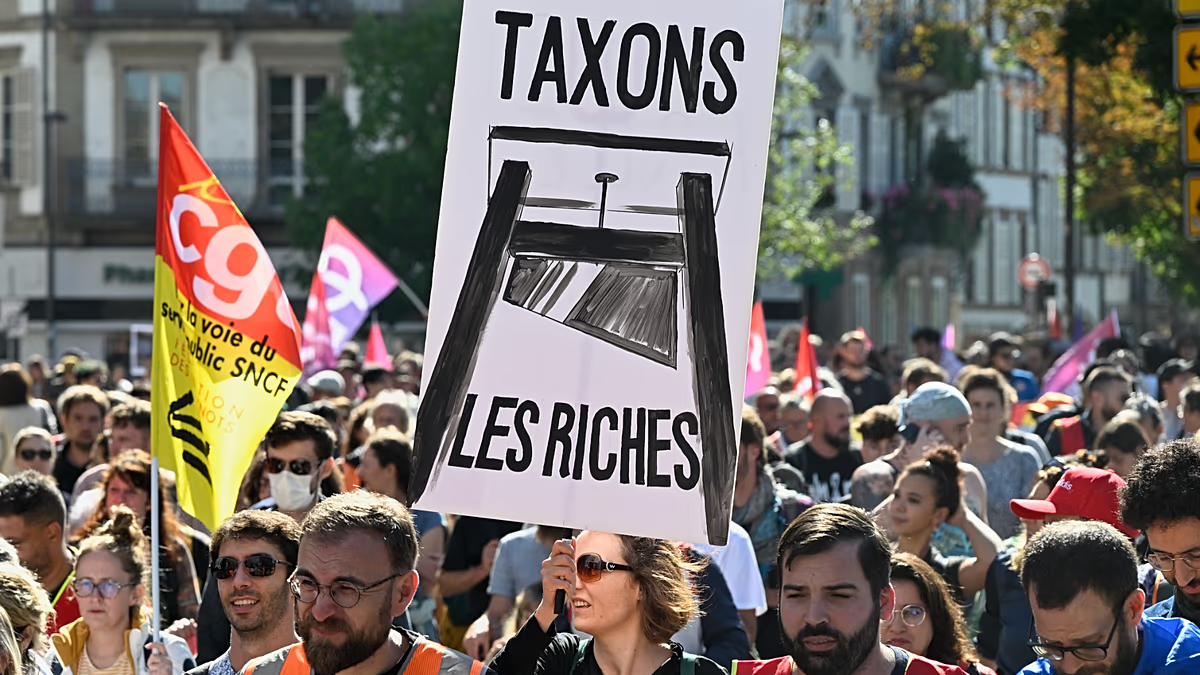
The number of millionaires residing in the UK fell last year to the lowest level since 2008, it has emerged.Reasons for the drop in number, which was down 7 per cent from 2024 to 442,000, include falling asset prices, high net-worth individuals (HNWI) leaving the UK and a reported low household saving rate.The figures comes from an index tracker run by the Adam Smith Institute (ASI).While the ASI’s tracker is based off data from the National Office for Statistics, it uses what it terms “constant prices” to adjust for the impact of inflation and exchange rates. A constant-price sterling millionaire, for the purposes of their tracker, includes assets surpassing £1m in total across “real and financial asset classes” - so property and other tangible assets, stocks or other investments, plus pensions and savings.The institute, a right-leaning research and think tank, says the UK must become a “more attractive place for HNWIs” and calls for the government to make policy changes “including abolishing inheritance tax, phasing out Capital Gains Tax and reforming the non-doms tax regime”.Such moves would be seen as enormously favourable towards wealthy families and questions would be asked of how any lost income would be replaced by the Treasury.In 2023-24, the government toot took £7.2bn receipts in IHT, equating to less than one per cent of total government revenue, per the IFS.But that rose to £8.5bn by 2025-26 and is forecast to rise past £14.5bn by 2030/31, due to a combination of frozen thresholds, fiscal drag and the forthcoming inclusion of pension pots in IHT calculations.The Adam Smith Institute also says calls for a wealth tax are “particularly misguided” in the context of millionaire departures.Get a free fractional share worth up to £100.Capital at risk.Terms and conditions apply.Go to websiteADVERTISEMENTGet a free fractional share worth up to £100.Capital at risk.Terms and conditions apply.Go to websiteADVERTISEMENTMultiple economists, analysts and tax experts have agreed that a wealth tax is a poor approach, citing failures of France, Sweden and Netherlands, among others, where tax take was low and departures of the wealthy - who also tend to create jobs and wealth for others - increased.Within the report, it claims another reason for the drop in millionaires is “a well-documented trend of high net-worth individuals either leaving Britain or no longer choosing to move here,” though this has not been documented in HMRC data.The report included a comment from Andrew Griffith, shadow secretary of state for business and trade, who said: “Whatever their personal finances, everyone should care about Britain having fewer millionaires to contribute to the tax pot and creating jobs and businesses here. It's a competitive world and when young and ambitious people are voting with their feet and leaving your country that's a shameful sign.”The report did not carry a comment from the government’s returned business secretary, Jonathan Reynolds, nor Peter Kyle, who served in the role under Keir Starmer.Mitchell Palmer, economist at the Adam Smith Institute, added: “The decline in millionaires may be greeted as a success by some on the Left, but it should instead be viewed as a warning signal. Every millionaire that leaves means less capital for British businesses, fewer international connections, and weaker entrepreneurial spirit in the economy.“Recently mooted anti-wealth proposals, such as a wealth tax or equalising the capital gains tax rate with income tax, will only make this problem worse. “Instead, the government should focus on making Britain an attractive place for ambitious people to build and keep their wealth. This includes cutting or abolishing Inheritance Tax and Capital Gains Tax.”
Number of UK millionaires falls to lowest level since global financial crisis
There were over 1m millionaires heading into the pandemic but the number has steadily fallen since
589 words~3 min read