Tuesday 28 July 2026 8:28 am
| Updated:
Tuesday 28 July 2026 8:29 am
The super rich cover around third of income tax and capital gains tax receipts.
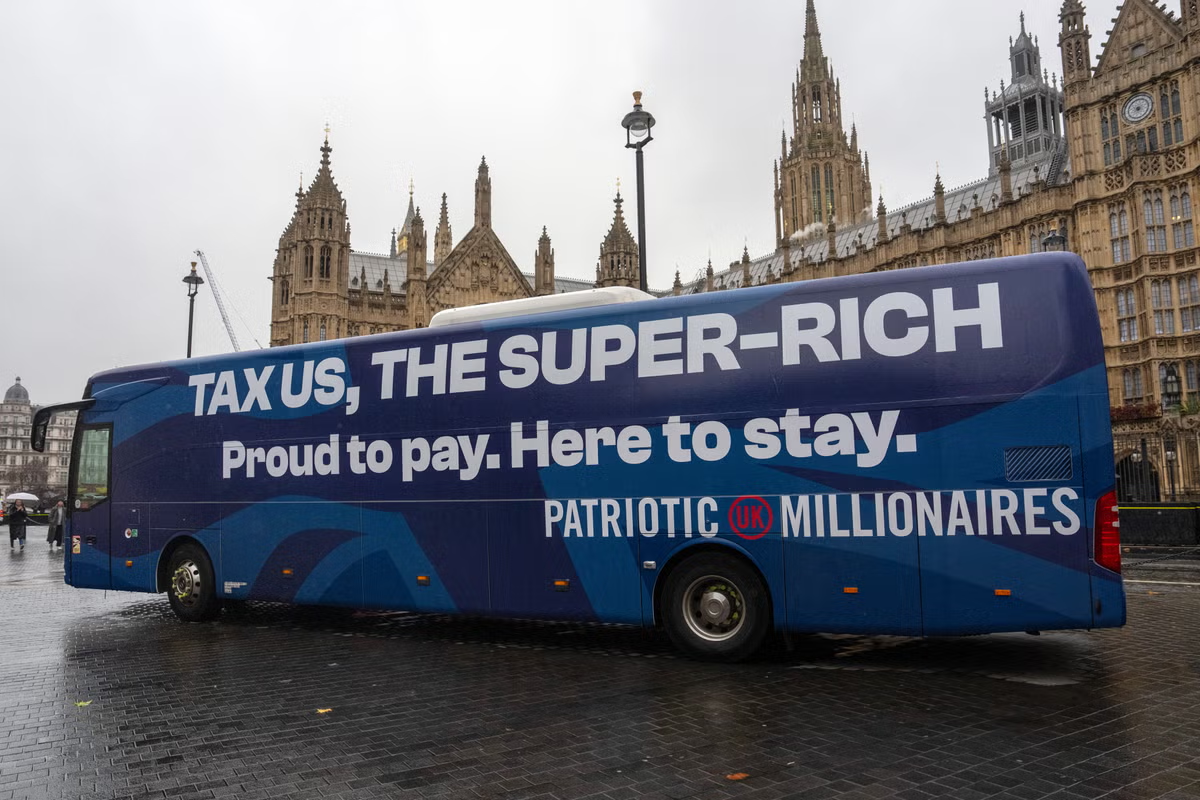
The number of millionaires in Britain has sunk to its lowest level since the 2008 financial crisis. Rich residents aren’t just fleeing because of policy choices like high levels of tax and the removal of non-dom status, but also a cultural hostility to wealth, says James LawsonIt is no secret that the wealthy and ambitious are leaving Britain. In fact, they are fleeing in their droves. New research from the Adam Smith Institute shows that the number of real-terms millionaires has hit its lowest level since the existential emergency that was the 2008 financial crisis. For each millionaire who chooses to leave, or overlooks Britain for her competitors in Europe, America and the Middle-East, the cost to our nation in reduced consumption and foregone investment is vast. The impact on our public services could be just as catastrophic. Replacing the tax contribution of the average departing millionaire requires the contribution of 49 average taxpayers. With public spending at a record high, and tax levels higher than any point since the Second World War, the loss is keenly felt. And with fewer millionaires to chip into the public purse, ordinary Brits are being forced to pick up the tab. But this exodus is no accident. Britons have simply stopped wanting to get rich. Just 19 per cent of us deem it a worthwhile endeavour, fewer than Japan, Italy, Sweden, Spain, America, and even France.Of course, we are an inherently modest nation. Wealth is rarely flaunted, and with good reason. To many, the idea of cruising the M6 in a lime-green Lamborghini or flying from London to Southampton in a private jet would seem overly extravagant, perhaps even ‘un-British‘.But now, our cultural taste and natural aversion to excess has morphed into something far more concerning. As a nation, we seem uncomfortable with the success. We’re more comfortable tearing wealth creators down than celebrating their astounding achievements. Just consider the popularity of influencers like Gary Steveson who seem to demonise millionaires. Such an attitude is hardly conducive to economic growth.This cultural malaise has transcended the sphere of social etiquette. It has infiltrated successive governments and left its mark on our tax system. Wealth creators are no longer considered valuable contributors to our nation’s culture, health, and prosperity. Instead, they are regarded as cash-cows to squeeze until the money runs dry. Take the crusade against the ‘non-domiciled’ tax status. After 200 years, Britain’s system to encourage wealthy individuals to invest, reside, and consume services in the UK is no more.Non-dom crusade will cost £111bnAlthough the full fallout will take years to manifest, the forecasts are stark: the OBR’s own data projects that 25 per cent of affected high-earners will move elsewhere. And while the wealthy forced to flee are welcomed in countries like Italy, Spain, or Greece, back home, their loss will be keenly felt. According to research from the ASI, the cost to the UK economy in lost growth and consumption will reach £111bn in the next decade alone.Of course, British-born risk takers have not been exempted from the anti-growth agenda. Increases to the minimum wage and national insurance, as well as reductions in business rate reliefs have made it tougher to get a startup off the ground. And if an entrepreneur manages to battle the headwinds and create a saleable business, they’re rewarded with more taxation. Entrepreneurs’ Relief was removed and replaced with a scheme half as generous, and capital gains tax hikes ensure less of the wealth businesses generate go to the person who took the risk to make it possible. It is therefore, unsurprising that 2025 saw the fewest businesses created since records began in 2017. We are no longer a nation of entrepreneurs. Instead, Britain is a country that seeks to punish aspiration through the tax system.Days into the new government, ministers have done little to restore confidence. Faced with a fresh letter from 120 so-called ‘patriotic millionaires’ calling for even higher taxes on wealth, they have been conspicuous in their silence. For the wealth creators who remain in Britain, uncertainty prevails. And from across Europe, the lesson is clear. Wealth taxes do not work. In three-quarters of the EU nations which implemented the measures in the 1990s, they have been rolled back. Sooner or later, governments square up to the reality of high implementation costs and even greater capital flight, and conclude that without wealth, an economy cannot function. To ignore these lessons and implement a similar system here would be disastrous. Our government must change course. London is not Miami or Monte Carlo, and in the last 3 years, economic growth has floundered at roughly one per eent1%. As the path to growth remains unclear, and Britain can no longer afford to treat personal wealth with contempt.In an increasingly competitive race to attract ever more mobile wealth creators, Britain must be bold. Our government must be unashamedly pro-wealth, fostering a culture that celebrates and encouraging success and refuses to nurse envy.That means looking again at tax reform across the board. Restoring competitive non-dom incentives, paring back capital gains tax, and easing top marginal income tax rates would ensure that enterprise is rewarded, rather than punished.The price of failing to act will be steep. If ministers cannot grasp the importance of attracting and retaining those who create wealth, they will soon learn a hard economic truth: that in their rush to tax the rich, they will succeed only in making the whole nation poorer.James Lawson is Chairman of the Adam Smith Institute.