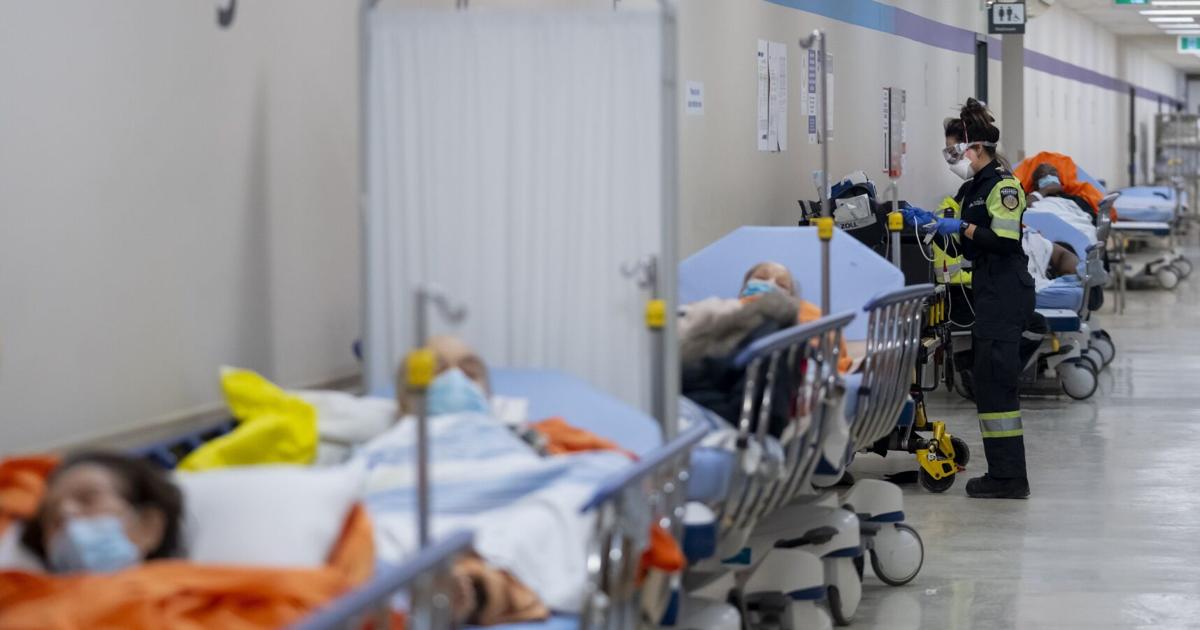
Skip to Content Subscribe Our Offers My Account Manage My Subscriptions FAQ Newsletters Canada Canadian True Crime Canadian Politics Health World Israel & Middle East Financial Post NP Comment Longreads Puzzmo Diversions Comics NP News Quiz New York Times Crossword Horoscopes Life Eating & Drinking Style Sponsored Play for Ontario Travel Travel Canada Travel USA Travel International Cruises Travel Essentials Culture Books Celebrity Movies Music Theatre Television Business Essentials Advice Lives Told Tails Told Shopping Buy Canadian Home Living Outdoor Living Kitchen & Dining Tech Style & Beauty Personal Care Entertainment & Hobbies Gift Guide Travel Guide Amazon Prime Day Deals Savings National Post Store More Sports Hockey Baseball Basketball Football Soccer Golf Tennis Driving Vehicle Research Reviews News Gear Guide Obituaries Place an Obituary Place an In Memoriam Classifieds Place an Ad Celebrations Working Business Ads Archives Healthing Epaper Manage Print Subscription Profile Settings My Subscriptions Saved Articles My Offers Newsletters Customer Service FAQ Newsletters Canada World Financial Post NP Comment Longreads Puzzmo Diversions Life Shopping Epaper Manage Print Subscription HomeNewsCanadaEmergency doctors are leaving or reducing hours in face of 'hopeless' ER crisis: surveyHalf of Canada's ER doctors have reduced their work hours and 10 per cent have quit over 'broken' health system, the new survey suggestsLast updated 12 minutes ago You can save this article by registering for free here. Or sign-in if you have an account.“This is the worst crisis that anyone could imagine. We are no longer able to provide the care that is required,” says the study's first author Dr. Kerstin de Wit. Photo by Peter Power/PostmediaCanada’s emergency doctors are feeling demoralized and defeated by a “broken” health system and one in 10 are exiting the profession, two bleak trends threatening to worsen the country’s ER crisis, according to a new study.Enjoy the latest local, national and international news.Exclusive articles by Conrad Black, Barbara Kay and others. Plus, special edition NP Platformed and First Reading newsletters and virtual events.Unlimited online access to National Post.National Post ePaper, an electronic replica of the print edition to view on any device, share and comment on.Daily puzzles including the New York Times Crossword.Support local journalism.Enjoy the latest local, national and international news.Exclusive articles by Conrad Black, Barbara Kay and others. Plus, special edition NP Platformed and First Reading newsletters and virtual events.Unlimited online access to National Post.National Post ePaper, an electronic replica of the print edition to view on any device, share and comment on.Daily puzzles including the New York Times Crossword.Support local journalism.Create an account or sign in to continue with your reading experience.Access articles from across Canada with one account.Share your thoughts and join the conversation in the comments.Enjoy additional articles per month.Get email updates from your favourite authors.Create an account or sign in to continue with your reading experience.Access articles from across Canada with one accountShare your thoughts and join the conversation in the commentsEnjoy additional articles per monthGet email updates from your favourite authorsSign In or Create an AccountorFor many emergency doctors, “the future of emergency medicine was hopeless, with no possibility of recovery,” the authors wrote, describing moral distress and burnout that’s risking patient safety.“All burnout dimensions levels” were high among doctors who responded to a survey, levels that remain “substantively unchanged” since the height of the COVID pandemic, when early tidal waves of seasonal respiratory viruses collided with COVID, pushing emergency rooms to the brink.Get a dash of perspective along with the trending news of the day in a very readable format.By signing up you consent to receive the above newsletter from Postmedia Network Inc.A welcome email is on its way. If you don't see it, please check your junk folder.The next issue of NP Posted will soon be in your inbox.We encountered an issue signing you up. Please try againToday, the country’s ERs are struggling with growing patient loads, record overcrowding and dangerous wait times, with hundreds of thousands of people languishing 14 hours or more in emergency every year.Doctors have warned that people with life-threatening conditions that need time-sensitive treatments, like drugs to break up clots and restore blood flow to the brain, are increasingly at risk, and the longer people wait, the more their condition deteriorates. People are being examined in chairs in waiting rooms and packed corridors. More people are leaving emergency rooms without being assessed by a doctor — a phenomenon administratively dubbed “left-without-being-seen” that increases the risk of death within seven days.The new study looked at emergency physician burnout rates in December 2020, burnout rates reported by the same doctors in September 2022 and, more recently, in January 2025.The response rate for the most recent iteration was 410 out of 615 doctors from across Canada who initially enrolled in the study.Of the 410, 41 said they had left emergency medicine — 10 had retired; 25 shifted to a different area of practice and six left clinical medicine, meaning they stopped treating patients altogether.Some simply left “to preserve their sanity,” said first author Dr. Kerstin de Wit, an emergency physician at Kingston Health Sciences Centre.Of the 351 remaining doctors who completed the full survey (18 didn’t and were excluded from further analysis), 163 of them (46 per cent) scored high on emotional exhaustion, and 193 (55 per cent) scored high on depersonalization, a phenomenon that makes people less empathic, more detached and aloof. It’s a recognized human response to burnout.“The unfortunate side effect is that the patient doesn’t feel they’re being heard as well, or they leave the emergency department feeling there was no sympathy for their condition,” said de Wit, a professor of emergency medicine and Canada Research Chair at Queen’s University.Some doctors scored high on both measures, and rates were highest among women and young doctors.Half who filled out the survey had reduced the number of shifts they’re working to allow time to recover between shifts; 20 per cent had taken time off work.“The prevailing theme was that the health care system is broken,” de Wit and her co-authors wrote in the Canadian Medical Association Journal.“We found repeated references to the emergency department making up for system inadequacies, with fewer resources and little support, and the expectation that the situation will worsen.”“There is an overriding sentiment that everybody is looking for a way to leave the emergency department,” de Wit said.The health-care system “continues to be brutal. Under resourced. Under supported. No end in sight,” one survey doctor commented.Others commented on a lack of accountability at every level of health care. “Anger was directed toward hospital and political leaders, and occasionally toward patients,” the researchers said.Some doctors complained they’re being expected to manage non-urgent conditions “day or night.” Some said patients blame them for long waits for diagnostic scans, excessive waits to see a specialist and other systemic problems they have no control over, “which was demoralizing,” the research team wrote.Others said the health-care system was “destroying” them.Doctors described what they’re doing to make their job bearable, Wit said: “There was a detachment. There was a certain degree of acceptance of the dismal care they were giving.” Some focused on what they could control.Overall, the findings point to a system “that feels no longer functional” and is threatening patient safety, the researchers wrote. Physician burnout increases the risk of medical errors, misdiagnoses, and rash decision-making.Hospitals find it too easy to put their heads in the sand and say ‘there’s nothing we can do’Excessive waits for emergency care have led to tragic and disastrous outcomes. In December, a 44-year-old Edmonton father of three, Prashant Sreekumar, died after collapsing in an emergency room after waiting more than eight hours to be seen for chest pain. In March 2025, 39-year-old Adam Burgoyne of Montreal died of an aortic dissection after giving up on a six-hour wait for emergency care.Emergency doctors and nurses are “frequently blamed directly,” and often publicly named in inquiries into patient deaths in emergency waiting rooms, a “trial by social media” that should stop, Dr. Catherine Varner, an emergency physician and deputy editor of the CMAJ wrote in a related editorial.“Consider the stark contrast with the communications on, and inquiry into, the tragic collision of an Air Canada flight with a fire truck on the runway at LaGuardia Airport” in March, Varner wrote.The two pilots were killed and a dozen passengers injured when the jet slammed into a Port Authority fire truck while landing at the New York airport.“Yet, air traffic controllers were not publicly named, and the media were swift to acknowledge the many system-level events that precipitated this tragic occurrence,” Varner wrote.“Health care system leaders must not use individuals as convenient shields to avoid taking accountability for a complex system problem.”Varner said the federal government needs to take “more deliberate action” and, instead of unconditional health transfers, tie conditions to the money and require provinces to report data on ER wait times and access to care.The problems hammering emergency departments are numerous and decades old, including poor access to primary care, insufficient long-term and home care for people in hospitals who no longer need to be there but can’t be discharged because there’s nowhere else for them to go, a chronic shortage of hospital beds on the wards and drawn-out waits for specialist care.“Hospitals find it too easy to put their heads in the sand and say ‘there’s nothing we can do’” de Wit said. “There must be a serious impetus to address the problem. It’s not our fault that this is happening, and it’s going to get worse.”“I think the reason it’s been accepted is that the public don’t know how bad it is, unless they’ve been unfortunate enough to visit the emergency department,” de Wit added.“This is the worst crisis that anyone could imagine. We are no longer able to provide the care that is required. Our system is inadequate.”Because of the sample size, the survey findings can’t be generalized to all emergency doctors and not everyone enrolled in 2020 completed the survey in 2025, which might bias the estimates of burnout, the researchers cautioned.National PostOur website is the place for the latest breaking news, exclusive scoops, longreads and provocative commentary. Please bookmark nationalpost.com and sign up for our newsletters here. Join the Conversation This website uses cookies to personalize your content (including ads), and allows us to analyze our traffic. Read more about cookies here. By continuing to use our site, you agree to our Terms of Use and Privacy Policy.
Emergency doctors are leaving or reducing hours in face of 'hopeless' ER crisis: survey
Half of Canada's ER doctors have reduced their work hours and 10 per cent have quit over 'broken' health system, a survey suggests.
1,730 words~8 min read